






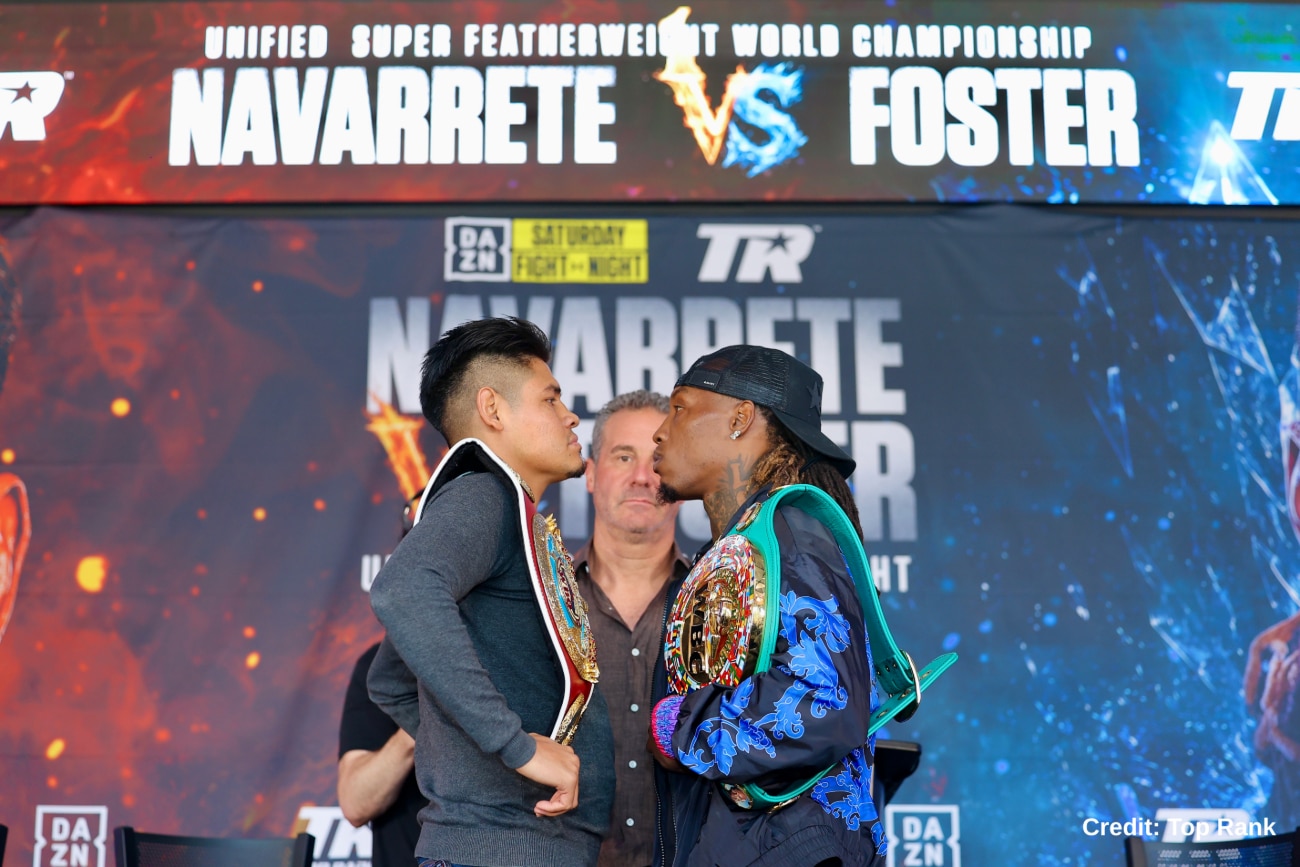
Tim Bradley is picking O’Shaquie Foster to defeat Emanuel Navarrete, but the call comes attached to an urgent reality check. Foster cannot spend thirty-six minutes waiting around for an immaculate counterpunch. Navarrete throws volume in bundles, keeps men moving in reverse, and steals rounds from guys who are content to admire their own defense.
The two meet October 24 in San Antonio with three super featherweight titles on the line.
Navarrete brings an unorthodox, lunging assault that presents a massive trap. He leaps into wide hooks, throws uppercuts from his knees, and squares his stance right in the line of fire. Foster owns the hand speed to slice Navarrete down the middle while those feet are still airborne. The opening vanishes instantly if Foster retreats instead of planting his feet to fire.
“You ain’t getting no points for no damn defense,” Bradley said on his channel when detailing the habit Foster has of letting opponents throw punches without paying an immediate tax.
Foster cannot afford to tuck behind a high shell while Navarrete clubs away at his elbows and shoulders. Those heavy thuds count in the eyes of ringside officials, particularly in Texas, where aggressive punch output always gets rewarded. Foster already tasted that bitter lesson during his robbery loss against Robson Conceicao, where he landed the cleaner counters yet gave away the visual contest.
The real blueprint involves ripping straight to Navarrete’s midsection and forcing him to drag his feet in reverse. Navarrete lacks the balance or footwork to operate on his back foot, but Foster must put hands on him early to make that happen. If Foster surrenders ring real estate and searches for single counters, he hands Navarrete the exact grinder bout he wants.
Sitting back and relying on defense against Emanuel Navarrete as the B-side is professional suicide. Navarrete is an established ticket seller, a fan favorite, and an all-action Mexican slugger fighting in front of a heavily pro-Navarrete Texas crowd. Every time Navarrete unleashes an ugly four-punch flurry that bounces off Foster’s gloves and forearms, ten thousand people in the arena are going to scream as if someone just got dropped. Judges hear that roar, see the constant forward march, and instinctively score the round for the aggressor.
Foster’s biggest flaw is that he falls in love with making guys miss by an inch without making them pay for it. He treats the sweet science like an academic exercise where simply not getting hit clean is enough to bank three minutes. It is not. That exact minimalist habit burned him against Robson Conceicao in Newark, where Foster clearly outboxed the guy on pure contact quality, threw far too little, and watched the belts get handed to the man who simply looked busier.
The similarities between Foster and Shakur Stevenson expose the exact problem. Shakur gets away with his safety-first style because he commands ring generalship with an authoritative, southpaw lead hand that physically dictates the distance. Shakur controls the geography of the ring so thoroughly that his opponents stop throwing because they feel stupid missing. Foster does not control real estate that way. He retreats in straight lines, covers up, and lets his opponents dictate where the action takes place while he waits for a clean counter window.
Against an awkward buzzsaw who throws 80 punches a round from his knees, his hips, and odd ceiling angles, waiting for the perfect counter means giving away forty seconds of every minute. Navarrete’s punches are heavy and crude. Even when they land on the shoulders, they physically push a retreating fighter back.
Foster does not need to get reckless and swing for the fences, but he absolutely must stand his ground and fire first. If he allows Navarrete to initiate every single sequence and just tries to slip and counter in spurts, he will walk back to his corner after twelve rounds feeling like a master boxer, only to hear the ring announcer read out scores that send him home empty-handed.
Read the full article here


