

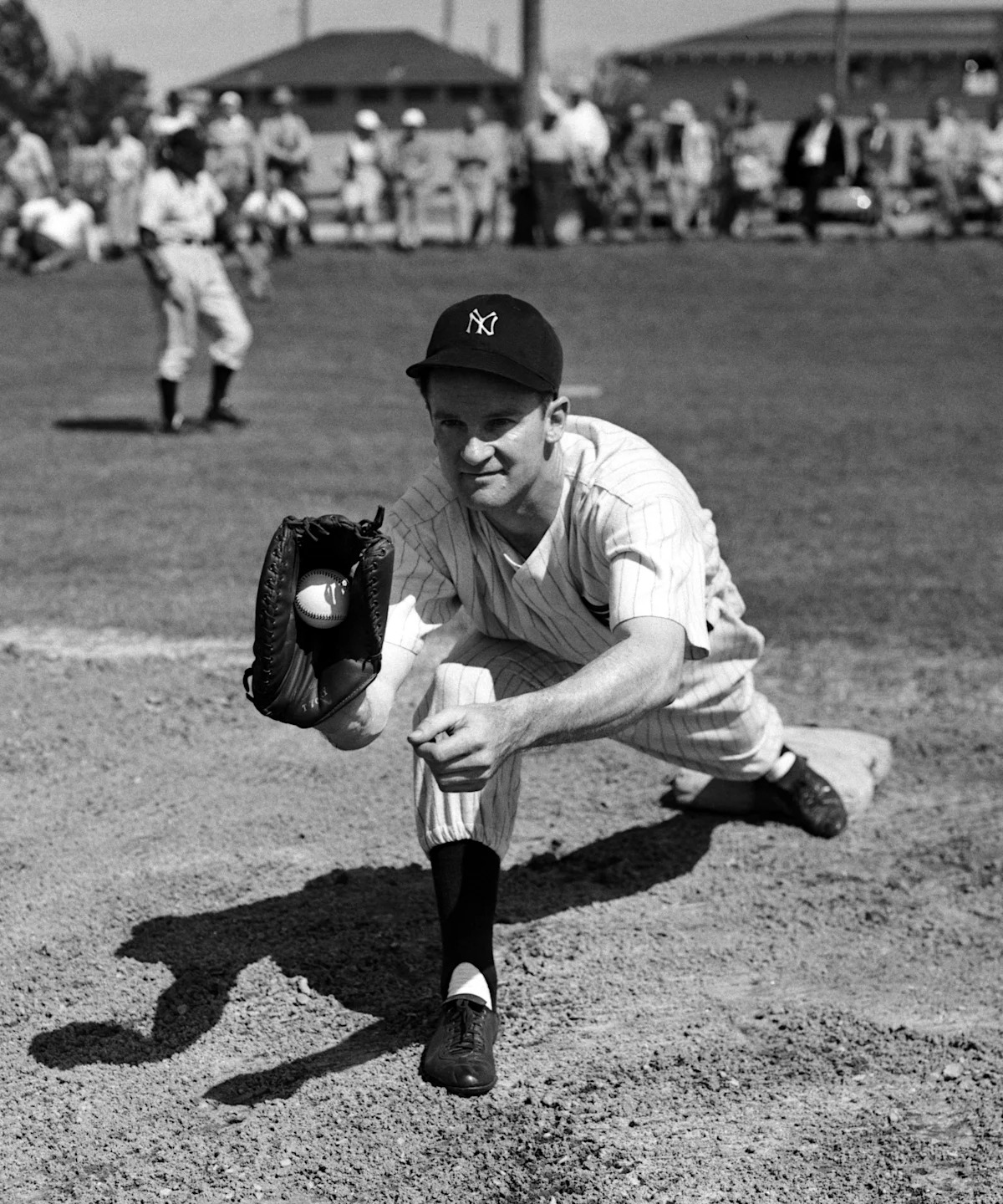
The 1947 World Series between the New York Yankees and Brooklyn Dodgers was littered with talent. The biggest name (for more reasons than just his incredible abilities on the baseball diamond) was Jackie Robinson. But there were also the people some modern-day baseball fans might know from the movie “42” based on Robinson: Pee Wee Reese, Eddie Stanky, Dixie Walker, Spider Jorgenson, and Ralph Branca. There were also the usual names waltzing around the Yankees dugout: Yogi Berra, Joe DiMaggio, Tommy Henrich, and Phil Rizutto.
Among the names who played all seven games in that World Series was George McQuinn, who was toward the end of his playing days but still found a way to power the group to another championship.
George Hartley McQuinn
Born: May 29, 1910 (Arlington, VA)
Died: December 24, 1978 (Alexandria, VA)
Yankees Tenure: 1947-48
George McQuinn was born in Arlington, Virginia, and began playing baseball at the age of seven. He started playing first base at the age of 12 after he saved up enough money to buy a George Sisler model first baseman’s glove. He continued playing baseball throughout his childhood and eventually attended Washington-Lee High School, where he would not just play, but star in baseball and basketball. After his high school career ended, he had the opportunity to play for the College of William and Mary in Williamsburg, Virginia, but ultimately turned it down to pursue the professional route.
McQuinn began playing for a semipro team in Northern Virginia before his manager arranged a tryout, and he showed enough skill to earn a contract with the New Haven Profs of the Class A Eastern League. However, he only received 19 at-bats in limited playing time before being released. But that wasn’t the end of the road for him. In fact, it was only the beginning.
One of the veteran infielders for the Profs, Joe Benes, saw something in the 19-year-old McQuinn, so he recommended him to Yankees scout Gene McCann, who signed McQuinn to a contract with the Wheeling Stogies, the Yankees’ farm club in the Class C Middle Atlantic League. He was then promoted for the 1931 season to the Scranton Miners of the Class B New York-Penn League thanks to an impressive .288 batting average, and he lit up those ranks, too, driving in over 1o0 runs with five homers and a .316 average.
McQuinn continued to make an impression and was eventually invited to spring training with the Newark Bears of the International League, which, at the time, was the Yankees’ top minor league team. But because of another player occupying the first base position, McQuinn was shipped north of the border to the Toronto Maple Leafs (no, not the hockey team). And while he started well with Toronto, he was brought back to Binghamton, where he had previously played a season, and he went on to win the New York-Penn League’s Most Valuable Player award.
After returning to Toronto for the 1934 season up until 1936, McQuinn was consistently written about as a potential call-up, but doing so would require the Yankees to have room at first base. And there were some in baseball circles who thought that maybe the Yankees would consider trading Lou Gehrig — yes, two-time MVP, American League Triple Crown and batting title winner, seven-time All-Star, seven-time World Series winner and Hall of Famer, Lou Gehrig — in order to bring McQuinn up. Obviously, that did not occur, but it’s certainly a wild alternate history to think about.
In 1936, the Cincinnati Reds purchased McQuinn’s contract from the Yankees on a condition that they could return him by June 1st. And it was at that point that the left-handed first baseman from Virginia got his shot in the majors.
But the story then isn’t a fairytale. McQuinn, at 25, despite all his time in the minors, was not good in his first 38 games as a professional, slashing .201/.262/.284 for an OPS+ of 51. He registered only 13 RBI, no home runs, 10 walks, 27 hits and seven extra-base hits in 134 at-bats. He was so bad, reportedly, because of the Reds pushing him into a thought process that was foreign — trying to focus on pulling the ball instead of hitting all over the diamond. Because of his inability to adjust, he was sent back to the Yankees’ system for further fine-tuning.
McQuinn went back to Toronto after his major league stint and hit .329 over the rest of the 1936 season, then hit .330 again, leading his Bears to a 109-43 record and a pennant win by 25.5 games. And while McQuinn was lighting up the Yankees farm team, Gehrig was still going strong for the big club, playing every single game for the team from 1936 to 1938. So there was no room to squeeze McQuinn into the lineup, and no reason to either, considering what Gehrig was doing at the plate with an average OBP of .454 and an OPS at 1.075 from the ages of 33 to 35.
After the 1937 season, McQuinn was eligible to be drafted by another team and was picked up by the St. Louis Browns, who gave him his first big league shot. This time, he took advantage of it: he played 148 games and set a career-high in batting average as he slashed .324/.384/.477 at the age of 28. McQuinn had the second-highest OPS of anyone on the Browns, showing the world that he was finally on the scene, finishing 21st in the AL MVP Award race.
McQuinn played for the Browns from that 1938 season to 1945 when he was 35 years old. In 1939, he was voted to his first All-Star Game and finished 13th in the MVP race following a season in which he played every game at first base and batted .316 with an OPS of .898 and a career-high 94 RBI. In 1940, he was selected for his second All-Star Game in a row. And since that season, he earned two more All-Star appearances and another top-20 finish in the MVP voting race. From 1941 to 1945, McQuinn slashed .266/.355/.406 for an OPS of .761 and an OPS+ of 111. He hit for a cycle in 1941 and led the AL in fielding percentage for the second season in a row, earning a reputation as the best defensive first baseman in the league and never once dipping below the 99.1 percent mark with the Browns. McQuinn was going to be traded to the Dodgers, who he would eventually face in the 1947 World Series with the Yankees, but he could not clear waivers, so the trade was nullified.
In 1942 and 1943, McQuinn had back issues, which caused his average to drop below expectations, and he also avoided service in World War II because of them, allowing him to stay in baseball while other big-name stars at the time went to fight overseas. And in 1944, when the Browns won the American League pennant against the weakened Yankees (who still gave them a run for their money up until the last day of the season) and faced the National League Pennant-winning Cardinals in the World Series, McQuinn not only continued his All-Star performance from the regular season (the fourth of his career), but he also did everything he could to win his Browns a championship, slashing .438/.609/.750 with one home run, five RBI and seven walks in the six-game series that was eventually lost.
In 1945, McQuinn’s last season with the Browns, he did what everyone expected him to do, even though the Browns did not return to the World Series. And following that season, the 36-year-old McQuinn was traded to the Philadelphia Athletics for another first baseman, Dick Siebert, in a deal that was catastrophic for both parties. Siebert could not come to terms with St. Louis and eventually retired, while McQuinn had his first below-average full season in the majors, frustrating A’s fans and leading to conversations that he should have retired. In fact, he almost did had it not been for his wife talking him out of it.
Following his release from the A’s thanks to manager Connie Mack, McQuinn finally got his chance to play for the Yankees 17 years after he entered their farm system in 1930. He took over first base when Tommy Henrich went to left field to cover for an injury, and McQuinn stayed there for the next two seasons.
In his first season in 1947, McQuinn’s spark returned. At the age of 37 and in 144 games, he hit over the .300 mark for the first time since his 29-year-old season in 1939. His on-base percentage rocketed to a career-high .395, and his slugging percentage of .437 was the highest since 1941. It was, statistically, the best season of his career. He finished sixth in MVP voting, the highest finish of his career, and was once again voted into the All-Star Game to represent the Yankees this time. And not only was he incredible in the regular season, but when the Yankees won the pennant in 1947 to face the Dodgers in the World Series, he was lauded as “the storybook story behind the Yankees’ surprising success … in 1947,” according to a sportswriter cited in McQuinn’s profile from the Society for American Baseball Research.
McQuinn didn’t hit super well in the World Series, batting .130, a large disappointment for fans of the game at the time considering his body of work in the regular season, but he still walked away a World Series champion, the first and only of his career after a grueling seven-game series.
The Yankees wanted to bring back McQuinn for one more season, and they did after a bit of a holdout from the 38-year-old. But due to back issues and simply old age, it was clear that McQuinn’s last hurrah came in 1947 (and what a last hurrah it was). He played in only 94 games with the Yankees in 1948, batting .248 with an OPS of 102. Due to his poor form and general wear and tear, the Yankees had no other choice but to release the veteran first baseman at the end of the year, and McQuinn retired as a result. He ended up managing in the Boston Braves organization from 1950 to 1958, then became a scout for the Washington Senators and eventually the Montreal Expos, before officially retiring from baseball in 1971. McQuinn passed away from a stroke in 1978 at the age of 68 in Alexandria, Virginia, at a hospital, but he led an incredible baseball life that had a playing career finished by exactly what every player dreams of: An excellent final full season and a championship to remember against some of the best players to ever play the game. Happy birthday, George!
Read the full article here