



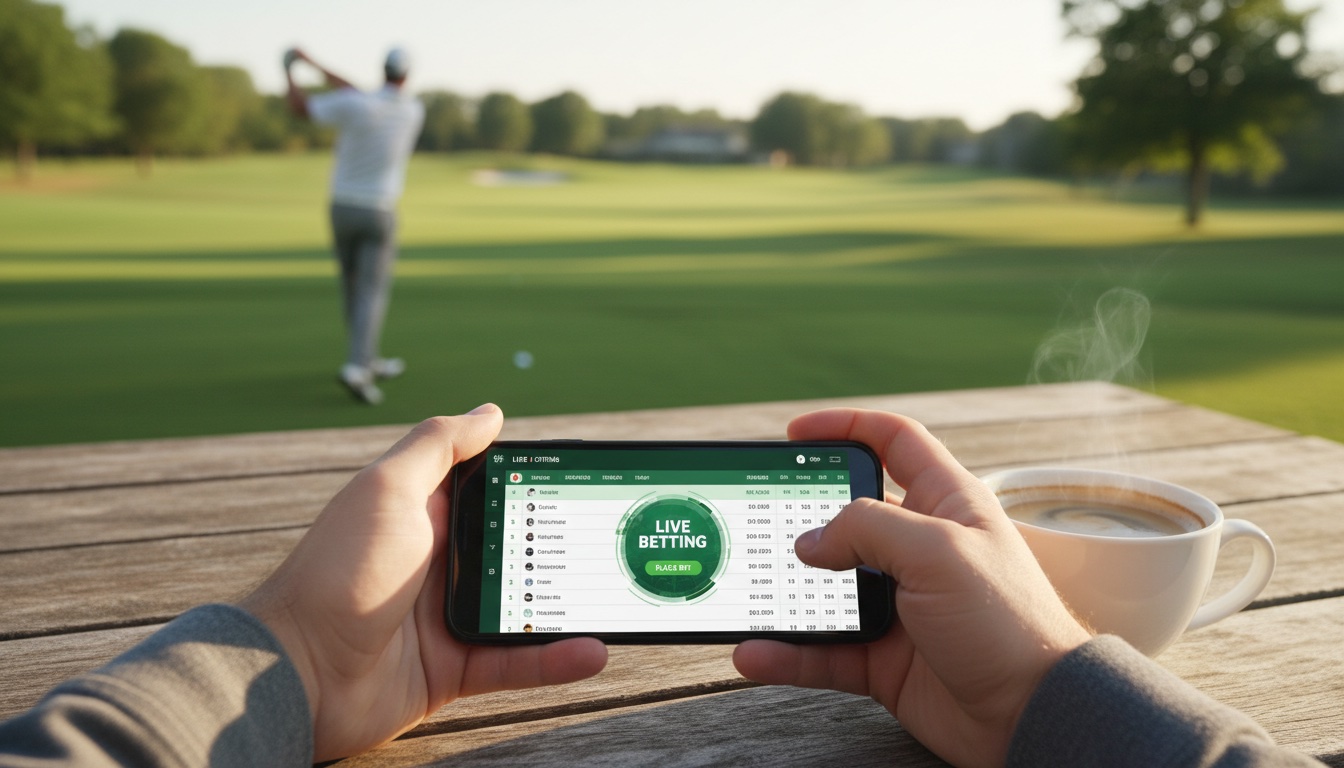
Watch any major from the sofa on a Sunday afternoon. The leaderboard tightens. Five players within two shots, 12 holes to play. You start glancing at the markets between groups. Maybe McIlroy at 7-2, maybe Scheffler at 11-4 in-running, maybe a value play on Ludvig Aberg at 12-1 to finish top-five. Whatever it is, the decision-to-action window in golf betting is unlike any other sport.
Football has the build-up and the match. Horse racing has the parade ring and the off. Tennis has the changeover. Golf has none of these natural pause points. The action is continuous, the markets are constantly updating, and any window you have to decide on a bet is open and closed within a few minutes as the next pairing reaches their tee shot.
That rhythm has shaped how golf bettors actually fund their accounts, and over the past five years it has driven mobile payment methods, particularly pay-by-phone, into a far more central role than they hold in other sports. Here is why golf has turned out to be the natural home for the format.
The Four-Day Tournament Problem
A typical Premier League fixture is roughly two hours of betting action. A horse race is over in minutes. A golf major, by contrast, runs over four days, sometimes spanning two continents and multiple time zones. The Masters, the US Open, the Open, and the PGA Championship each produce four full days of continuous betting markets, with thousands of micro-markets running at any given moment.
This creates a particular pattern of betting behaviour. Most casual golf bettors do not fund a single large account at the start of the tournament. They make smaller, more frequent decisions across the four days, often topping up a betting account between rounds based on how the cut has reshaped the field or how Saturday’s play has set up the final round.
That pattern, multiple small top-ups over a long window, is exactly the use case mobile payment methods are built for. Card details are friction. Account logins on a Wi-Fi connection are friction. Phone-based payment, where you confirm a small top-up with an SMS code in seconds, is purpose-built for the kind of mid-tournament account management golf betting demands.
Major Championship Viewing and the Time-Zone Gap
The structure of major championship viewing in the UK adds another layer. The US-based majors, the Masters in April and the US Open in June, are broadcast through the evening UK time. The PGA Championship runs similarly. Only the Open Championship sits in UK daytime. For three of the four majors, UK viewers are watching late, often on a sofa with a phone in hand rather than in front of a desktop computer.
The BBC’s coverage of the Open Championship remains the closest the four majors come to a daytime UK viewing experience, but even there the rhythm of golf betting tends toward mobile. The pace of play, the rolling coverage across multiple groups, the leaderboard movement happening every few minutes, all push viewers toward second-screen engagement on a phone.
The relevance for payment methods is straightforward. A late-evening Masters viewer reaching for their phone to top up a £20 account is not going to dig out their wallet for card details. Mobile payment methods like the pay-by-phone option JeffBet.net and similar UK-licensed operators offer route the deposit through the phone bill rather than a card transaction, which removes most of the friction at the moment the viewer actually wants to engage.
In-Play Markets and the Continuous Decision Cycle
Golf in-play markets are the busiest of any sport per minute of live action. A 72-hole tournament produces roughly 18 hours of cumulative play across four days, but the number of distinct betting events within that window is enormous. Outright winner. Top-five finish. Top-ten finish. Round leader. First-round leader. Group winner. Head-to-head matchups. Hole-by-hole markets on the final round. Each of these can be revised every few holes as the leaderboard shifts.
For a recreational bettor, the practical effect is that decisions are being made constantly across the tournament weekend, not in one concentrated burst. Each individual bet might be £5 or £10 rather than a single £50 stake placed before the tournament starts. That distribution of small stakes over a long period is one of the strongest fits for pay-by-phone, which is regulator-capped at £30 to £40 per day and £240 per month across all providers combined.
Those caps, often presented as a drawback in other contexts, are actually a useful structural fit for golf betting patterns. Most casual viewers will not exceed them over a major weekend, and the daily cap creates a natural ceiling on impulsive top-ups when the tournament tightens.
Why Pay-by-Phone Fits Golf Better Than Other Sports
| Sport | Typical Betting Pattern | Pay-by-Phone Fit |
| Football | Pre-match accumulator, then live in-play | Medium (single deposit usually enough) |
| Horse racing | Single race, single decision | Medium (one deposit per meeting) |
| Tennis | Match-long engagement, periodic top-ups | Good (small stakes, mobile viewing) |
| Golf majors | Four days of distributed micro-bets | Strong (small frequent top-ups suit the format) |
| Cricket Test matches | Five days, session-by-session markets | Strong (similar profile to golf) |
The Ryder Cup Effect
The Ryder Cup deserves its own mention because it operates differently from the four individual-stroke-play majors. Three days, team format, dramatic momentum swings, foursome and four-ball pairings followed by Sunday singles. The market structure is completely different from a regular tour event, and the engagement curve from UK bettors during a Ryder Cup spikes far higher than during a typical week.
Operators have known this for years. Ryder Cup weekends produce some of the highest mobile betting volumes of any sporting event in the UK calendar outside the major football fixtures. The combination of compressed time frame (three days versus four), team-based emotional investment, and dramatic format with constantly shifting odds creates exactly the conditions where small frequent top-ups via mobile payment make sense.
The 2025 Ryder Cup at Bethpage Black, with its evening UK viewing times, was a particularly clean example. Late-night topping up of a small recreational betting account is not something most casual viewers will do via card. The mobile-first payment methods like pay-by-phone fit that viewing pattern almost perfectly.
Course-Side and the Live Tournament Crowd
There is another use case worth mentioning, even though it applies to a smaller proportion of UK golf bettors. People actually attending tournaments, whether at Wentworth for the BMW PGA, at the Open venue of the year, or at any of the DP World Tour events held in the UK, are by definition on patchy network coverage. Mobile data on a course can be inconsistent. Wi-Fi access is rare outside specific hospitality areas. Power-saving on a phone matters because charging opportunities are limited.
In this environment, payment methods that require less data and complete more reliably on weak signal are practically more usable than those that demand a robust connection for card processing and 3DS verification. Pay-by-phone routes the transaction through the network operator’s own infrastructure rather than over the public internet, which means it tends to complete reliably in conditions where card-based payments time out.
This is a niche advantage, but for the on-course supporter who fancies a small in-play bet during a back-nine charge on Sunday, it is a meaningful one.
The Limits and What They Mean
Pay-by-phone is regulator-capped, and those caps are tighter than card limits. The Phone-paid Services Authority sets a £240 monthly ceiling across all providers combined, with individual provider daily limits ranging from £30 to £40. For most casual golf bettors, these limits are functionally invisible: a typical recreational engagement with major weekend markets will fall well within them.
For higher-staking bettors, pay-by-phone simply does not work as a primary funding method. It is a small-stakes recreational tool. The same characteristics that make it well-suited to distributed micro-betting across a major weekend make it badly suited to large concentrated stakes. UK regulations also prohibit withdrawals back to a phone bill, meaning any winnings need to be routed to a separately registered card or bank account.
These constraints are worth understanding before signing up, because they shape what the method actually does well. For someone watching the back nine of a major final round and wanting to top up a small account for a final-round leader market, pay-by-phone is excellent. For someone trying to fund a serious betting bankroll, it is not the right tool.
A Natural Fit That Took a While to Find Each Other
Golf and mobile payment methods have spent the past five years gradually figuring out that they suit each other. The structure of golf betting, four-day tournaments, time-zone viewing, continuously updating markets, sofa-based engagement, mapped onto the strengths of pay-by-phone almost without anyone designing it deliberately. The result is that golf has quietly become one of the strongest fits for the payment method in the UK betting market.
The major weekends will continue to be where this is most visible. Watch how many bettors quietly reach for their phones during a Sunday back nine at the Masters, and you are watching the use case the method was effectively built for, even if no one in the payment industry initially had golf in mind when they designed it.
Responsible Gambling
Golf betting, like all forms of gambling, carries financial risk. The convenience of mobile payment methods can make small top-ups easier than they once were, which is a feature in some contexts and a consideration in others. Setting personal deposit limits within a betting account, alongside the regulator-set PSA caps, is a sensible habit for any recreational bettor.
BeGambleAware offers free support and information at begambleaware.org. The National Gambling Helpline is available 24 hours a day on 0808 8020 133. GamStop national self-exclusion is available at gamstop.co.uk and applies across all UKGC-licensed operators within 24 hours of registration.
Read the full article here


