



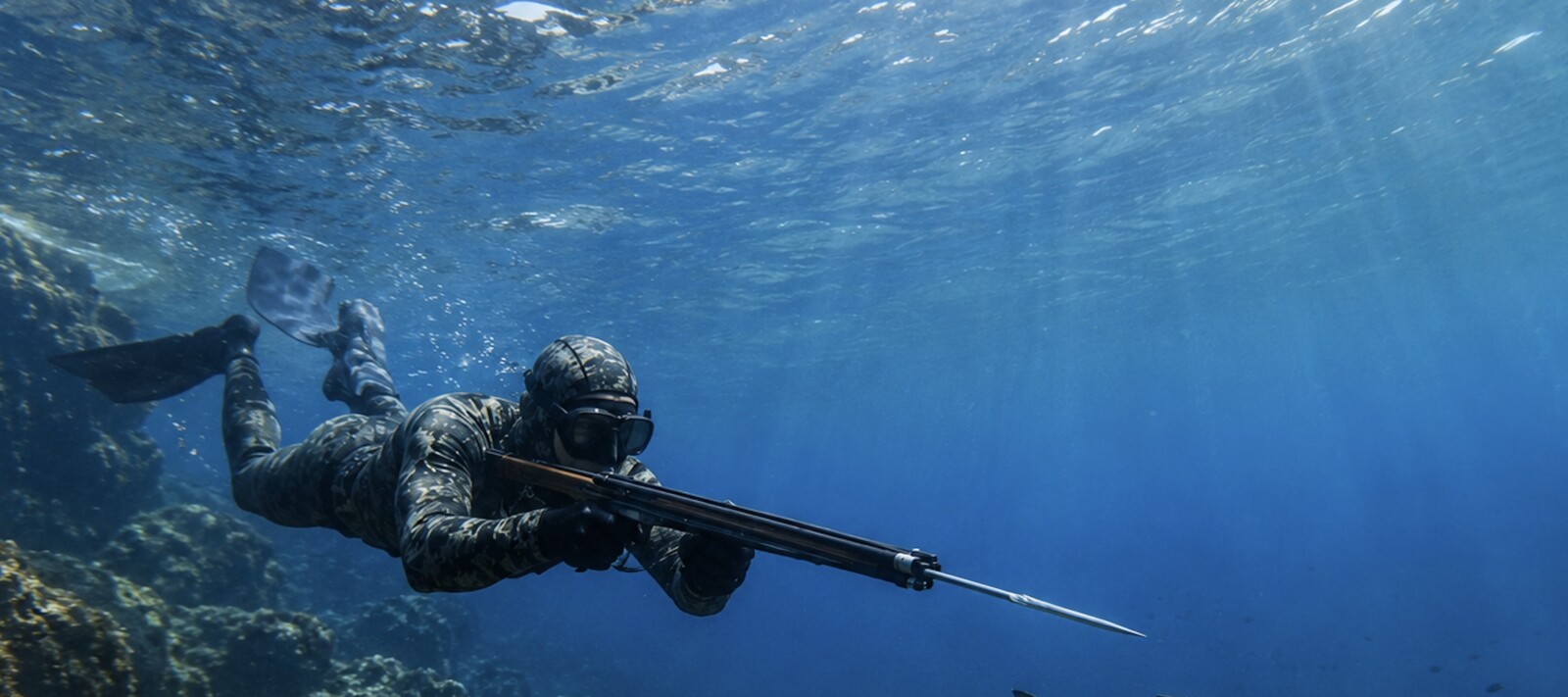
There is a specific kind of patience that spearfishing develops — one that most people don’t have when they start and most people can’t do without by the time they have a season or two behind them.
You are underwater, eight metres down on a single breath, tucked into a rock shelf or hovering motionless above a patch of reef, waiting for a bass or a pollock to move within range. The fish can sense movement. They can sense anxiety. The diver who fidgets, kicks too hard, or approaches too fast catches nothing. The diver who has learned to slow their heart rate, equalise quietly, and read the water around them brings something home for dinner.
That is the experience of spearfishing in the UK in a paragraph. It is not the experience most people expect when they first look into it.
What the UK Actually Offers
The default assumption about spearfishing in Britain is that the water is too cold and too murky to make it worthwhile. The reality is more nuanced. Water clarity in the UK is highly location-dependent, and in the right places — the west-facing coasts of Cornwall, the Lizard Peninsula, the southwest tip of Wales, parts of the Scottish west coast — visibility can reach fifteen metres or more on a good day. Kelp forests a few metres below the surface teem with spider crabs, lobsters, pollock, and bass. The marine life is there. What changes is the conditions needed to reach it comfortably.
Cornwall remains the most developed region for the spearfishing experience in the UK. Falmouth Bay, the waters around the Lizard, and St Ives Bay all offer accessible depths with varied terrain and a good species mix. Plymouth is worth knowing about too — the combination of wrecks, reefs, and rocky ground accessible from shore makes it one of the most productive areas on the south coast. The visibility around Plymouth Sound varies considerably depending on recent weather and tidal phase, but on the right days it is among the best on the English Channel coast.
The Freediving Connection
Here is the thing that separates spearfishing from almost every other fishing method: the diver and the fish share the same water on the same terms. There is no boat between you and the environment, no line, no sonar. Success depends entirely on breath-hold capability, movement quality, and understanding of fish behaviour. This is why the spearfishing experience in the UK is inseparable from freediving — and why every serious instructor in the country will tell beginners to learn freediving first.
An AIDA freediving certification — the internationally recognised qualification system — gives a diver the breath control, equalisation technique, and water confidence that spearfishing demands before a speargun enters the equation. The AIDA 2 certification, which qualifies divers to 20 metres and covers safe buddy procedures, is the level most spearfishing course providers in the UK require before they’ll take a student into open water with equipment. The Delphy Pool facility in Cornwall, built around a 37-metre quarry pool, has become one of the primary training venues for combined freediving and spearfishing courses — a purpose-built environment that allows skills to be developed in controlled conditions before moving to the coast.
What Spearfishing Courses Cover
A structured spearfishing course in the UK runs over one or two days depending on the provider and the student’s existing freediving level. The curriculum covers equipment selection — wetsuit thickness, gun length appropriate for UK conditions, float line and safety buoy setup — alongside fish identification, legal size limits, seasonal restrictions, and the hunting techniques specific to different species and habitats.
Ambush hunting — finding a position on the reef and waiting for fish to come to you rather than chasing them — is the core skill. Fish are significantly larger underwater than they appear due to refraction; everything looks approximately 33% bigger beneath the surface, which affects shot selection and the assessment of whether a fish meets minimum legal size. Understanding this early prevents mistakes that matter both legally and ethically.
The sustainability question sits at the centre of responsible spearfishing experience in the UK. Unlike commercial fishing or even rod fishing, spearfishing is entirely selective — you choose exactly which fish you take, from which species, at what size. There are no bycatch issues, no nets, no indiscriminate catch. Practiced responsibly, it is argued by many marine biologists to be one of the lowest-impact methods of harvesting wild fish available to individuals. That argument is increasingly part of why people are drawn to it.
adventuro lists spearfishing courses and experiences across the UK at adventuro.com — a practical starting point for finding instruction by region and comparing what different course structures offer.
The patience is the point. Everything else — the equipment, the technique, the regulations — is learnable in a weekend. The stillness underwater takes longer. It is also the part that stays with you.
Read the full article here


