

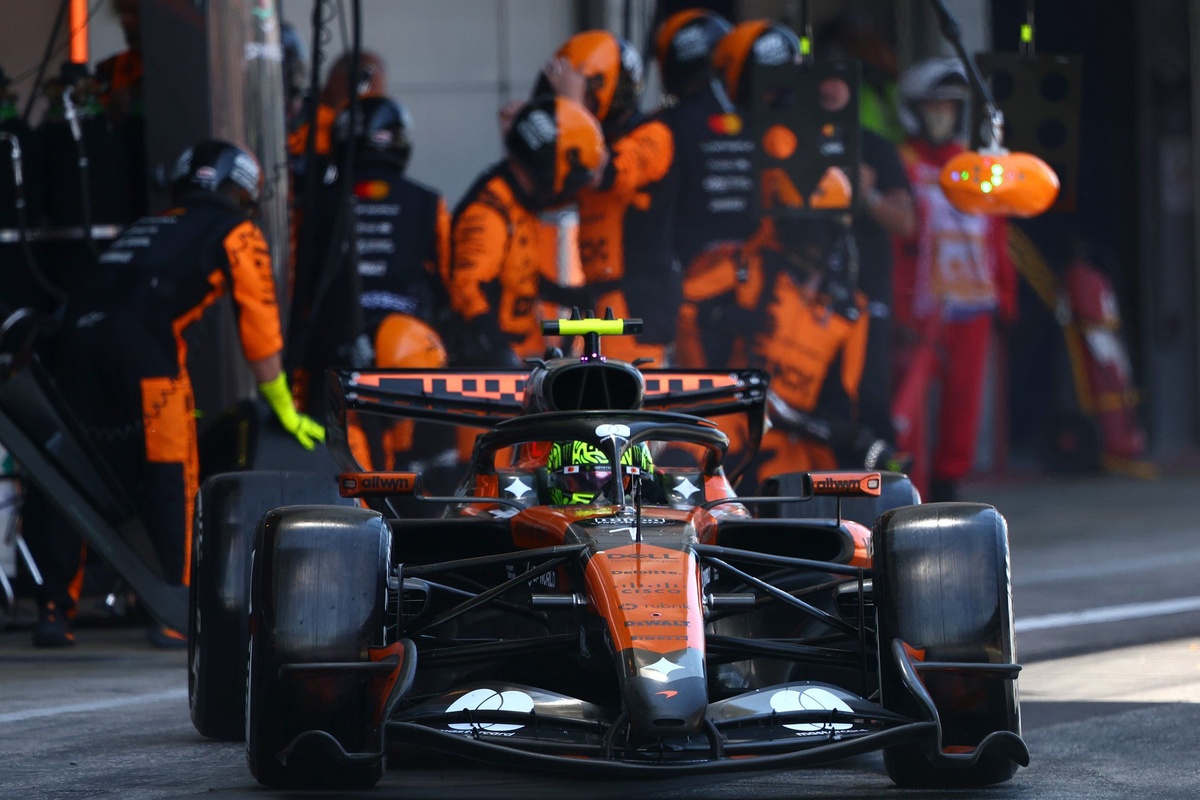
The McLaren Formula 1 team is gradually starting to hone in on regaining its famous tyre management prowess that helped make it so successful in 2024 and 2025.
Speaking to Autosport over the course of last year, team boss Andrea Stella was bullish about McLaren being able to carry over some of its title winning strengths across an entirely different set of regulations because of the knowhow and methodologies it had built up under his tenure.
“There are a couple of things that carry over, independently of the technical regulations,” Stella said. “One is the technical fundamentals whereby we pursued aerodynamic efficiency, interaction with the tyres, efficient cooling. It’s universal. And some aspects of the methodology, or some aspects as to how you generate this knowledge, will be transferable.”
McLaren’s ability to manage tyre temperatures was a particularly powerful strength as it became a dominant force in 2024 and 2025, with it even accused by rivals of using water cooling tricks to keep the rear Pirellis under control – claims that governing body the FIA shut down after conducting tests.
But as F1 shifted to a radically different set of regulations, that tyre strength, which was a key part of McLaren’s title winning arsenal, has seemingly disappeared, with the Barcelona Grand Prix at the hot and high downforce Montmelo circuit perhaps the best indicator.
After having been trading turns with Ferrari as the second fastest team behind Mercedes, the Scuderia took a major step forward with its Barcelona upgrade. As Lewis Hamilton delivered an eye-watering final stint to put 20 seconds on second-placed George Russell, Lando Norris benefitted from Kimi Antonelli’s retirement to claim third, with team-mate Oscar Piastri struggling more in the Spanish heat as he finished a distant fifth.
Andrea Stella says McLaren has invested heavily in its tyre management
Photo by: Steven Tee / LAT Images via Getty Images
Afterwards, Stella admitted that Ferrari has simply produced a better car now with more downforce, but on Saturday he also acknowledged that McLaren hasn’t been able to carry over its tyre strength from last year.
“We have invested over the years to make sure that we were conditioning the tyres, especially in hot races, and keep them cold enough that the grip wouldn’t decay at a fast rate,” Stella explained. “I have to say that some conditions changed from a technical point of view as we designed a new car, different tyres, so this is a journey that is still ongoing.
“We know at McLaren that we have some opportunities to do better. At the moment we are not as competitive as we were in 2025 in terms of tyre conditioning and degradation, a very clear objective for development. We don’t seem to be having any particular advantage from this point of view.”
Stella says the 2026 regulation set has been such a seismic shift, with teams also having to incorporate the highly complex new power units and ancillary systems, that McLaren has needed to do a “reset” and cover all its bases before being able to hone in on the finer details. That development trajectory has effectively started now.
“It’s a bit of a reset that we were kind of forced to take as we designed a completely new car, which created some extra demands,” the Italian explained. “We needed to meet all these demands in a single go to start a new project. And now we are starting with the development and fine-tuning in the areas where most opportunities exist.
“Now we are gradually evolving towards what we think is the right thing to do for the tyres.”
We want to hear from you!
Let us know what you would like to see from us in the future.
Take our survey
– The Autosport.com Team
Read the full article here