

The circuit in Madrid has offered Formula 1 drivers a surprisingly high level of grip during their first visit, something that is certainly not a given at a new circuit. The grip level has taken some teams in the paddock by surprise, although the very high tyre degradation so far has done the same.
“It was tricky at the start of the weekend because this track has so much grip, even though it’s a completely new asphalt surface,” Mercedes team boss Toto Wolff said. “And interestingly enough, we have faced the exact opposite problem to what we expected.
“Based on how it looked after the first session, our strategy director said, ‘Six stops!’, because there was actually eight-tenths of degradation per lap. We’ve never seen that before, but in the end, I think it’ll end up being a one-stop.”
Why is tyre degradation so high in Madrid?
After Friday’s practice sessions, tyre supplier Pirelli also expressed its surprise, not so much at the grip level – as that had already proved high during the pre-race measurements on Wednesday – but at the tyre degradation.
“Yes, honestly it has been a surprise,” Pirelli chief engineer Simone Berra said when asked about it by Motorsport.com. “The teams are working on their set-ups to find the best compromise between the performance and long-run degradation. But, for sure, it’s a surprise to have these kinds of values. They are outside our range of expectations.”
Those values are not quite as extreme as Wolff suggested, but they are still noteworthy by F1 standards – something that is normally more characteristic of Qatar, a track where the heat is combined with a succession of high-speed corners. According to Pirelli, Friday saw two to three tenths of a second of lap time lost per lap purely through tyre degradation.
The Madring has offered a surprisingly good level of grip so far, but it’s very hard on the tyres
Photo by: Michael Potts / LAT Images via Getty Images
According to the Italian tyre supplier, the high degradation in Madrid has two underlying causes: graining and the usual thermal degradation at the rear axle.
“With this smooth tarmac and the high grip levels, we have graining generation,” said Berra. “We basically reach the peak of the stress, so the tyre starts to tear and propagate graining.
“The graining level is for sure a limitation here, drivers can feel that there is a drop in performance. This is one of the effects that they have encountered during the high fuel runs on Friday, where front left graining was a limitation, inducing mid-corner understeer throughout the run. But we also had some thermal decay on the rear axle, so the combination of the two effects is generating a significant level of degradation.”
F1 drivers criticise Madrid’s long pitlane
It will obviously not lead to six pitstops, but according to Pirelli it does make the strategic trade-off difficult. This is compounded by the fact that teams do not have a particularly large amount of long-run data following Arvid Lindblad’s crash in FP2.
“What to expect for the race is already a question mark. I don’t want to exclude any kind of situation,” Berra said.
After the second practice session, Pirelli predicted a two-stopper, but a day later that prediction has been revised to a one-stopper. The reason is simple: the extremely long pitlane in Madrid.

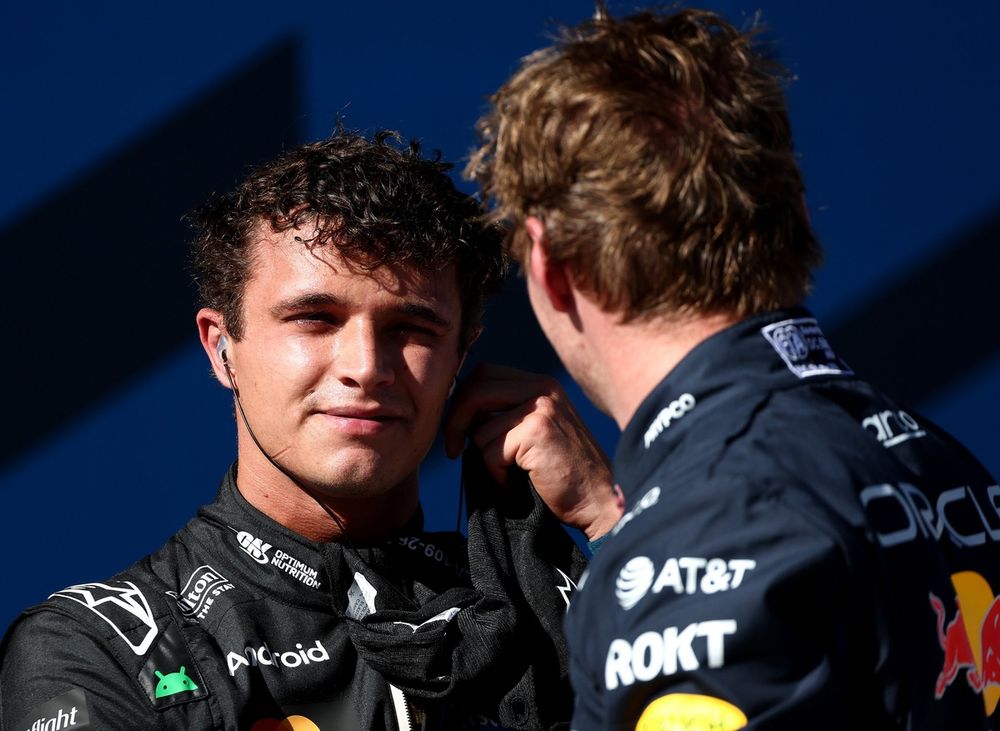
Both Norris and Verstappen believe that the pitlane is far too long and highlights a design flaw
Photo by: Sam Bloxham / LAT Images via Getty Images
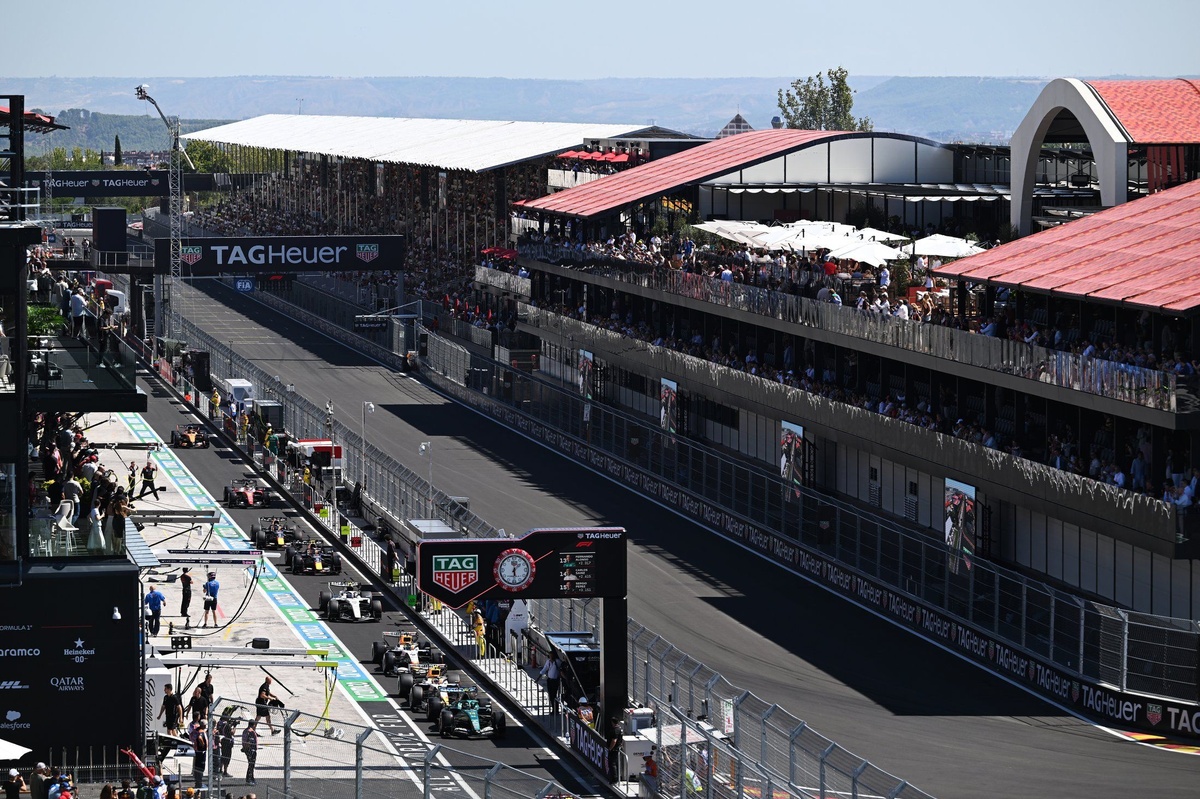
The pitlane is effectively split into two sections because part of the IFEMA complex sits in between. Although the pitlane does cut out Turns 1 and 2, drivers nevertheless believe it has been a major mistake in the Madring’s design process.
“The pitlane is like six kilometres long!” said Lando Norris in the post-qualifying press conference. “We should have two parts of the pitlane: pit limiter, off pit limiter, and then pit limiter again. It’s the longest pit lane of the year and biggest pit loss of the year as well. That just makes overtaking worse.
“It makes the desire to box and do different strategies worse. If we’re going to build a new track and spend so much money on building a new track, this is probably one of the main factors, I would say, in making a track, to have a short pitlane so people can pit and then you create overtaking.”
The long pitlane favours a one-stopper, despite the fact that according to Pirelli the pure race time is the same for one and two pitstops. Normally, that is a perfect scenario for creating strategic variation – which is exactly what Pirelli wants to achieve – but the Madrid pitlane could potentially ruin that.
An undercut relatively near the front of the field could trigger a second round of pitstops, but that is also a gamble, as track position is crucial in Madrid. Giving up track position for fresh rubber is risky, as Berra also acknowledges.
“The other factor is that, speaking with the teams, it seems quite difficult to overtake here,” he said. “If you are in traffic, you lose quite a lot of performance and you destroy your tyres as well, because you lose load and generate higher temperatures. So the traffic can have a detrimental effect and is pushing towards the one-stop.”
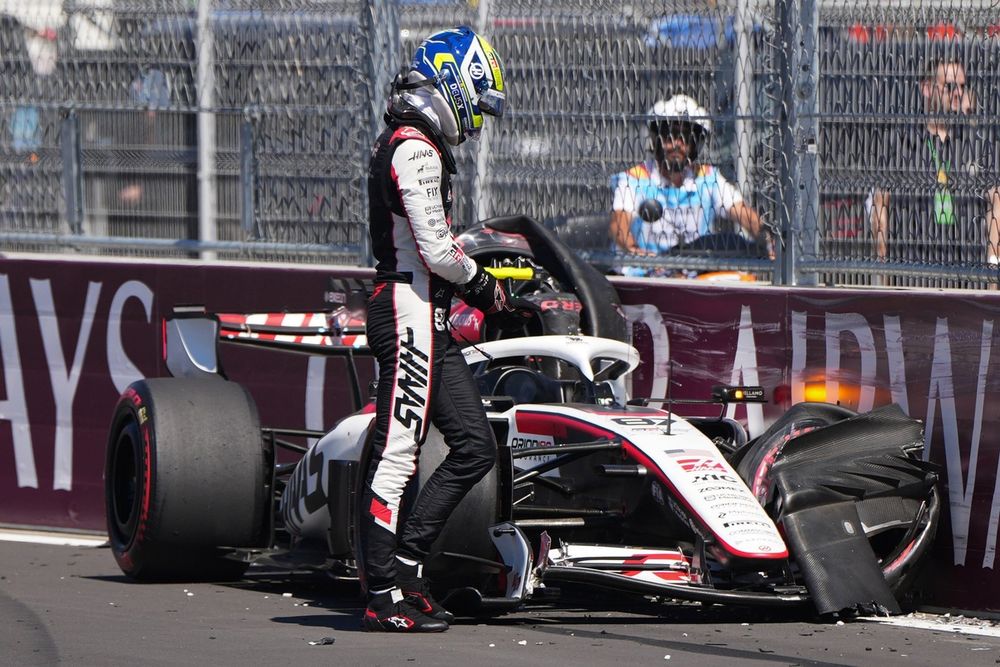
Apart from all the rational factors, misfortune in Madrid is just around the corner, as Bearman discovered on Saturday
Photo by: Alex Bierens de Haan / LAT Images via Getty Images
Aside from these factors, a crash – and with it a safety car or red flag – also appears to be a distinct possibility in Madrid, meaning Lady Luck could play an even bigger role than any of the factors teams can rationally account for.
Teams need to be prepared for different scenarios, which is why some outfits have deliberately saved tyres on Friday and Saturday. In the event of an early red flag or safety car, they want to be able to switch to a new set of hard tyres, while in the event of a late crash they would prefer to make an additional pitstop for new softs or mediums.
That is precisely why the Ferrari drivers completed Q1 on mediums, leaving them with a set of fresh softs for the race.
“I think they are more relaxed,” Pirelli’s head of motorsport Dario Marrafuschi said about that. “That was a choice, in my opinion, thinking of possible neutralisations. So they have a new set of soft, maybe for the last stint in case of a neutralisation.
“If you start a normal race, our suggestion is medium-hard, but in case of a neutralisation in the last laps, they have a new set of softs. That will be a great advantage, even though overtaking is difficult anyway.”
We want to hear from you!
Let us know what you would like to see from us in the future.
Take our survey
– The Autosport.com Team
Read the full article here