

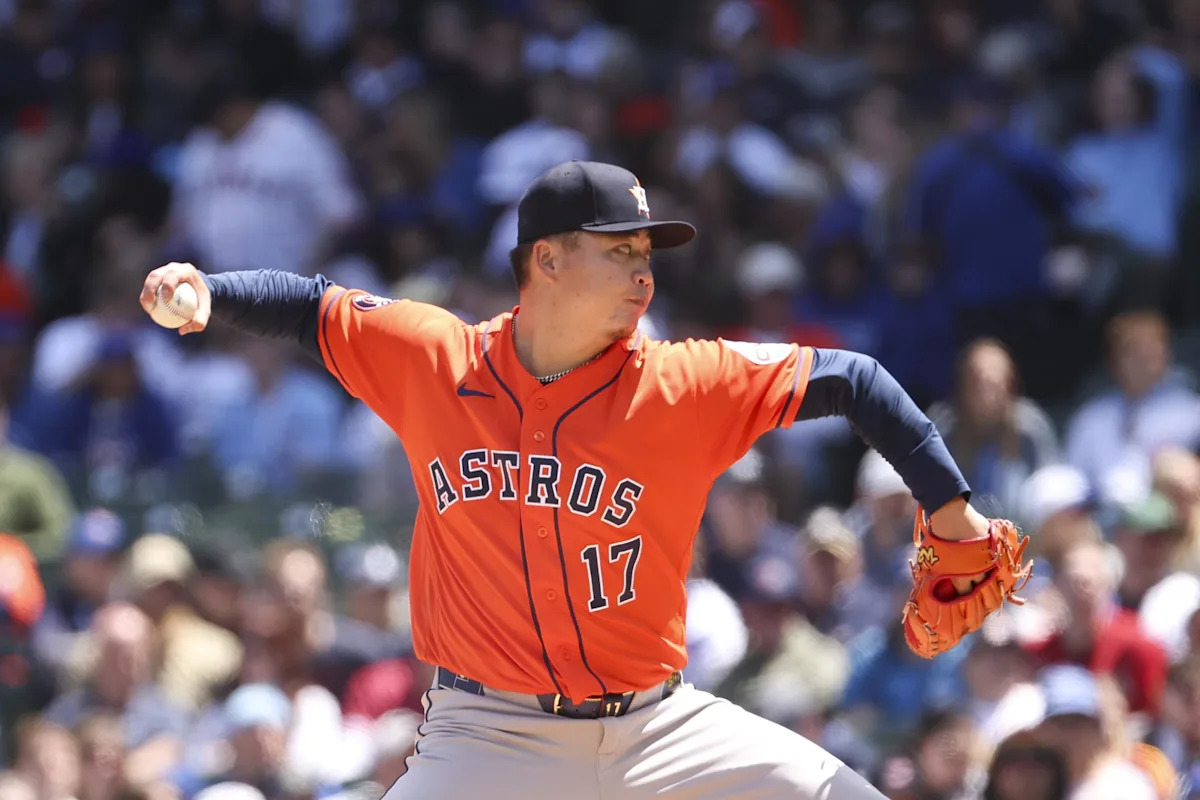
One of the axioms I always live by is that I really don’t buy heavily into trends until Memorial Day. Obviously, Memorial Day has now come and gone. I have to admit that this early season has tested that axiom and my own patience as an analyst. I suppose this is my own version of a mea culpa. There are the numbers and they are what they are, but there are also the underlying reasons for the numbers. We should explore those before we get to the numbers themselves.
Reason One: Changes from the ABS system
The pitching lab works the way that any lab works. Science doesn’t happen without data. The Astros have famously taken pitchers that have struggled in other organizations and made them work here because they have relied more heavily on data than most organizations. That data pushed towards certain kinds of pitchers. The Astros have favored higher spin rates and pitchers that live successfully at the top of the zone and above.
Justin Verlander is probably the most famous of those examples but we could rattle off the names fairly easily here. They all had one thing in common. They had impressive four seam velocity and got hitters to chase near the top of the zone. The new ABS system has neutralized the high fastball considerably as the entire zone has moved lower. That could partially explain the heavy walks in the first month plus as pitchers suddenly weren’t getting the high strike calls and hitters weren’t chasing those four seam fastballs.
Obviously, the numbers (as we will see) have not completely stabilized and likely won’t throughout the season. That spills us into our second point, but the idea of data is important here. If the lab is built on data then there needed to be a healthy amount of new data to help the strategy evolve. Obviously, this alone will help performance some. We could certainly break each pitcher down between March/April and May, but suffice it to say, most of the Astros pitchers (that are still in Houston) have performed better than they did in March and April.
Reason Two: The who is more important than the what
One of the things that Joe Espada and Dana Brown will have to answer for are the slow starts. It is a noticeable trend and comes down to two very clear takeaways. First, there are some fundamental issues about how this team prepares in February and March. This year in particular saw very few pitchers building up the kinds of innings that we are traditionally used to. We were told they were throwing on the back fields and we were told not to worry. Clearly, those things were a concern and we were right to be concerned.
However, the Astros as an organization have lived around the margins with their pitching staff for over half a decade now. Each season is its own universe and the “back of the baseball card” gang have collectively failed to see that. Relief pitching in particular is a fungible asset which clearly points to a year to year quality of this whole thing. Espada has needed time to figure out who he can trust and how he can trust them.
This is not unique as every season has brought unique challenges in finding a reliable rotation and reliable high leverage relievers outside of Bryan Abreu and Josh Hader. Even if Abreu was the Abreu of old for the whole season, the Astros were still going to struggle with a new cast of characters and some obviously failed and failed pretty spectacularly. Some of those arms are no longer there and their absence has helped with the resurgence for the last four weeks.
The Numbers
|
W-L |
INN |
ERA |
H/9 |
BB/9 |
HR/9 |
|
|
First 27 |
9-18 |
253.1 |
6.29 |
9.24 |
5.61 |
1.53 |
|
Last 26 |
13-13 |
229.0 |
4.09 |
7.39 |
4.36 |
1.02 |
We should start by talking about what these numbers mean and what they don’t mean. Absolutely, the staff has been considerably better overall. In particular, the total number of base runners per nine innings has fallen considerably. Obviously, they are doing a better job of keeping the ball in the ballpark. We did not list the strikeouts because there isn’t a considerable difference there.
Over a long enough timeline the survival rate drops to zero. With smaller samples there will always be random variance involved. That’s a fancy sounding term, so what does that mean exactly? It means that the numbers you see cannot be completely attributed to the quality of the pitchers or their performance. Sometimes there is good and bad luck involved. That can impact the batting average on balls in play (BABIP) but also the amount of home runs given up.
This means that if left to their own devices, the pitchers that started March and April would have likely improved naturally. The home run rate was unsustainable. Guys like Mike Burrows have not been good, but their underlying statistics show they would not have continued to be that bad. Over the course of a full season, those numbers will always normalize some.
These numbers do say two very important things. First, the Astros have made some personnel changes and usage changes that have positively impacted performance. We could name the names, but the current five or six man rotation is performing much better than the one that started the season. Maybe more importantly, whether through health or a better understanding of how to use each pitcher, the bullpen has become much more functional than it was in the first month.
Secondly, while the last month has been a bit of a lime wedge, the overall performance is not the kind of performance we saw from this team over the course of their dominant seasons. The team ERA over the last month has been nearly league average. They are still walking too many guys and giving up a few too many home runs to be called a good staff. In other words, they are not the historically horrific staff they were in the first month plus, but they are still not what any honest analyst would call a good staff either.
Obviously, some of that could change. Hunter Brown is set to return in another week or so. Josh Hader is set to return in another couple of weeks. One could easily foresee those two pitchers alone changing the calculus some. It also could be said that pitchers like Nate Pearson and Alimber Santa could potentially add to that when given more opportunities. I’m obviously not predicting that, but the possibility cannot be ignored.
The long and short of it is that this is likely an average pitching staff over the balance of a full season. The gains from Brown and Hader could be enough to offset the damage the first month caused. Also, it should be noted that the hitting between the first month and this past month has been a mirror image of the pitching gains. This leads me to the same math conclusion I reached before this recent road trip. The Astros on balance are no longer a bad baseball team. The question is whether they will be good enough to dig out of the hole the first month put them in. That remains to be seen. How optimistic are you for a total rebound?
Read the full article here