

The NBA Draft Combine is a wrap, and now the scouts and front offices are modifying their boards based on the measureables, drills and conversations in Chicago. Between cartoonish measurements, a 30-point scrimmage explosion and a few of the guys who left more questions than answers, expect movement before the May 27 withdrawal deadline.
Here’s who helped themselves and who hurt their stock — and what it means for your dynasty teams.
Risers
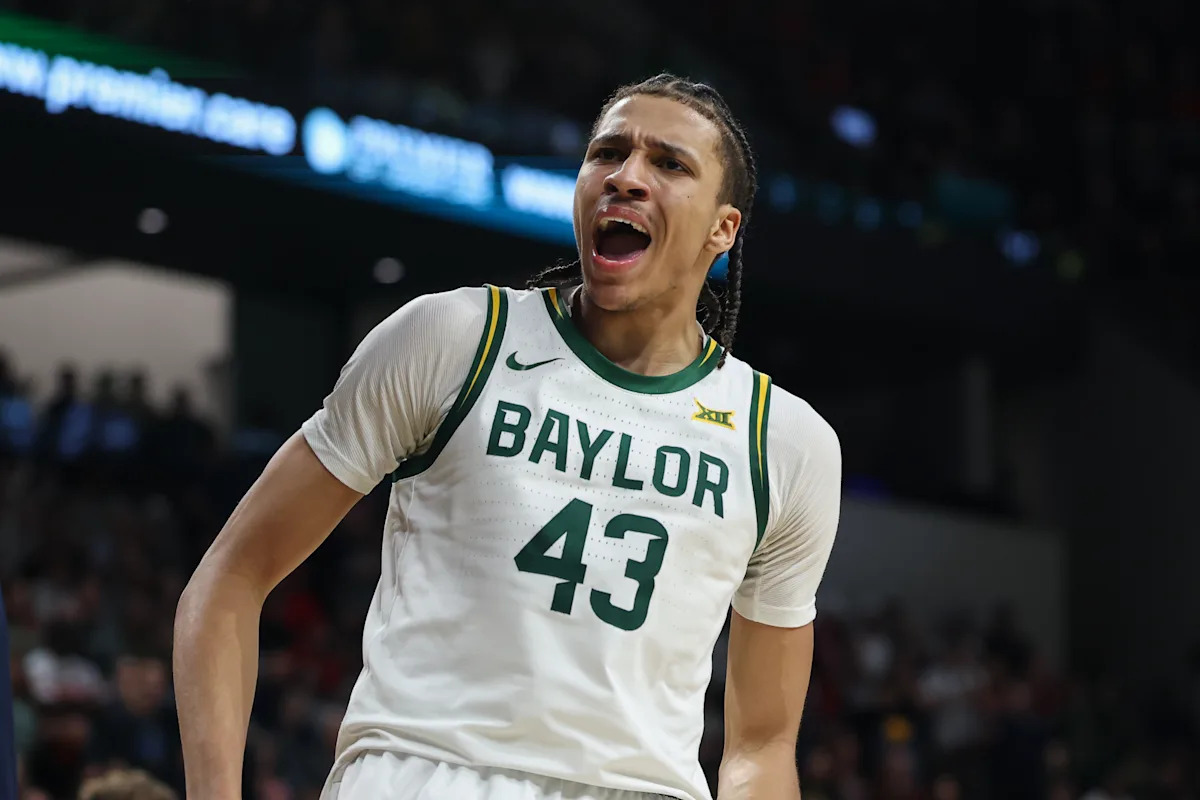
Cameron Carr, SG, Baylor
Carr showed out across the board. Before the Combine, he was outside the lottery, but his performance over the week may have pushed him into the top 14 picks. The 6-foot-5 shooting guard has a 7’1” wingspan with a max vert of 42.5. He crushed the agility drills and his athleticism is off the charts. When it came to scrimmaging, he poured in 30 points, six 3s and 7 rebounds.
By going off at the combine, I’m expecting him to slide ahead of several prospects in dynasty if he lands in a positive situation.
Aday Mara, C, Michigan
Mara’s rise up draft boards accelerated after a strong NCAA tournament, just as I predicted before March Madness. Standing at 7’3″ barefoot with a 7’6” wingspan, his 9’9″ standing reach is the second-longest in combine history. As expected, his shuttle and sprint times were slow, but he impressed with an 11.47 in the pro-lane agility drill.
From a fantasy perspective, Mara projects as a high-level shot-blocker and rebounder, similar to Zach Edey or Donovan Clingan. He also reads the game well and has flashes of Marc Gasol-like passing. Even without scrimmaging, his testing pushed him into top-10 real-life and dynasty draft conversations.
Morez Johnson Jr., PF, Michigan
A 39-inch max vertical, the second-fastest pro lane agility time at the combine, while impressively knocking down an uncharacteristic 17-of-25 3s in the shooting drill, certainly raised eyebrows at the combine.
Johnson, the 6’9” forward and NCAA champion, shot 34% from 3 during the season, but it was with extremely low volume at 0.9 per game. Seeing that kind of potential as a shooter raises his floor and he’s already generated enough buzz to stay in the NBA Draft. Yahoo Sports’ Kevin O’Connor has Johnson mocked to OKC at 17, which would be a great landing spot for dynasty managers.
Tarris Reed Jr., C, UConn
Reed looked the part of a frontcourt player with upside all week in Chicago. Despite being the second-heaviest center prospect, he finished second in the pro-lane agility drill at 11.03 seconds. Having quick feet lends more confidence in his switchability defensively, but it also helps that he’s sporting a 7’4” wingspan to pair with a 6-foot-10 frame.
Play 2026 Soccer Pick ‘Em with FOX One and make your picks for the world’s biggest soccer tournament
Beyond the measurements, he played well across two scrimmages, producing 9 points, 5 rebounds and 2 assists in 19 minutes on Wednesday and followed that up with 17 points, 5 boards and 2 blocks on Thursday. He could hear his name called in the late-first round and creep into a dynasty sleeper.
Chris Cenac Jr., PF/C, Houston
The freshman forward didn’t wow evaluators in the tournament, but his testing gave him new life. Cenac’s number ranked well above average for his position in nearly every metric except hand width. I see an offensive skill set similar to Jaren Jackson Jr.’s. Cenac shot 15-for-30 off-the-dribble, 9-for-20 on spot-ups and 16-25 on 3s in the shooting drills. Seeing that he shot 3.9 3s per-40 minutes in the regular season, prospective teams likely view him as an athletic, rangey wing with an active motor who can stretch the floor.
KOC has him going 18th to the Hornets, which, if it holds, could be an ideal landing spot where he can slot in once Miles Bridges’ contract expires next summer.
Fallers
Koa Peat, F, Arizona
Standing at 6’7” and 245 pounds, Peat’s bruising frame settles in as a tweener in the NBA. He doesn’t have the prototypical size of a power forward and his shooting isn’t good enough to be a threat on the wing as a small forward. He’s spent the offseason making significant mechanical changes to his jump shot, but the early results haven’t been positive: he shot 13-of-50 on spot-ups and 3s at the combine. Then he opted out of scrimmages.
Fantasy-wise, Peat went in the second round of a 30-team dynasty start-up last year. With these issues in mind, his value would be far less this season. At this rate, the most economical move is to return to Arizona and enter a weaker 2027 draft class.
Joshua Jefferson, F, Iowa State
Another player who landed on my tournament watchlist, Jefferson, suffered an ankle injury in Iowa State’s opening contest and didn’t play for the rest of the tourney. He was fully healthy entering the combine, but unfortunately, Jefferson had the slowest pro-lane agility time, with bottom-third results in verticals, sprint and shuttle.
Athletic testing isn’t everything, but you can’t post those numbers in front of every front office in the league and expect teams to look the other way. Unless there’s some drastic development, the All-American will likely return to the NCAA after an unimpressive performance in Chicago. He can be left off dynasty draft boards for the moment.
Tyler Tanner, PG, Vanderbilt
Tanner crushed the shooting drills and posted the fourth-highest max vert among point guards. Going back to the regular season, Tanner had more dunks than many of the top prospects in the class who are several inches taller.
While being an exceptional primary ball-handler, initiator and athlete, his sub-6-foot frame continues to hold him back in the eyes of NBA teams. He also had a couple of underwhelming scrimmages, which pushed him into fringe first-round-prospect territory, at best. The 2026 class is loaded with guards who possess a more prototypical size, so despite Tanner’s excitement about staying in the draft, there’s a strong financial incentive to return to Vanderbilt. He’d be bench depth in a dynasty league like Ryan Nembhard, who eventually went undrafted last season.
Read the full article here