





When a hitter is performing well or struggling, the first question I ask myself is, “Why and how?” Then I ask, “What’s going on under the hood?” It’s easy to get lost in the weeds with all the advanced metrics available, but the goal is to make this information digestible. Have these hitters been fortunate or unfortunate? Or have any skills changed within their profile? Will these hitters continue finding success? Or will they bounce back from their struggles?
Reach out on X (@corbin_young21) if you’re interested in me diving into specific hitters.
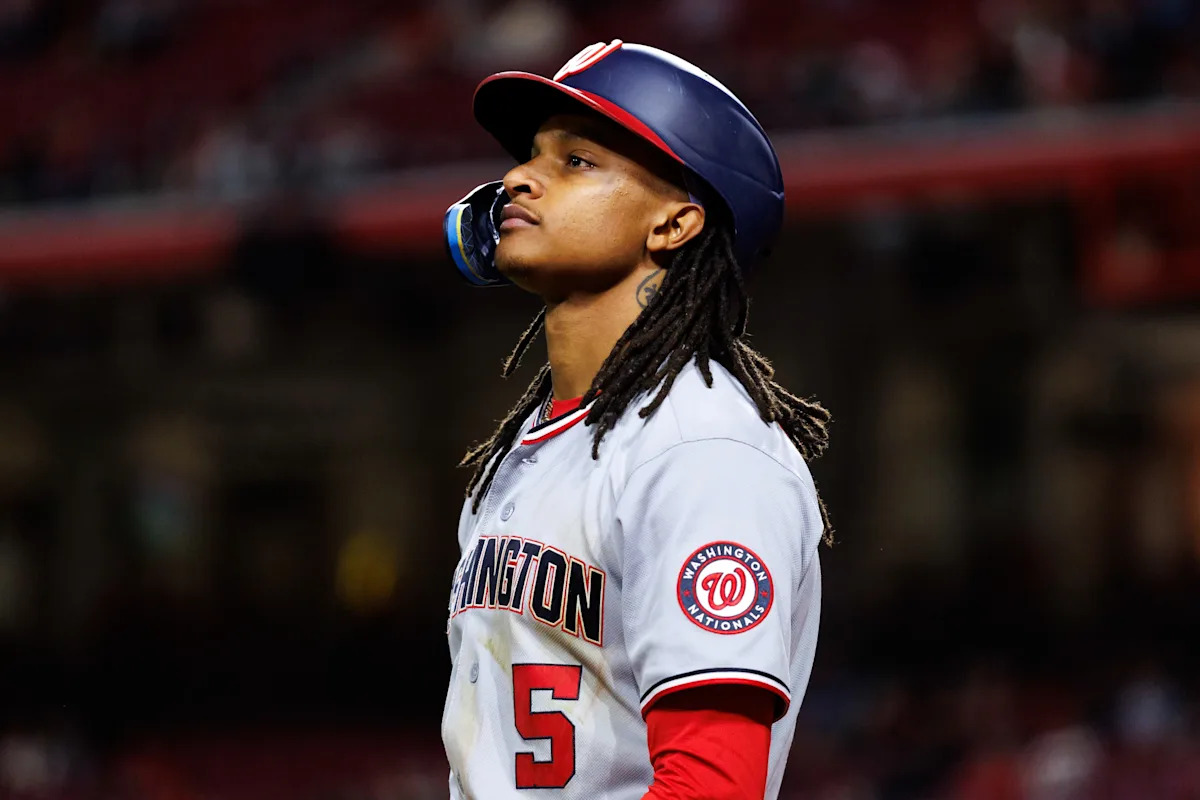
CJ Abrams, Nationals (98% Rostered)
After nearly averaging 20 home runs and 30 stolen bases over the past two seasons, CJ Abrams could surpass that in 2026. Abrams has been fortunate, with a career-high BABIP (.336), supporting a career-best batting average. Interestingly, Abrams’ contact rate was a career low (72.6%), making us wonder whether his 10% walk rate can be sustained with similar chase and swing rates in 2026 compared to the career averages. For context, Abrams had a 77.9% contact rate and 35% chase rate throughout his career.
Speaking of luck, Abrams’ home run rate (HR/F) reached a career-high at 16.9% in 2026, mainly supported by his 6.8% barrel rate per plate appearance. Besides the increased barrel rate, Abrams has shown consistent bat speed, pull rates and flyball rates, evidenced by a 21-22% pulled air rate over the past few seasons. Like the rest of Abrams’ profile, his barrel rate was a career high, two percentage points above his career average (4.8%).
It might be noisy, but Abrams has seen his stolen base opportunity rate gradually decline from 2023 (43%) to 2024 (36%) to 2025 (26%) and 2026 (20%). Regardless, it shows that Abrams continues to run at a high rate, meaning 30 stolen bases should be a regular part of his fantasy profile.
The projections suggest Abrams could surpass the 25 home run mark while nearly replicating another 30 stolen base season. Abrams’ batting average might regress, but it could end up closer to his .260-.270 xBA, making him a near-elite fantasy asset.
Avoid selling high, even if we think the Nationals’ lineup might be overperforming their expectations.
Daylen Lile, Nationals (64% Rostered)
Daylen Lile flashed power and speed in his MLB debut in 2025, though his .336 BABIP was fueling the batting average (.299). Meanwhile, Lile’s BABIP has fallen to .292, lowering his batting average to .264, which is still above-average. Lile’s contact rate fell from 83.5% in 2025 to 77% in 2026. Meanwhile, Lile has been chasing more in 2026 (36.5%) compared to 2025 (26.7%), with his swinging-strike rate jumping to 12.5%, a four-point increase from 2025 (8.5%).
As a lefty, Lile uses a pull-heavy (43.5%), flyball (42.2%) approach, aligning with a slightly above average pulled air rate (career average of 18.8%). Lile has mediocre power, with a 5.6% barrel rate per plate appearance, meaning he’ll need volume to reach 15+ home runs. Thankfully, Lile hits the ball hard enough that he isn’t a liability in the home run category so far in 2026, though he never reached double-digit home runs in the minors.
From a speed standpoint, Lile interestingly converted 55% of his stolen base chances throughout his career. That’s an awful conversion rate when Lile safely steals just over half of his attempts, which might lead to managers lowering his stolen base chances. Lile had a 17% stolen base opportunity rate in 2025, which dipped slightly to 12% in 2026. Thankfully, Lile has been an athletic (95th percentile Sprint Speed) and defensive (79th percentile Outs Above Average) specimen, typically leading to potential steals.
Play 2026 Soccer Pick ‘Em with FOX One and make your picks for the world’s biggest soccer tournament
There’s the potential for 15 home runs and 15 stolen bases as his floor across a full season, which is valuable in deeper formats.
JJ Bleday, Reds (34% Rostered)
After being the fourth overall pick in the 2019 draft, JJ Bleday has been a post-hype sleeper for multiple seasons. Bleday had concerns about strikeouts and contact rates in the past. He has shown similar contact, chase and swing rates in 2026, within 1-2 percentage points of his career averages. The most significant skill change involves Bleday’s 74.7 mph bat speed, which is over 2.5 points above his career average (72 mph). That said, Bleday has been swinging faster at a high percentage (50.4%), indicating he posted a bat speed of 75 mph or more half the time.
JJ Bleday’s pull and flyball rates. (Photo by Corbin Young/FanGraphs)
Bleday’s bat speed remains an input into the power metrics. We can speculate on Bleday’s increased power inputs, positively impacting his career-best 10.3% barrel rate per plate appearance. That mainly comes from Bleday’s pull-heavy (48.4%) and flyball (50%) approach, as he attempts to lean into the pull-heavy profile. Both metrics have been 3-5 percentage points higher than his career average. It was a bit more drastic earlier in the season, with pull and flyball rates at 55% or higher. There can be diminishing returns when pulling balls into the air too often.

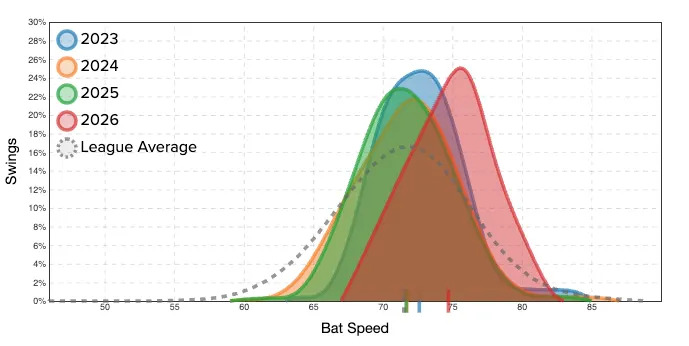
JJ Bleday’s bat speed distribution. (Photo by Corbin Young/Yahoo Sports)
When Bleday pulled the ball into the air, he boasted a 97.9 mph average exit velocity, 75.1 mph bat speed, 89.5% ideal attack angle and a .912 wOBA (.687 xwOBA) in 2026. This is what it looks like when a hitter with above-average power taps more into their pull side by swinging faster and hitting the ball harder.
Bleday has been messing with his batting stance too, using a significantly more open one at 28 degrees open compared to 11 degrees open in his career. There’s also an intentional approach to hit the ball in front of the plate (5.3 inches) in 2026 and 2025 (5.1 inches), supporting the pull rates.
The more open stance and intercept point farther in front of the plate over the past two seasons could have helped him perform better against breaking pitches. That’s especially true when he turns on a breaking ball coming toward him from a right-handed pitcher. It’s normal to be skeptical of Bleday’s batted ball results, especially via non-fastballs. Bleday has been obliterating the breaking balls, evidenced by a .708 wOBA (.506 xwOBA) in 2026, up from a .340 wOBA (.291 xwOBA) in 2025.
Bleday’s increased bat speed and power inputs have positively impacted him in 2026, leading to us buying into the different approach and skills to support the early season production. He should replicate something similar to 2024 with more than 20 home runs, making him an underrated buy or hold based on the skills in deeper formats.
Miguel Vargas, White Sox (79% Rostered)
We’re finally seeing the upside for Miguel Vargas in 2026. Vargas has been an asset in OBP and points leagues, boasting nearly identical strikeout (16.9%) and walk rates (15%). His improved on-base skills and lower strikeout rates have been supported by a career-best 85.4% contact rate and career-low 17.3% chase rate. For context, Vargas’ contact and chase rates in 2026 are 4-5 percentage points better than the career norm.

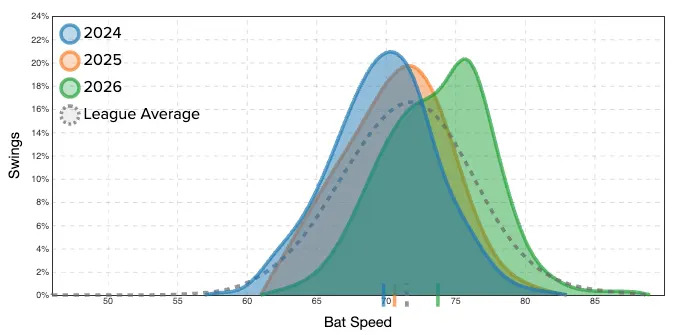
Miguel Vargas’ bat speed distribution. (Photo by Corbin Young/Yahoo Sports)
Vargas projects to hit a career high in home runs, given his above-average bat speed (73.7 mph), increasing by over two mph in 2026 from his career average. Furthermore, Vargas has a 41.1% fast-swing percentage, more than double his career norm (16.4%), indicating he consistently swings harder. Swinging faster doesn’t always lead toward optimal outcomes, but Vargas’ strong plate discipline with his above-average bat speed translates to a career-best 10.2% barrel rate per plate appearance.
Like Vargas’ home run projection, he will set a career high in stolen bases. That’s mainly because Vargas has been running slightly more often, with an 13% stolen base opportunity rate in 2026, up from 7% in his career. Vargas used to have upside for 20 home runs and 10 stolen bases, but we’re seeing hints at another level with 25+ home runs and 15 stolen bases being probable in 2026.
I would acquire Vargas where available, especially in OBP and points formats. That said, monitor Vargas’ health after being hit by a pitch on his hand on Tuesday.
Randy Arozarena, Mariners (97% Rostered)
Randy Arozarena has been one of the Mariners’ best hitters in 2026. After we’ve seen Arozarena’s batting average decline, his .385 BABIP fuels his batting average spike this season, so there’s some luck in his favor. Interestingly, Arozarena has been chasing more (31.9%) while maintaining his contact rate (73.6%) in 2026. For context, Arozarena’s chase rate would be a career worst, five points above his career average. It’s probably unreliable, but Arozarena has been making more contact outside the zone (69.4%), which might not be the best process since that’s nearly 10 points higher than his career average.

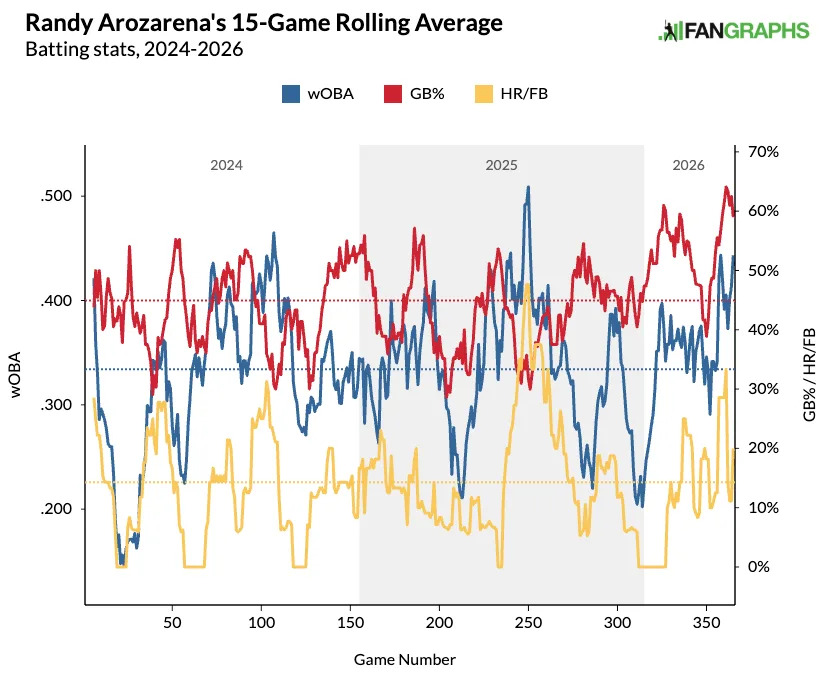
Randy Arozarena’s rolling groundball and home run rates. (Photo by Corbin Young/FanGraphs)
Arozarena has been hitting plenty of groundballs, 53.3% of the time in 2026, up from 42.5% in 2025. Though his groundball rate negatively affects his power, it can help his BABIP as a hitter with above-average speed like Arozarena. That said, Arozarena’s barrel rate per plate appearance has dropped to 3.8% in 2026 from 6.9% (2025). Furthermore, Arozarena’s Exit Velocity 50 or EV50 was above-average in 2025, given his 102.5 mph EV50 (No. 55), tying him with Christian Walker and Shea Langeliers last season. Like Arozarena’s barrel rate, his EV50 has fallen to 100.3 mph (No. 125) in 2026.
That tells us Arozarena still hits the ball hard, but maybe not in the high-end range.
Arozarena is on pace for 30+ stolen bases again while continuing to run at a high rate, with a 28% stolen base opportunity rate, similar to 2025 (24%). Running often and converting 85% of his chances will help maintain and boost Arozarena’s fantasy value. Arozarena could be more like 2022, with 20 home runs and 32 stolen bases in 2026, especially if he struggles to elevate the ball more consistently this year.
It looks like more of the same with Arozarena, with the potential for a higher batting average, though it’s probably fluky in that department.
Read the full article here


