

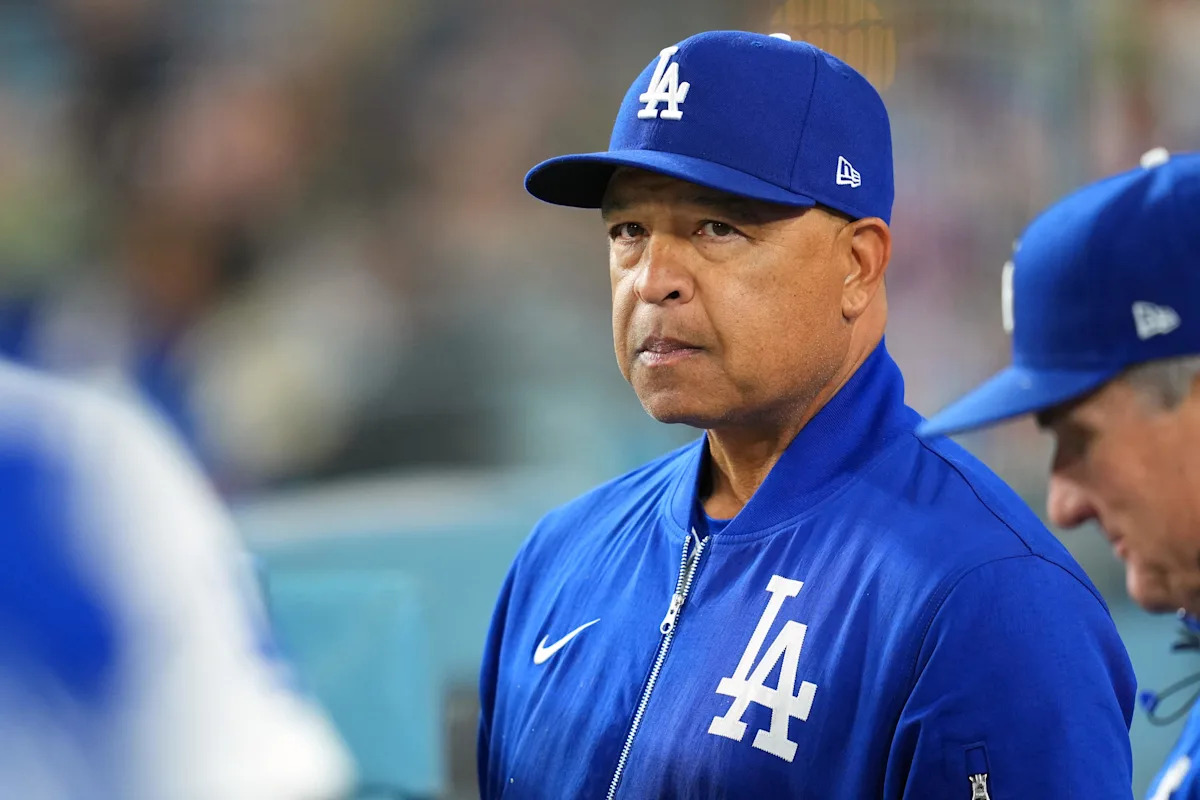
Adjectives that come to mind about Dave Roberts in the media are measured, reasoned, and thoughtful. Maybe a bit verbose or circular, especially when it comes to injury updates.
The point is that it’s rare when Roberts calls out a player, and it’s usually a doozy when it happens. The anger of the quiet person often booms the loudest. When Bob Nightengale of USA Today dropped “’Couldn’t be more lazy.’ Dodgers fire back at MLB payroll crybabies,” one could be forgiven for wondering if the headline was merely clickbait for diplomatic double-talk that did not say anything.
Those fears were dispelled instantly, immediately, and thoroughly. On Wednesday, Dave Roberts was there to take names and chew bubblegum; unfortunately for the targets of his vitriol, he was out of bubblegum:
“My honest opinion is the majority of takes about the Dodgers couldn’t be more lazy…that it’s just about the payroll. It’s about the draft. It’s about layering on where we pick in the draft annually. The player development. How we acquire international talent. How we perform consistently at the major-league level.
“I actually think it’s a competitive advantage in the sense that people feel that way, and not look at themselves in the mirror and see how they can operate things better. So that’s beneficial for us.”
As if to dispel the notion that Roberts had made an accidental remark, he kept talking:
“Having the payroll and the depth that gives you [is] certainly is a benefit. No one’s debating that. But I do think that the players we acquire, how we play the game every night, getting younger players to assimilate in a star-studded clubhouse, that’s important. That’s hard to quantify, but that’s of value.
“If you look at the World Series the last couple of years, there’s a lot of home-grown guys making league minimum that have been on postseason rosters.”
Then, for good measure, Roberts floated the idea of the Dodgers acquiring Detroit Tigers’ ace Tarik Skubal at the deadline.
“They would go ballistic,” Roberts said laughing. “But we would have the prospect capital to do [acquire Skubal]. We are one of the teams that could do that with the Tigers.”
One wonders who “they” are. Whether it’s the rest of the league or the critics of the Dodgers, Dave Roberts was not having it on June 3.
The players aren’t having it either
And lest anyone think it was just Roberts blowing off steam, Miguel Rojas added some justified rhetorical heat, stating it’s not just spending fueling the Dodgers’ success, and the organization’s roster construction is often overlooked:
“At the end of the day,” 2025 World Series hero Miguel Rojas said, “it’s not about wasting money or spending money to buy the best players because that’s not going to guarantee you anything. You can see it. There are another five or six clubs close to us in payroll, and they haven’t accomplished it. That’s why people aren’t talking about them, because they haven’t won. People just talk about us…
…The way they constructed the roster in this organization deserves a lot of credit,” Rojas said. “It’s not just buying the players and spending money on players, it’s having Plan B’s and C’s behind them, and that’s where I feel the organization is not getting enough credit for building a full team that is capable of sustaining so many injuries throughout the season and having guys ready when they get called up.”
Emmet Sheehan also went on the record, praising the Dodgers’ development system:
“Our development system is what gets overlooked,” Sheehan says, “how much time and money they put into finding the right people in the minor leagues to make people better. When I got drafted, I didn’t realize how lucky I was coming to an organization like this. Obviously, they put a lot of money into the team here, which is awesome, but there are a lot of guys that contribute way more than people realize, guys stepping up when we’ve had injuries.”
Even Jack Dreyer chimed in, praising how the Dodgers helped him develop as a bullpen stalwart:
“One of the things that the Dodgers do better than anybody else,” Dreyer said, “is that as soon as you get into that organization, they’re doing everything they can to develop you to maximize your potential. When I first got to the Dodgers organization, I had a long way to go before I had a chance at anything. I think they saw something that even I didn’t see in myself, but they kept fine-tuning, and tweaking, and revamping different things until I got to this point. Every single guy who’s in the Dodger organization is very lucky with all of the resources the Dodgers provide, so I’m very thankful I signed here.”
For regulars at True Blue LA, Roberts and the other quoted players are merely parroting arguments that have been expertly and diligently proffered in these parts for years.
Is it nice to have the indirect inference that various Dodgers players and staff read True Blue LA? Sure. Are we going to belabor what we have previously argued in a bit of self-congratulatory puffery? A little. Pride counts for something around these parts.
After all, the New York Mets and San Francisco Giants are seemingly hellbent on disproving the notion that spending necessarily equates to winning. The Mets look like an unexpected rebuild that has gone horribly wrong, whereas the Giants have somehow doubled down on a posture of masterly inactivity, resulting in one of the worst records in the league with a gaggle of immovable contracts.
The incompetence is almost impressive in its depth and scope.
The Commissioner’s Changing Tune
Contrast the fire coming out of the Dodgers with Commissioner Rob Manfred’s first public remarks since labor talks started, and one has quite the contrast. Watching the Commissioner act as a sock puppet for the owners is not particularly new or generally interesting. But occasionally the act has unintended consequences for those who have been paying attention.
On June 3, the Commissioner held his first press conference since MLBPA and MLB began their labor negotiations. ESPN’s Jorge Castillo reported that once again, the Commissioner repeated the talking point that the Dodgers were to blame for the perceived inequity in the sport:
“I think that the Dodgers understand there is a need to update the overall economic model in the industry and that the upside associated with that, in terms of growing the industry, growing the popularity of the sport, is big for large markets, small markets, owners and players in every way,” Manfred said. “That upside is bigger than any issue that separates us in the bargaining table.”
The Commissioner had previously praised the league’s parity, even as recently as October 2024, during the Dodgers/Yankees World Series:
Naturally, some fans in smaller markets will in turn complain that those teams, and their large payrolls, are the last two standing. But Manfred defended the state of competition and parity across the sport.
“Our record on competitive balance is darn good,” Manfred said. “I just don’t think you can scream about the Yankees and the Dodgers given the matchups that we’ve had in recent years.”
On Wednesday, he flip-flopped faster on that position than a fry cook at the International House of Pancakes during the Sunday brunch rush:
“We have tried mightily over several rounds of bargaining to use a competitive balance tax to address competitive concerns, and sometimes, you got to admit you failed…
…We want to make an agreement. We made a proposal on one set of topics at the outset of negotiations.
I went and said myself: Look, we’re open to whatever ideas people have. But we need a realistic framework that addresses the fans’ concerns about competitive balance, and you just can’t ignore that financial penalties have not gotten it done for us.”
Mockery aside, even if entirely well-deserved for trying to use the Dodgers to distract and enrage the fans of baseball, the Commissioner did say something accidentally revealing, as if accidentally almost having an epiphany before fleeing from it as fast as humanly possible:
“In the context, particularly of the postseason, where you’re trying to generate interest and maximize viewership, I think it’s important to emphasize competitiveness,” Manfred said. “And there are aspects of competitiveness: we haven’t had repeat winners (recently) until the Dodgers.
“When we think about it from a labor perspective, we’re focused on an entirely different part of the calendar. And that’s the offseason, when you’re trying to sell season tickets, and the perception among our fans that’s really strong that we have a lack of competitiveness.”
Fan perceptions do not always motivate major change — not unless they’re having major impacts. Considering MLB’s ratings and ticket sales figures have generally improved in recent years, has MLB identified quantifiable ways that this perception is harming them?
“We actually have spent a lot of time on this topic, and teams that go through periods, particularly longer periods, of non-competitiveness, not only have lower revenues, but they are slower to recover once they become competitive,” Manfred said Wednesday.
He didn’t offer specific figures.
(Emphasis added.)
Teams that are bad tend to make less money and are slower to recover once they actually do something productive? You don’t say. Whether the Commissioner meant to say the quiet, obvious part out loud is an open question; however, a broken clock is right twice a day.
The unspoken conclusion that the Commissioner failed to reach, even though it was right there, is that maybe teams should try more. You know, like San Diego, which just sold for a record amount.
However, that admission would be telling, and a puppet can’t leave its strings, not with the collective puppeteer holding on for dear life.
Read the full article here