







The NBA moves quickly, whether talking about the speed of the game, which newcomers to the league struggle to process, or how fast NBA rosters change. The Suns’ roster has completely turned over and then retooled since they selected Ryan Dunn at number 28 in the 2024 draft. Dunn was selected for a team featuring Booker, Beal and Durant, and he emerged from the wreckage of that 36-win season with momentum, but it’s a new season and a new team. The forward position that was once viewed as a hole on the roster has become a logjam.
Only months ago, Dunn seemed to me to be a piece the Suns needed to have on their team. Length, athleticism, defense, and rim pressure on a bargain deal. A guy you develop to outplay the value on his contract before you sign him to a team-friendly deal like Gillespie or Goodwin. Fast forward a few months later and I look at the roster and wonder if Ryan Dunn is out of time. There’s no more easing in. It’s now or never if Ryan Dunn is going to carve out a role on the Phoenix Suns.
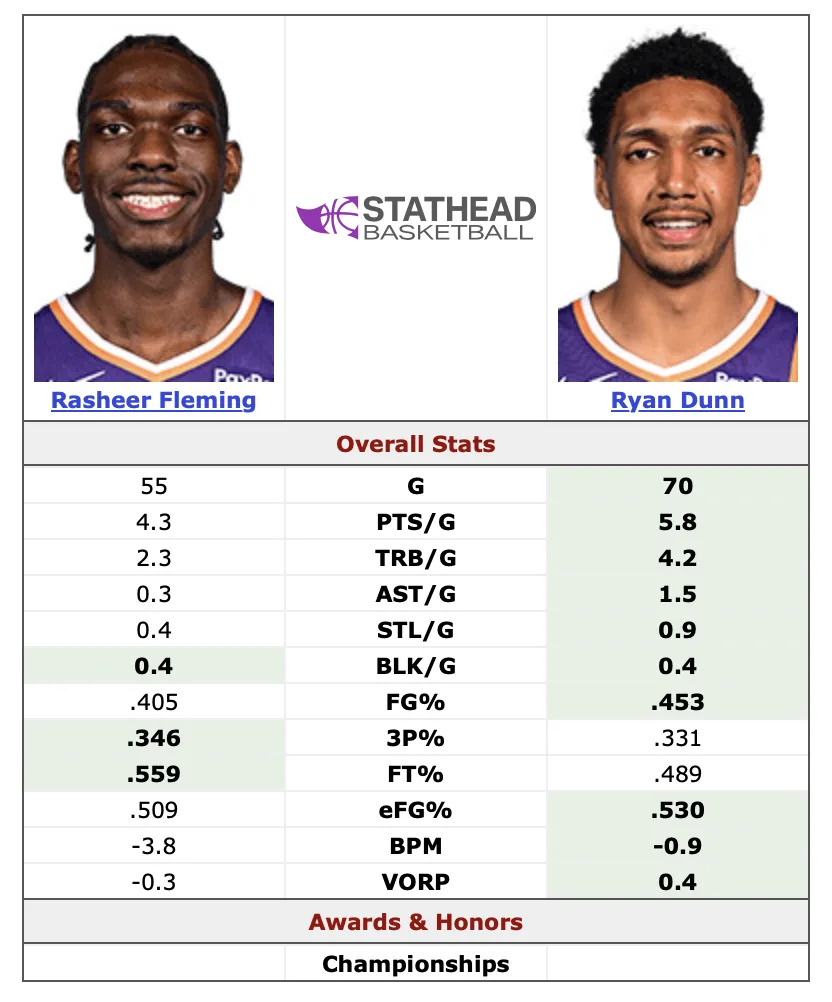
I’ve heard it said online that Ryan Dunn regressed last year, but the stats paint a different picture. Dunn trended up in his shooting percentage, including the all-important three-point shooting percentage, which lifted to 33.1 in 25/26, up from 31.1 in 24/25. He improved his production in rebounds, steals, and assists, and he played slightly more minutes than he had for Budenholzer and the KD Suns. Still, the overwhelming sentiment in the fanbase seems to be one of skepticism about speculating on Ryan Dunn’s potential. Shiny new forwards have caught their attention, and a lot of the positives Dunn brought to the team last year, that earned him playoff minutes over Fleming, are easy to overlook.
I think the disconnect between the production and the fan’s opinion of the production comes from the expectations of the role Dunn would have coming into last season and the role he ended up playing. Dunn started 44 of the 74 games he played for the KD Suns. He only started 16 of the 70 games he played under Jordan Ott, who willingly sacrificed defense for the sharp shooting and reliability of the veteran Royce O’neale. Eight of those sixteen starts came in the first 8 games of the season. Ryan Dunn was only able to hit more than one three in 2 of those first 8 games and Jordan Ott quickly moved on from Dunn being a regular in the starting lineup.

Dunn, however, had more of an impact off the bench than I feel he gets credit for from the fanbase. Content creators and the Twitterati are put off by Dunn’s defense, which was supposed to be his NBA-ready skill. Dunn hasn’t been the stifling point of attack defender fans were expecting. He should be given his frame and athleticism, but he seems to struggle predicting where offensive players will go and staying in position to get a good contest when defending ball handlers; as a member of a team defense, Ryan Dunn makes the defense better.
Ryan Dunn was on 6/10 of the top steals-producing lineups for the Suns last year. He also lifts the team’s rebounding. The Suns had six lineups with positive total rebounding last season, and Ryan Dunn was on four of them. When sorting the Suns lineups by plus-minus, Ryan Dunn appears on 6/10 of those five-man combinations.
These aren’t coincidences. The Suns played better in key areas when Ryan Dunn was in the lineup, which is why I’m not chicken-littling Dunn’s defensive impact. The questions about Dunn’s game as a prospect remain the same questions about Dunn’s game going into his third season for the Suns. What can he consistently contribute on the offensive end in terms of the corner three, his handles going to the rim, and limiting turnovers, and how does he compare in those areas to his competition?

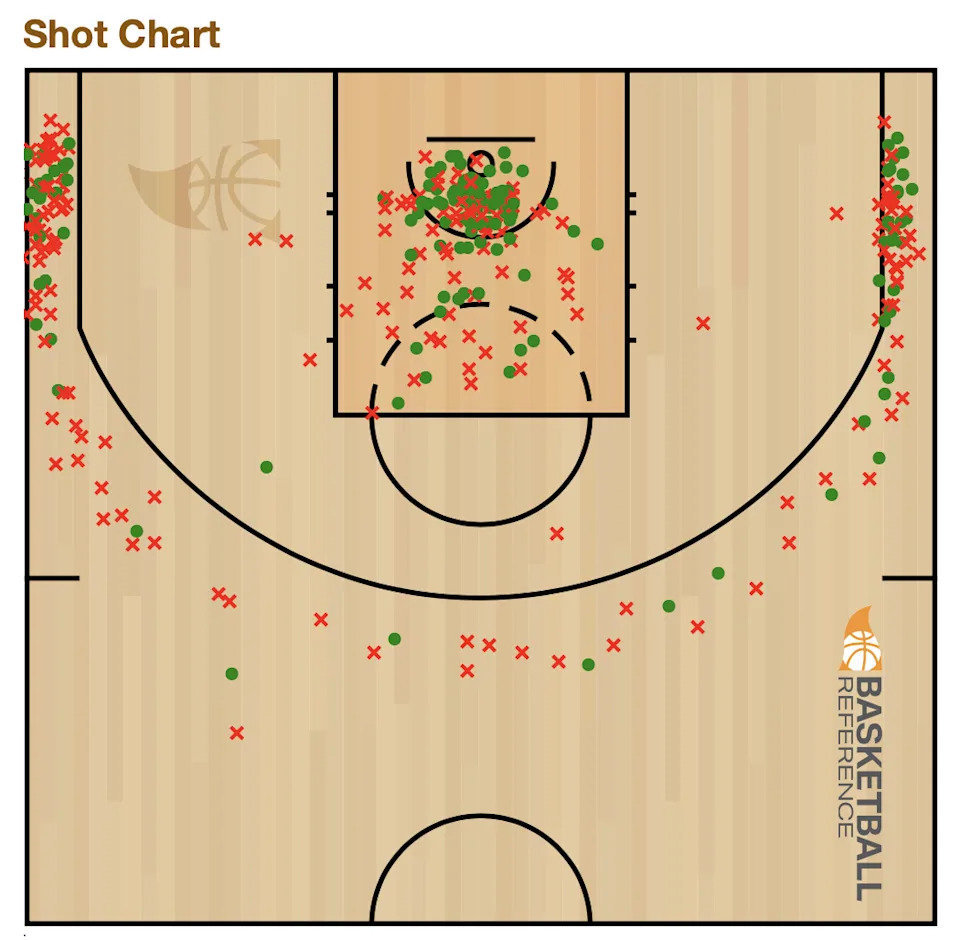
Ryan Dunn’s three-point shot is trending up, which is what the Suns needed to see when evaluating the progress of his development. Ryan Dunn’s viability as a rotational player on an NBA team centers around him pushing that three-point percentage over the 35% mark this season. Rasheer Fleming shot 34% from three-point range and, in limited opportunity, knocked down 45 three-pointers. Ryan Dunn knocked down 56. If Dunn can’t do more with his opportunities this season, he will lose them to Rasheer.
Dunn can’t be a worse three-point shooter than Rasheer if he wants to maintain his 19 minutes a game, but he doesn’t need to be significantly better and likely comes out ahead in the event of a draw because Ryan Dunn has some offensive versatility that Rasheer doesn’t.
Rasheer has a promising three-point shot, and we are all salivating as we project his defensive impact, but Sheer is quite honestly a statue on offense. His contribution is spacing the floor with the corner three. He’s not a solid playmaker; he doesn’t seem entirely comfortable with knowing where to go with the ball, and he can’t put it on the floor in an NBA game. Ryan Dunn has flashed that he can.
I trust there will come a day when Rasheer will get the ball in the corner, pump fake the contest, put the ball on the bounce, and finish through contact at the rim, but that day will not come this next season if it comes at all. Ryan Dunn could separate himself from Rasheer by improving his handles and decision-making on the perimeter. Including lowering the amount of turnovers he commits, which went up last year.

Ryan Dunn has juice when he’s going to the rim. He makes great cuts and is looking for any opportunity to take flight for a monster dunk. Last season Ryan Dunn took 121 runs at the rim and finished 82 of them. Of those shots at the rim, 56%of them were assisted. Compare that to Rasheer, who went 34/60 at the rim on 73.5% assisted, and you can maybe start to understand what Jordan Ott saw in Ryan Dunn’s game that he didn’t see in Sheer’s when he decided to give Dunn the nod over Fleming at the end of the season. Could Dunn further separate himself by being a guy who can attack the rim when he gets the ball and all the defenders run to find a shooter to hug?
Last season Dunn got to the free throw line 49 times and only converted 23 of them, and while that isn’t a big part of Rasheer’s offensive bag, Koa Peat won’t be in the G League forever, and that projects to be a huge feature in his game. This is where it gets really tricky for Dunn.
If Fleming finishes the season in front of Dunn in terms of minutes played, Dunn begins next season, or maybe even the back half of this season, battling for the leftover backup forward minutes with Koa Peat. Who are the Suns more likely to view as the player with the brighter future? Ryan Dunn, who lost out to Rasheer Fleming and is now 24 going into his 4th year on the team, or a 20-year-old Koa Peat, who could have been a lottery pick, in his first year out of the G-League?
It’s now or never for Ryan Dunn. If it’s not already too late. Fans were initially surprised that Ryan Dunn didn’t participate in the summer league. I don’t think it was completely shocking given there aren’t many third-year players playing, but you do wonder if it was more about how it would affect the perception of Ryan Dunn to potential trade partners if he showed up on the summer league roster than whether or not he still needs extra reps on his three-point shot.
Ryan Dunn still has a chance to be a part of the Suns’ solution going forward but it’s going to depend on the development of his shot and ability to drive to the basket that will separate him from the competition pooling up behind him. The runway to get this done is shrinking. It’s a different team than the one he was drafted to play with; no one could have known how quickly that situation would implode when Dunn was drafted. The Suns are moving on, and if Ryan Dunn doesn’t claim his spot now, it’s unlikely there’ll be a spot for him going forward.
Will Ryan Dunn take that next step on offense next year? Let me know what you think in the comments.
Read the full article here


