

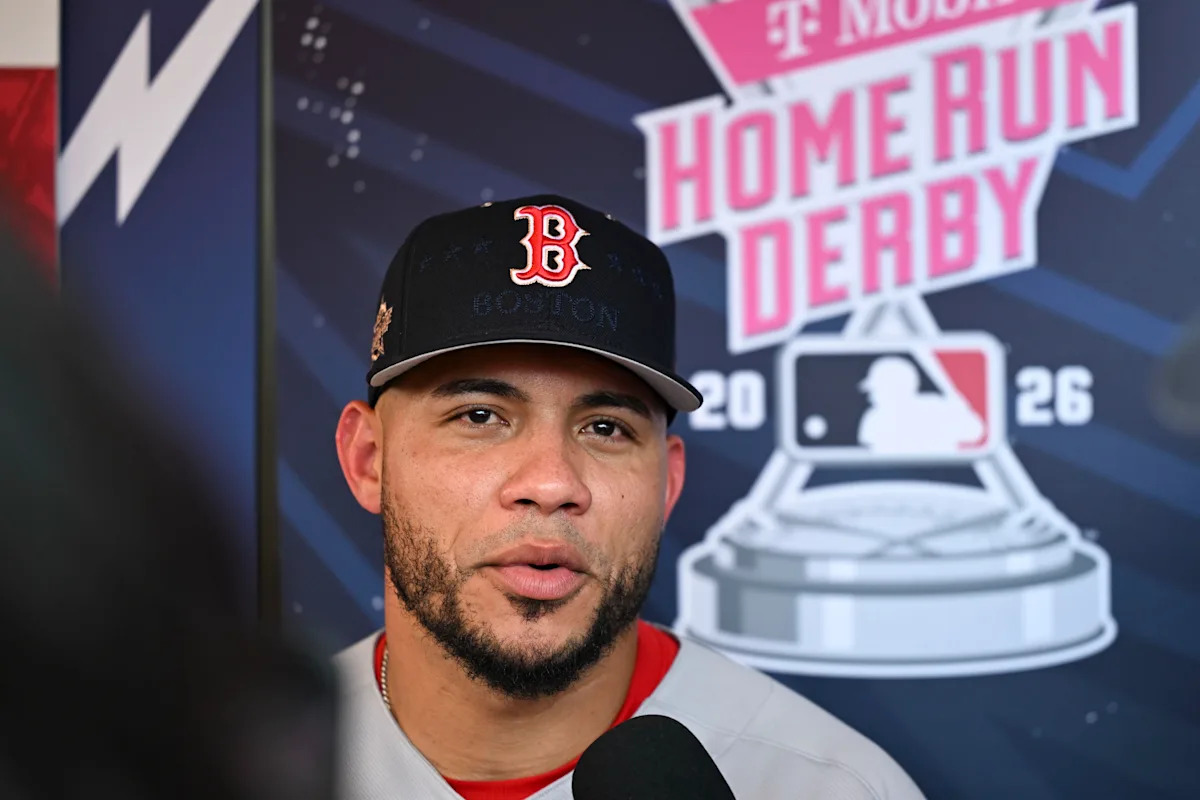
At its core, the Home Run Derby is a vibes event. Eight large men try to hit a baseball extremely far, we “ooooh and ahhhh” at the majestic dingers. You do not need Statcast to enjoy it. That said, the past few years there has been an alternative Statcast broadcast to focus on bat speed, launch angle, barrel rates and so much more. So, I decided to fill the void and create a Statcast preview of tonight’s long ball festivities in Philadelphia.
Cubs fans in particular have some old friends to cheer for tonight. Kyle Schwarber will look to avenge his 2018 Home Run Derby appearance when Bryce Harper (also in tonight’s field) just edged him out on some, shall we say questionable batting practice pitches given the timing rules. Schwarber already has an MLB leading 32 home runs on the 2026 campaign and this will be his third Home Run Derby appearance. He’ll be up against another 2016 Cubs hero, Willson Contreras. Contreras is having one of the best offensive seasons of his career in Boston slashing .285/.379/.542 with 20 home runs so far in the 2026 campaign.
But today I want to dig a little deeper than hometown legends and slash lines to see who has the edge in a stacked Derby field that will see Schwarber and Contreras joined by the Rays Junior Caminero (second appearance), Harper (third appearance), the Cardinals Jordan Walker (first appearance), the White Sox’ Munetaka Murakami (first appearance), the Royals Jac Caglianone (first appearance) and the Yankees Ben Rice (first appearance). It does seem worth caveating that Murakami stands out among the first-timers with 246 career home runs in NPB before joining the White Sox this season. But that’s besides the point, there will be bombs in Philadelphia tonight and Statcast can tell us a bit about who has the edge in different categories.
The bat-speed monsters
Junior Caminero owns the field’s top average bat speed, with Jordan Walker sitting right behind him. You can see how the field stacks up in terms of average bat speed below:
|
Player |
Competitve Swings |
% Competitive Swings |
Raw Contact # |
Avg Bat Speed |
MLB Bat Speed Rank |
% Fast Swing |
% Squared Up Contact |
% Squared Up Swing |
% Blast Contact |
% Blast Swing |
|---|---|---|---|---|---|---|---|---|---|---|
|
Caminero, Junior |
594 |
91.10% |
468 |
79.9 |
1 |
88.22% |
30.98% |
24.41% |
25.64% |
20.20% |
|
Walker, Jordan |
652 |
90.30% |
470 |
79.2 |
2 |
86.04% |
30.21% |
21.78% |
23.19% |
16.72% |
|
Caglianone, Jac |
607 |
90.33% |
433 |
77.3 |
7 |
75.12% |
30.02% |
21.42% |
23.33% |
16.64% |
|
Schwarber, Kyle |
697 |
90.17% |
483 |
77.1 |
9 |
75.61% |
24.22% |
16.79% |
17.18% |
11.91% |
|
Contreras, Willson |
615 |
90.31% |
446 |
77.0 |
10 |
70.89% |
26.23% |
19.02% |
17.26% |
12.52% |
|
Murakami, Munetaka |
421 |
90.15% |
247 |
75.2 |
26 |
55.34% |
33.60% |
19.71% |
23.48% |
13.78% |
|
Harper, Bryce |
725 |
90.29% |
512 |
74.3 |
54 |
47.86% |
30.27% |
21.38% |
17.19% |
12.14% |
|
Rice, Ben |
595 |
90.56% |
470 |
72.6 |
91 |
24.03% |
36.60% |
28.91% |
19.15% |
15.13% |
Walker and Caminero are both in the 100th-percentile bat-speed leaguewide. Caglianone is right behind them at the 97th percentile with Schwarber and Contreras both in the 96th percentile. Bat speed isn’t everything, but in a competition aimed at hitting home runs, having a quick swing can certainly be a difference maker. It also probably helps on the endurance side of the derby to have experience swinging hard most of the time, which Caminero, Walker, Caglianone, Schwarber, Contreras and Murakami all do (although there is a big difference between taking a maximum swing 55.34% of the time vs. 88.22% of the time).
PLAKATA!
Then there is the question of how frequently these players hit a blast, or as Marquee Sports Network’s Carlos Peña might say, “PLAKATA!” Blast is Statcast’s metric for a ball where there was a fast swing and squared up contact:
During the 2024 season, 10% of competitive swings and 27% of batted balls across the Major Leagues qualified as blasts.
The value for hitters on blasts vs. non-blasts was about as large as you can get.
Blasts (i.e., squared-up contact with a high swing speed)
.563 BA // 1.182 SLG // .727 wOBA
103.5 mph exit velocity // 99.9% hard-hit rate // 28% barrel rate
+34 run value per 100 pitches
Non-blast batted balls
.231 BA // .295 SLG // .225 wOBA
84.1 mph exit velocity // 17% hard-hit rate // 0.7% barrel rate
-5 run value per 100 pitches
Obviously the Home Run Derby is batting practice, so there’s less pressure to hit, say, a Hunter Greene 100 MPH fastball as a blast. However, it does seem intuitive that having a higher blast rate in a game situation would likely translate to a better ability to hit blasts in a practice situation. I resorted the above table by % Blast by Swing and Caminero is still number one in MLB, followed by Walker at nine, Caglianone at 10, Rice at 25, Murakami at 39, Contreras at 57, Harper at 65 and Schwarber at 73.
A Barrel of Dingers
Blasts aren’t the only way to measure elite contact, though. Part of the Home Run Derby game is elevating the ball and squaring up contact. The way to measure that is Statcast’s barrel rate. As a reminder, barrels are defined by MLB as:
The Barrel classification is assigned to batted-ball events whose comparable hit types (in terms of exit velocity and launch angle) have led to a minimum .500 batting average and 1.500 slugging percentage since Statcast was implemented Major League wide in 2015.
But similar to how Quality Starts have generally yielded a mean ERA much lower than the baseline of 4.50, the average Barrel has produced a batting mark and a slugging percentage significantly higher than .500 and 1.500, respectively. During the 2016 regular season, balls assigned the Barreled classification had a batting average of .822 and a 2.386 slugging percentage.
To be Barreled, a batted ball requires an exit velocity of at least 98 mph. At that speed, balls struck with a launch angle between 26-30 degrees always garner Barreled classification. For every mph over 98, the range of launch angles expands.
Below you can see the Home Run Derby contestants sorted by barrel rate, including their MLB rank by barrel rate in the final column:
|
Player name |
Attempts |
Launch Angle |
Max EV |
Avg EV |
Max Distance |
Avg Distance |
Avg HR Distance |
Barrels |
Barrel Rate |
Barrel/PA |
MLB Rank |
|---|---|---|---|---|---|---|---|---|---|---|---|
|
Murakami, Munetaka |
125 |
14 |
114.1 |
94.1 |
451 |
189 |
409 |
25 |
20.0 |
9.7 |
3 |
|
Schwarber, Kyle |
207 |
21.8 |
113.2 |
93.4 |
460 |
210 |
404 |
40 |
19.3 |
9.7 |
5 |
|
Rice, Ben |
248 |
14.2 |
110.9 |
92.1 |
433 |
184 |
389 |
38 |
15.3 |
9.7 |
21 |
|
Caglianone, Jac |
218 |
7.3 |
116.1 |
93 |
444 |
164 |
414 |
32 |
14.7 |
9.2 |
26 |
|
Contreras, Willson |
225 |
17.4 |
114.4 |
90.6 |
449 |
176 |
407 |
32 |
14.2 |
8.8 |
31 |
|
Walker, Jordan |
262 |
11.5 |
116.6 |
94.2 |
459 |
173 |
406 |
37 |
14.1 |
9.4 |
32 |
|
Caminero, Junior |
279 |
8.7 |
116.9 |
93.2 |
463 |
147 |
408 |
38 |
13.6 |
9.2 |
36 |
|
Harper, Bryce |
266 |
11.6 |
113.5 |
90.1 |
457 |
171 |
400 |
30 |
11.3 |
7.4 |
66 |
By this metric, Murakami and Schwarber rise to the top of the field, with Rice, Caglianone, Contreras, Walker and Caminero all squarely in the 85th percentile and above in all of baseball. If the name of the game is hitting the ball hard, in the air, it would seem that Murakami and Schwarber may be the favorites to come out on top of a stacked field.
Wild Cards
That said, baseball is always going to baseball so I’m sure some elements of our expectations will be tested. The two biggest wild cards in this year’s Home Run Derby are the changes to the format and the pitchers throwing batting practice.
The format this year will not have a timer and players will get a finite number of swings, per MLB:
Eight players will still make up the field, same as in years past. But instead of trying to hit as many homers as they can during timed rounds, participants will start each round with a finite number of swings: 20 in Round 1, 15 in Round 2 and 15 again in the final round.
All swings will count against a player’s swing allotment, whether it results in a homer or not. However, a player who homers on his final swing of a round can keep swinging until he doesn’t hit one out.
The lack of a timer could alleviate some of the endurance issues that have haunted players who hit a large number of home runs early, or found themselves in a tie in the early rounds, only to fade later. It also means you have to be prepared to rake, right away.
Finally, one of the biggest variables in the Derby has always been having a pitcher who can throw you balls in your personal sweet spot over and over again. One of the reasons Pete Alonso was so excellent in his Home Run Derby appearances (aside from being built for the event and prodigious power) was Dave Jauss doing an excellent job throwing to him. You can hear Jauss talk about that below:
View Link
As Jay Jaffe at FanGraphs noted, having Jauss throw batting practice to the perfect human specimen for Derby multiple times was probably at least part of the reason for Alonso’s success in the Derby:
As I noted last year, the 6-foot-3, 245-pound Alonso seems built for this competition, stepping into the box looking loose and operating at maximum efficiency in an event where efficiency is underappreciated. Some credit for that is almost certainly owed to Mets bench coach Dave Jauss, his pitcher, who consistently puts the ball in his wheelhouse. Alonso always appears to understand exactly what he needs to do to win, whereas others step into the box thinking, “I’ll try Plan A, and if that doesn’t work, I’ll try Plan B…” by which point it’s too late, at least in this unforgiving draw. In both the semifinals and finals last year, Alonso needed far less than the allotted time to win.
Whatever transpires in Philadelphia tonight, I expect there will be a lot of joy and spectacle. Whether your turn of phrase as the ball sails over the fence is BOOMSTICK!, PLAKATA!, BOMBSKI!, or some other moniker, it should be an awesome show to remember tonight at Citizens Bank Park.
There will be a “game thread” here for the Home Run Derby. It will post at 6 p.m. CT and the event begins at 7 p.m. CT.
Read the full article here