

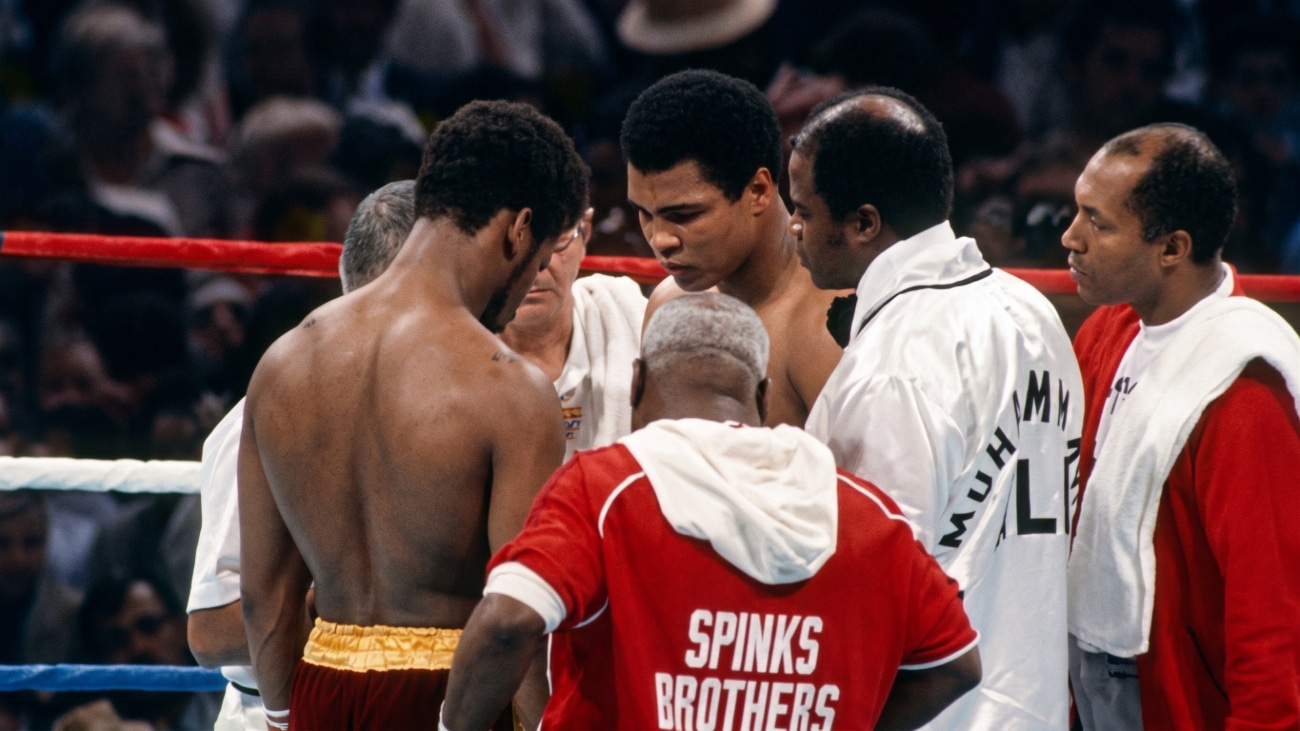

Spinks had defeated an underprepared Ali in Las Vegas despite having only seven professional fights. Ali treated the rematch as his final championship stand. Spinks handled his sudden fame much differently.
The 25-year-old champion missed training time, disappeared from camp, and surrounded himself with an oversized entourage. His corner became divided by competing advisers. The disorganization reached an almost comical level when his team forgot basic supplies on fight day.
Spinks had youth, stamina, and confidence. Ali had discipline. That difference decided the “Battle of New Orleans” before either man reached the ring.
Ali Turns Holding Into A Weapon
Ali knew he could no longer dance continuously for 15 rounds. His solution was to fight in short tactical sequences.
He jabbed, landed the occasional right hand, stepped away, and clinched Spinks before the champion could plant his feet. Ali frequently controlled the back of Spinks’s head, forcing the younger fighter to restart after every break.
Referee Lucien Joubert penalized Ali in the fifth round for excessive holding, but the deduction revealed how central clinching was to the plan. Ali was not merely resting. He was breaking Spinks’s rhythm and preventing him from using the relentless combinations that had won their first fight.
Spinks kept advancing without cutting off the ring. His aggression became predictable. Instead of making Ali work at a punishing pace, he followed him and accepted repeated resets.
Ali’s old speed surfaced only in flashes, but he no longer needed to dominate every second. He controlled where the exchanges occurred and how long they lasted.
The judges scored the fight 10-4, 11-4, and 10-4 for Ali.
The championship picture carried an irony that became clearer with time. The WBC had stripped Spinks after he chose the richer Ali rematch instead of facing Ken Norton.
Norton received the WBC title before losing it to Larry Holmes in June 1978. By the time Ali reclaimed the WBA crown, Holmes already held the other major belt and represented the division’s future.
Ali had secured his historic third championship, but he was no longer the best heavyweight in the world. The throne had split between boxing’s greatest star and the younger fighter destined to succeed him.
A Perfect Ending That Did Not Last
The ABC broadcast reached an enormous prime-time audience, with Howard Cosell calling the action. The record indoor crowd, celebrity attendance, and multimillion-dollar gate turned Ali’s victory into a global cultural event.
Ali formally retired in June 1979, giving boxing what looked like a perfect conclusion. He had avenged his loss, regained his championship and left with history secured.
His later returns against Holmes and Trevor Berbick damaged that ending. Still, New Orleans remains the final championship performance of a diminished master who understood exactly what he had left and used every bit of it.
Read the full article here