






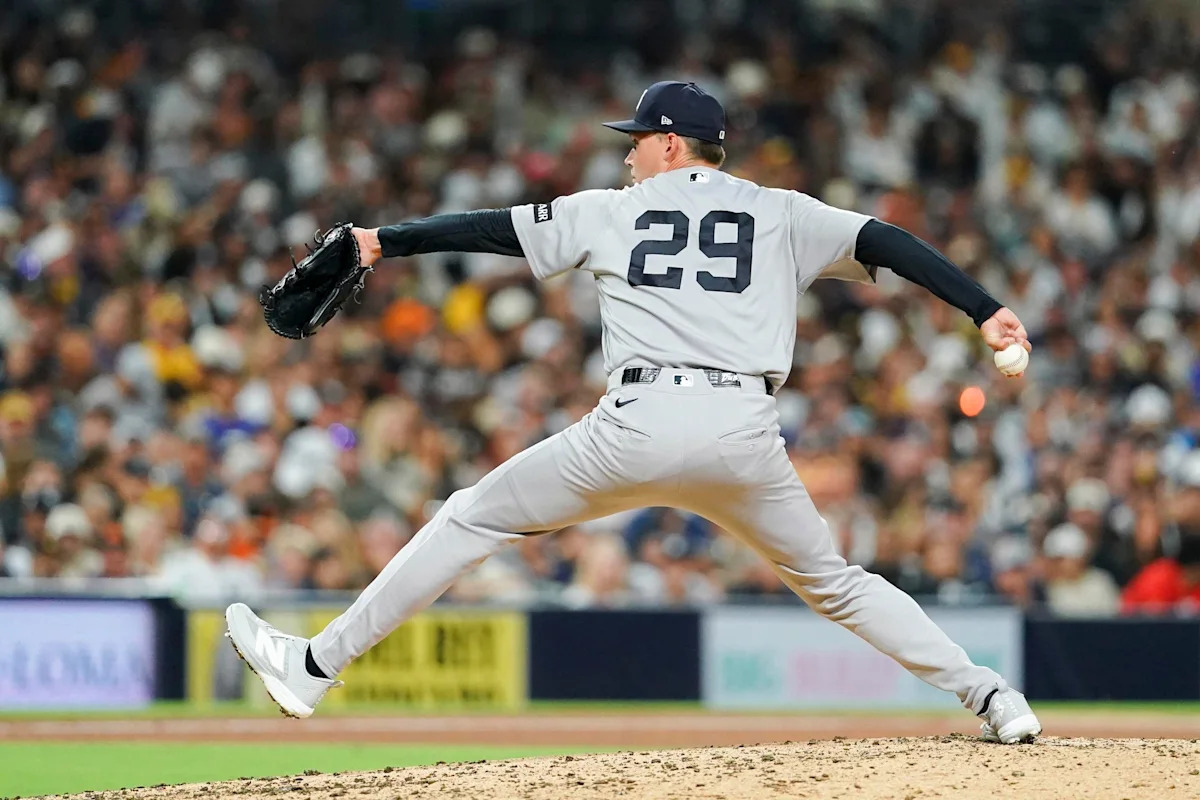
Aaron Judge is back and (almost) all is well with the world. However, our focus today is not the offense but on the pitching side of things. Specifically, a sequence from Will Warren pitching in perhaps his impending role as a multi-inning reliever.
We join Warren with two outs in the sixth inning last Friday in San Diego. Max Fried has exceeded expectations to give the Yankees 5.2 innings of one-run ball on just 72 pitches in his second start back from his most recent elbow bone bruise IL stint. The score is tied, 1-1, Ben Rice answering Xander Bogaerts’ RBI single with a solo home run in the third. Warren is called on for just his second relief appearance of the year, and it gets off to an inauspicious start with Warren walking Ty France on four straight fastballs that were miles from the zone.
That brings the once-dangerous Jackson Merrill to the plate, the 2024 NL Rookie of the Year runner-up having regressed significantly with each subsequent year in the bigs. Nonetheless, it’s a nightmare scenario for Warren, who struggles mightily facing lefties and pitching out of the stretch.
Warren has to get ahead of Merrill, if only to fully turn the page on the four errant fastballs he sprayed against France.
View Link
Austin Wells sets a target low and away, but Warren misses his spot and ends up hoofing this 94 mph four-seamer pretty much right down the middle. He’s lucky that Merrill left the bat on his shoulder, perhaps hunting a get-me-over breaking pitch after watching Warren walk France.
The benefit of establishing the fastball for a called strike early on is it should generate chase potential on breaking and off-speed pitches below the zone. That is exactly Wells’ thinking here as he calls for a changeup off the plate low and away.
View Link
Once again, Warren yanks this pitch inside, missing his target by almost two feet. At no point during its flight does this changeup look like a strike, making for a very simple take from Merrill.
So far both of Warren’s misses have been to the glove side, his release point on both the four-seamer and changeup a fraction late. Regardless, Wells calls for another changeup — a pitch Merrill has struggled to hit from righties the last two seasons.
View Link
That’s three pitches and three badly missed locations. Warren leaves this changeup up — fortunately for him the tailing movement that carries the pitch off the plate away is enough to keep the ball off Merrill’s barrel.
Somewhat serendipitously, Warren finds himself ahead in the count, 1-2. If there is one pitch Merrill has always been able to hit, it’s the curveball, and he likely knows Warren’s tendency to throw them way more against lefties. The trick with a pitch you know the hitter is hunting is to throw it far enough away from the zone that it’s impossible to do damage, but still close enough to entice him to swing.
View Link
The process here is sound but the execution was not. This curveball is simply not close enough to the zone to extract a chase from Merrill.
After three straight slower secondaries, Warren feels the time is right for one of his trademark sinkers thrown to the glove-side edge of the plate. His sinker can exhibit in excess of a foot-and-a-half of tailing arm-side movement, which is how he has at times proven adept at that called strike three looking front door against lefties and back door against righties.
View Link
I count this as the third pulled pitch by Warren in this AB, his release point still not quite right. Just like the 0-1 changeup he threw, this sinker looks like a ball for the duration of its flight toward home which means another straightforward take from Merrill.
Warren has squandered the count leverage he possessed with two non-competitive two-strike pitches, and now he faces a full count. It’s good to see that he doesn’t immediately give in and groove a fastball, and instead continues to hunt the strikeout with a back-foot sweeper.
View Link
Merrill is a hair early with his swing and tops it foul. This is probably the best executed pitch of the bunch, and even then it could have been better. Even though it lands on the corner down and in, it’s a dangerous pitch to throw a lefty looking to pull the ball — ideally you would like to get it a little lower and a little farther inside. Even in a 3-2 count, Warren gets so much movement on his sweeper that there’s a good chance the batter will chase, and if not, a walk is better than a two-run homer.
After finally showing Merrill a pitch that breaks toward him, Warren immediately switches back to the changeup that fades away. If he can throw it down a similar tunnel as the sweeper he just threw, he’ll have a good chance at the strikeout swinging, even on a pitch out of the zone away.
View Link
Make that four pitches that Warren has yanked. As a righty, you generally do not want to throw a changeup down and in to a lefty because the movement of the pitch runs it directly into the sweet spot of the barrel. Luckily for Warren, Merrill has yet to show that he can adjust his swing path low enough to do anything other than foul off these secondary pitches down and in.
It seems like Warren gets fed up with trying and failing to execute one of his secondaries, because he decides to throw his four-seamer as hard as he can by the hitter.
View Link
This pitch comes right down the pipe, but once again Merrill’s swing path only allows him to strike the top of the baseball. George Lombard Jr. is perfectly positioned to gobble up the grounder up the middle and fire to first to end the inning. I have long maintained that Warren is far too cavalier with his fastball in the zone, particularly with two strikes. At 92-94 it’s just not a good enough pitch to groove to big league hitters. However, as his fastest pitch of the day at 97 mph, that added velo creates a little more margin for error.
Here’s the full sequence:
View Link
Courtesy of Baseball Savant
This is certainly an outlier for Sequence of the Week in that none of the pitches Warren threw were particularly well executed. I also normally do not select ABs or sequences from losing efforts, but this one stood out because of the broader context of the Yankees’ pitching situation. If everything goes according to plan, Warren will not be pitching in the rotation come the postseason. Therefore, this AB and his relief outing as a whole can serve as a proof of concept for Warren’s deployment out of the bullpen if and when all of their starters are fully healthy and built up.
There are still a lot of rough edges to the second-year pitcher’s game — case in point, he gets to a 1-2 count with relative ease, but then required another five pitches to retire Merrill after consecutive put-away pitches landed nowhere close to the zone. I’m sure many are also understandably still scarred from the six runs he gave up in 4.2 innings of relief in Game 2 of the 2025 ALDS against the Blue Jays. However, I feel that this AB showcases the way his stuff can play up when he pitches at max effort in shorter bursts as a reliever rather than have to conserve energy and save bullets to make it through a start. If nothing else, the mistakes he makes in the zone with his fastball are less apt to get punished. The secondary pitches in his arsenal are too good to get such pedestrian results, and I think those pitches could see an uptick in whiff and chase when thrown off a higher velocity heater in relief.
Read the full article here


