





By some measures, no major-league team was more impacted by injuries last season than the Houston Astros. Star slugger Yordan Alvarez was limited to just 48 games due to a recurring hand injury. Infielder Isaac Paredes missed two months with a hamstring strain. Closer Josh Hader had a season-ending shoulder injury in August. Ronel Blanco and Spencer Arrighetti, who combined to make 57 starts in 2024, made just 18 in 2025, with Blanco undergoing season-ending elbow surgery in May. Cristian Javier, another rotation mainstay, only made eight starts down the stretch after returning from his own elbow procedure.
It’s reasonable to suggest that that unrelenting rash of ailments cost Houston a trip to the postseason, marking its first October miss since 2016. The Astros still managed to finish with the same record (87-75) as the wild-card bound Detroit Tigers, but lost out on a playoff spot due to a tiebreaker. Had even one or two of their key players remained available, it’s hard to imagine their impressive streak of playing October baseball would have been snapped. But it wasn’t to be, sending Houston into its longest offseason in years.
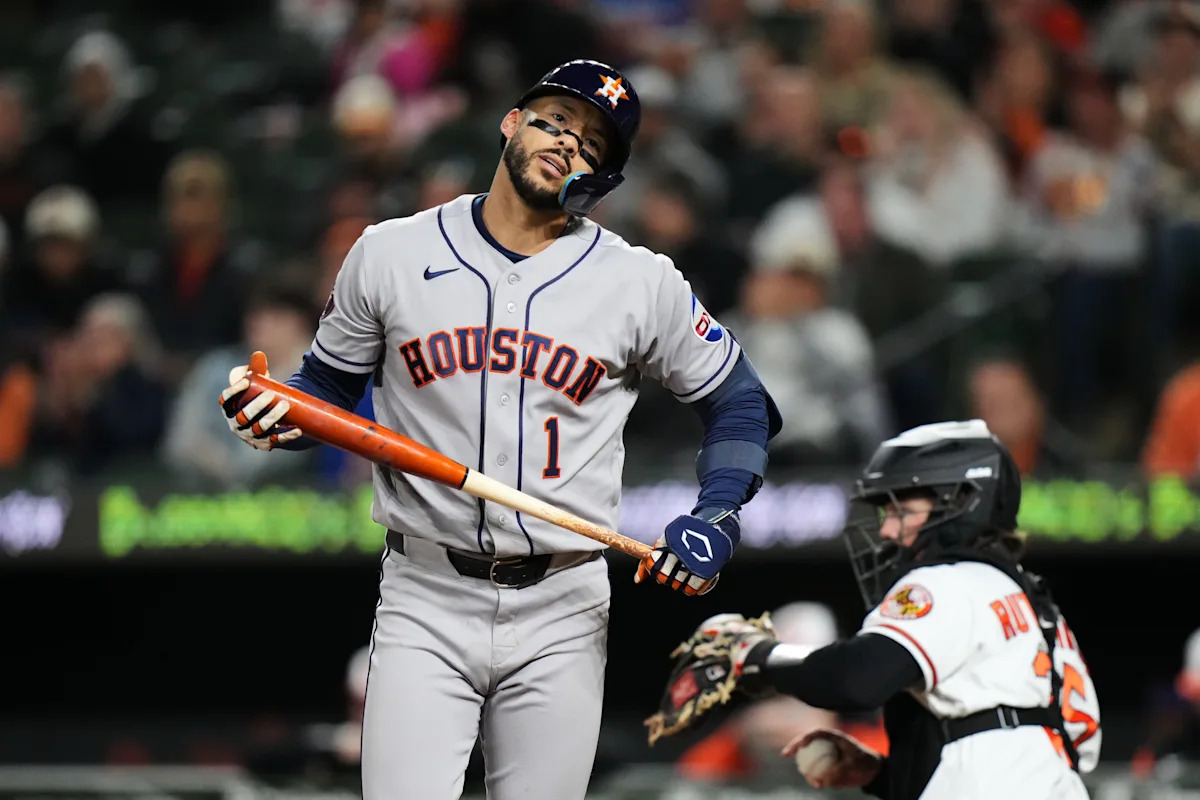
Entering 2026, it was natural for the Astros to lean on the hopeful sentiment that they couldn’t possibly be so injury-ravaged for a second consecutive year, and that they still had enough high-end talent to return to October. Yet here we are, barely into May, and Houston finds itself dealing with a new wave of injuries threatening to derail another season. Its latest gut punch: infielder Carlos Correa, done for the year after suffering a left ankle injury during batting practice that will require season-ending surgery.
Despite a notoriously checkered history of durability of his own — including a surgically repaired right ankle that caused agreements with both the Mets and Giants to fall through in free agency — Correa had been dependable since returning to Houston last summer via a shocking deadline swap with Minnesota. Correa started 51 of the Astros’ final 53 games last season, and 32 of the first 36 games this year in the Houston infield, making his first appearances at third base while also covering at his native shortstop while starter Jeremy Peña dealt with his own injuries. And while he hasn’t slugged at a high level since rejoining the Astros, Correa’s advanced approach still impacted the lineup in a meaningful way: his .360 OBP ranks 11th among qualified AL hitters since last year’s trade deadline.
Now Correa is out, joining a litany of other crucial members of the Astros roster on the crowded injured list. Correa is the second member of the Astros starting lineup to hit the IL this week, joining catcher Yainer Diaz, who was shelved a day earlier due to a strained oblique. Even with infielder Nick Allen’s corresponding activation from a back injury, the Astros still have six different position players on the injured list, more than any other major-league team: Correa, Diaz, star shortstop Peña (hamstring), plus three outfielders, Joey Loperfido (quad), Jake Meyers (oblique), and Taylor Trammell (groin).
And then there’s the decimated pitching staff. Eight Astros hurlers remain on the pitching staff, including five on the 60-day IL (Blanco, Javier, Hader, Brandon Walter, Hayden Wesneski) plus three more on the 15-day (Hunter Brown, Tatsuya Imai, Nate Pearson). That brings Houston’s IL total to 14, tied with Detroit for the most in MLB. Imai, Houston’s marquee free agent addition and first in franchise history signed straight from Japan’s NPB, is expected back next week, though his poor form before being placed on the injured list (and in his rehab outings) don’t suggest he is about to change this rotation for the better right away.
Losing Brown, who finished third in AL Cy Young voting last season, was especially devastating. He landed on the IL with a Grade 2 shoulder strain after just two starts, and still isn’t expected back for at least another month. But Brown’s absence alone does not fully explain the complete disintegration on the mound that has taken place since he went down. Losing several other arms along the way, not to mention those like Hader and Pearson, who have yet to even make their season debuts, has made things difficult. But Houston historically — and most notably last year — has found pathways to competent run prevention regardless of the specific personnel involved. Yet this year, Astros arms have combined to rank last in nearly every statistical category on the mound.
Wednesday’s blowout defeat against the Dodgers marked the latest in a pattern of poor pitching performances that have plagued Houston all season long. Starter Lance McCullers Jr., after allowing six earned runs in 2 2/3 innings, said he lost part of his fingernail during the game and was unsure if he’d be able to make his next start. The Astros’ 12 runs surrendered to the Dodgers tied a season-high (which had already occurred twice), ballooning the team ERA to a woeful 5.82, nearly a full run worse than the 29th-ranked D-backs at 4.92. Free passes have been issued at an alarming rate, with the five walks allowed to the Dodgers on Wednesday raising Houston’s staggering season total to 201, miles ahead of the next-highest, Cincinnati at 173, and more than double that of the AL West rival Mariners (93).
Most frustrating is that Houston’s stunning decline on the mound has almost completely negated its strength on the other side of the ball, as the offense rates as one of the league’s best despite the injury bug impacting the lineup as well. It is this troubling trend that could prove far more daunting than the Astros’ upcoming challenge of replacing Correa. Peña reportedly could begin a rehab assignment as soon as this weekend, and Paredes — whose playing time has been sporadic while stuck on a crowded depth chart at full strength — can now handle third base full-time, which could form a solid left side of the infield even sans Correa. Meanwhile, Alvarez looks like an MVP candidate, and Christian Walker’s encouraging resurgence has elevated Houston’s offensive ceiling even further. Losing a player like Correa can not and should not be downplayed — and his absence will be felt especially off the field considering his unquestioned role as their clubhouse leader — but the Astros do have options to continue thriving offensively without him.
But if they can’t get things sorted out on the mound, their efforts at the plate will continue to be rendered moot.
Read the full article here


