

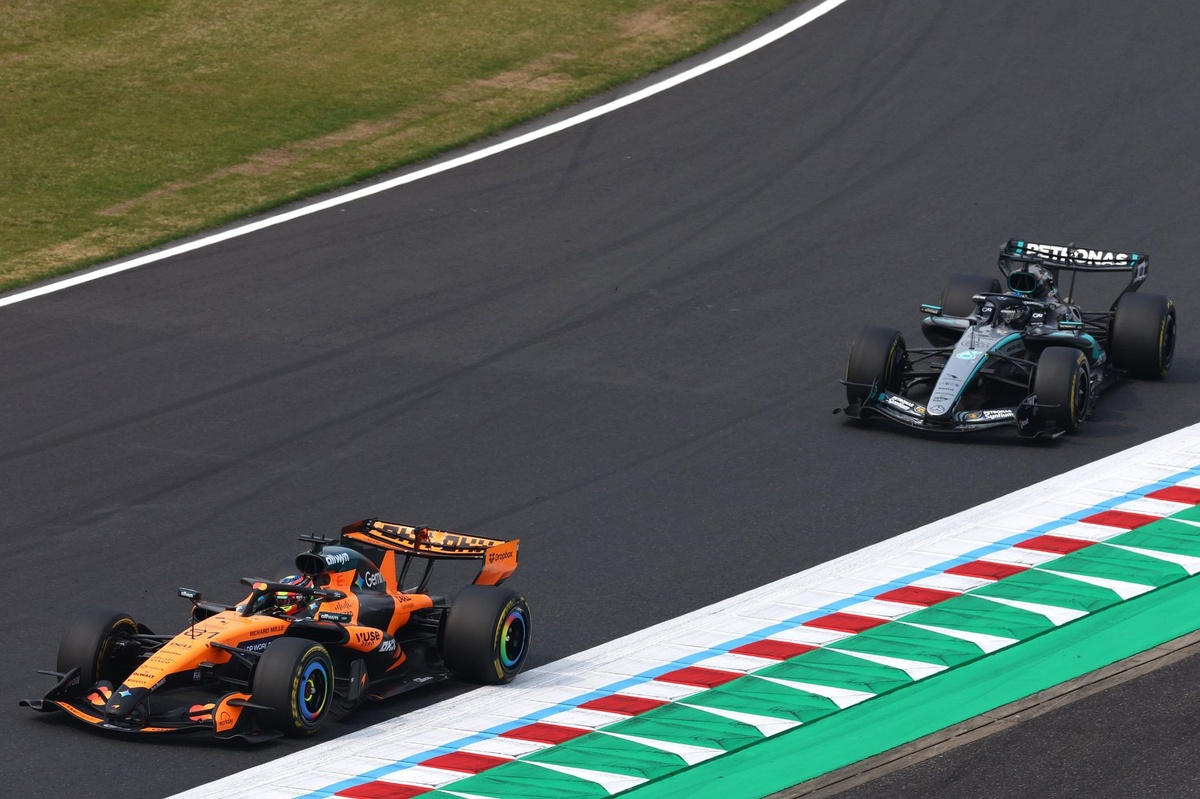
Times change quickly. In recent years, there had been extensive discussion about making the gearbox a standard component for all teams to reduce costs, as it was increasingly viewed as no longer being a decisive performance factor in Formula 1. Yet, with the 2026 regulation overhaul, the gearbox once again became a central aspect of car design.
The clearest example is the contrast between Mercedes and McLaren. Although the two teams share the same power unit, they exploit the Mercedes unit in noticeably different ways, creating differences not only in slow-speed sections but also on the straights.
McLaren designs and manufactures its own gearbox internally – not just the casing, but all of the internal components as well. The team has also made different choices regarding gear ratios, with the MCL40 running shorter gearing.
“I think there are definitely pros and cons with the ratios,” said McLaren team principal Andrea Stella during the Canadian Grand Prix weekend. “We are on the shorter side compared to Mercedes. This may give you some advantages in acceleration, for instance, possibly it may give you advantages in a start.”
This issue had already become apparent in the opening races of the season, but after five grands prix the picture is much clearer. The Woking team frequently showed stronger launches than Mercedes despite using the same power unit. This suggested that Mercedes’ difficulties could not be attributed to a single factor.
Just as choosing a larger or smaller turbocharger brings both benefits and drawbacks, different gearbox ratios also come with trade-offs. Given the characteristics of the current technical regulations, some teams, such as Mercedes and Red Bull, have opted for relatively long lower gears. This helps keep engine revs higher through slow corners and maximises battery recharging. Different gear ratios mean different engine speeds and different levels of stress on the engine, so they must be selected carefully.
Lando Norris, McLaren
Photo by: Alastair Staley / LAT Images via Getty Images
Shorter gear ratios, on the other hand, multiply torque at the driven wheels, improving acceleration off the line. This is especially beneficial in the initial phase of acceleration, before the MGU-K contributes and when the car relies solely on the internal combustion engine – provided the engineers have correctly judged the available grip to avoid excessive wheelspin.
However, the difference is not limited to race starts. It also affects acceleration throughout the lap. Data from the first five races reveals a recurring trend, also acknowledged by Stella: the shorter the straight, the more competitive the McLaren tends to be.
It is true that in the early rounds of the season McLaren was still learning how to fully exploit the Mercedes power unit, naturally lacking some of the knowledge possessed by the manufacturer that developed it. Nevertheless, this difference in approach remained evident not only in the opening races but also in the most recent events, where differing energy recovery limits provided a broader perspective.
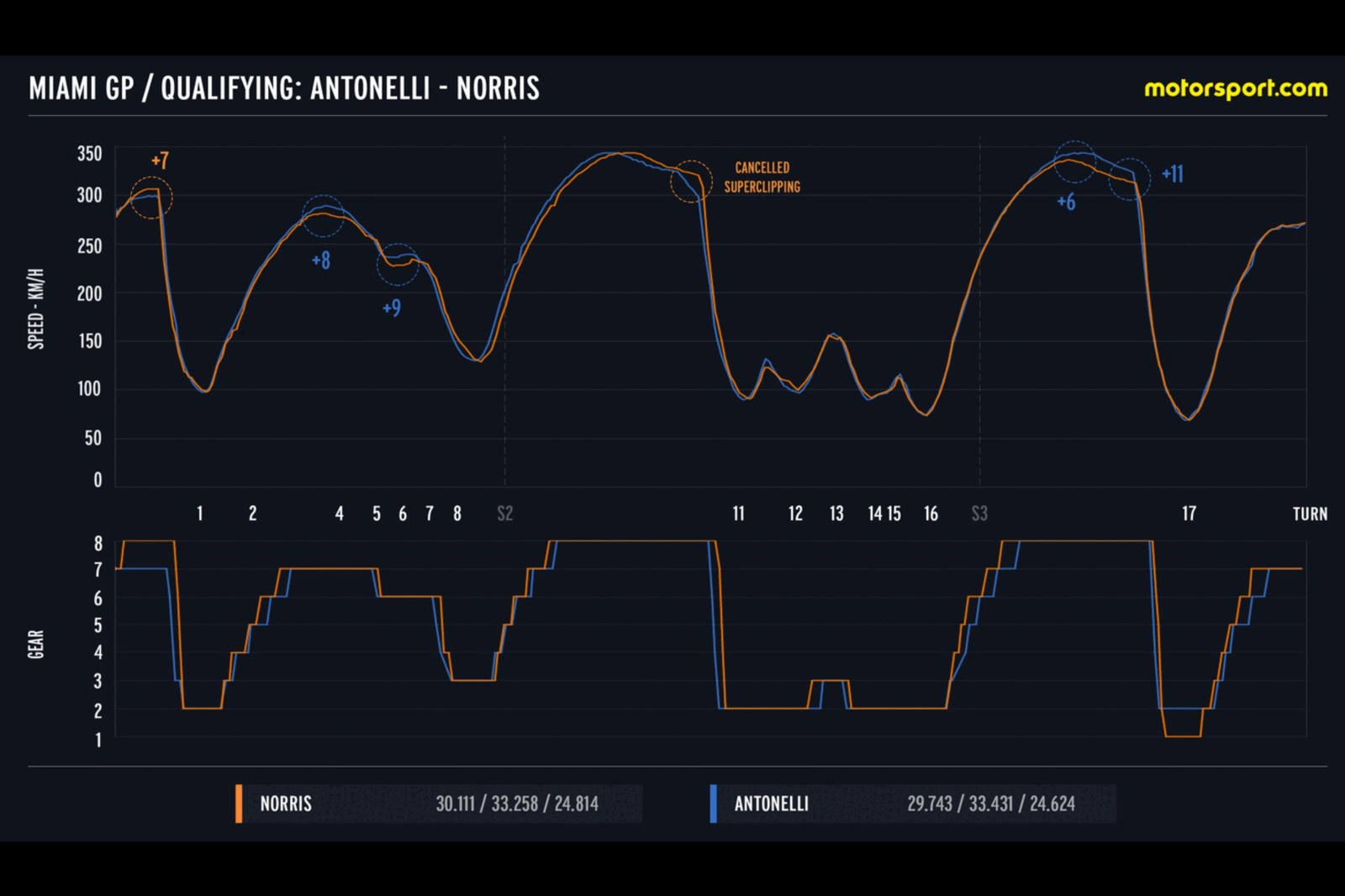
Miami and Montreal represented opposite extremes. In Miami, the FIA allowed up to 8 MJ of energy recovery in qualifying – the maximum permitted by the regulations. In Canada, the limit was reduced to just 6 MJ per lap, requiring much more careful and selective energy management. Looking at Miami, McLaren was able to stay with its rivals on the first straight, but the longer the straight continued, the more the MCL40 began to struggle.
Interestingly, this behaviour did not become apparent before Turn 11 in Saturday qualifying for a specific reason. After experiencing issues exiting Turn 16 in previous sessions, McLaren instructed its drivers to cancel superclipping before braking for Turn 11. This prevented the issue from recurring but also altered battery management strategy.
As a result, before the final braking zone at the end of the long straight, McLaren suffered both from its shorter eighth gear and from having already used a significant amount of its electrical energy elsewhere on the lap, resulting in a top-speed deficit of more than 10 km/h compared with Mercedes.
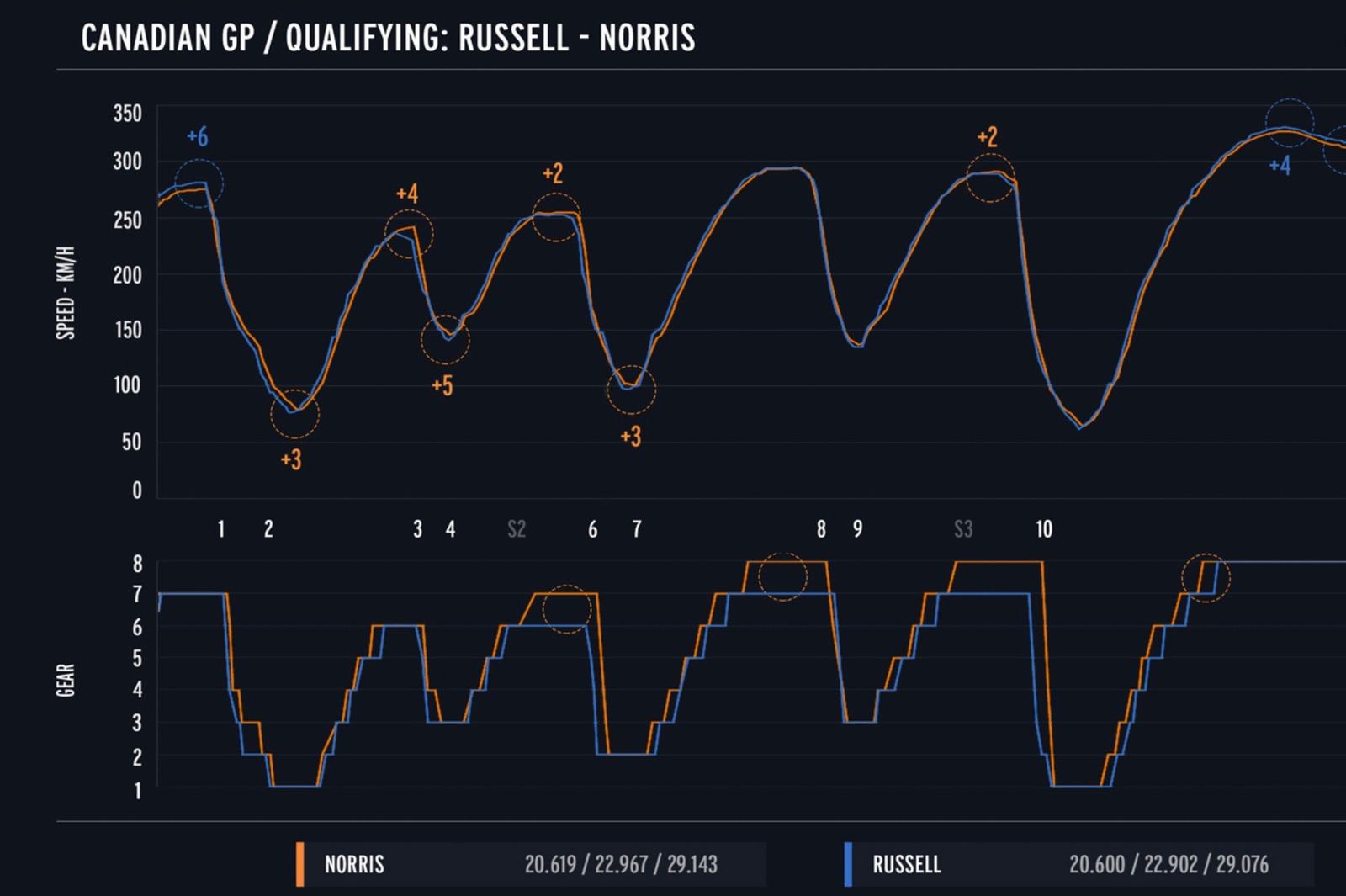
A similar pattern appeared in Canada, despite it being a very different circuit in terms of energy recovery. On the first two short straights of Sector 2, where top speeds were around 290 km/h, McLaren matched the performance of the Mercedes W17. However, on the long straight leading to the final chicane, Mercedes regained its advantage.
Looking at gearbox traces makes the picture even clearer. McLaren tends to use one gear higher in several areas of the lap, selecting eighth gear where others remain in seventh. On circuits where superclipping is especially important, reaching a higher speed at the end of a straight can provide a double benefit – not only in lap time but also in energy recovery opportunities.
During Friday sprint qualifying in Canada, the gap on the long straight was particularly large, sometimes exceeding 10 km/h. This was one reason McLaren modified its energy management strategy for Saturday to reduce the deficit.
“It may give you advantage in a straight dependent on the speed, but it may have some disadvantages,” added Stella. “For instance, when we have speeds in a long straight like from corner 10 to 13, then you may want to have slightly longer, for instance, eighth gear. So, it’s a bit of a mixed bag as to where you want to beat with the ratios.”
There is not necessarily one universally better choice. Rather, each approach has strengths and weaknesses depending on where a team wants to gain lap time. On circuits with very long straights, especially where available energy is limited, Mercedes appears to have some extra potential. Conversely, on tighter tracks with many acceleration zones, McLaren can benefit from the stronger punch provided by its shorter gearing.
The strength of the W17 so far has been that, aside from its higher downforce level (an area where McLaren is rapidly catching up), it strikes a compromise that allows it to remain competitive across circuits with very different characteristics. There will be specific tracks where it struggles more, but overall it appears that, beyond the quality of the power unit itself, the way Mercedes generates lap time is well suited to a wide variety of circuits.
Gear ratios must be homologated at the beginning of the season and normally remain fixed throughout the year. However, this season the regulations include a one-time exception allowing teams to change them once. Stella does not believe such a change is necessary, arguing that the advantages of McLaren’s current setup outweigh the drawbacks and fit well with the overall design philosophy of the MCL40.
“At the moment, we are happy with where we are,” Stella concluded. “We are not considering to review our availability, even though the regulations would allow you to do so. But we think that some of the advantages that we cash in in other conditions than the longest straights are overall a positive position in which we are.”
We want to hear from you!
Let us know what you would like to see from us in the future.
Take our survey
– The Autosport.com Team
Read the full article here