

LeBron James has had success on a lot of different teams, lineup configurations, and eras over the last 23 years. Looking at what worked for a LeBron team a decade or so ago — in a vastly different NBA and style of play — isn’t all that constructive. James isn’t the player he was then, and neither is what he needs around him.
That said, there are commonalities among all four of his title teams that transcend eras. And among the finalists that James seems to be choosing from, those qualities are best seen in the Cleveland Cavaliers.
What has worked in the past?
Let’s start by taking a look at the different types of teams James won with.
First, we have the 2012 and 2013 Miami Heat. Those teams were juggernauts on both ends of the court. They were one of the best defenses in the league during those two years due to their ability to generate turnovers. And the offense was lethal once they got into the open court.
The 2016 championship team in Cleveland didn’t have that same defensive prowess. They, instead, were an offensive powerhouse with their four-out offense featuring dynamic off-the-dribble playmakers in James and Kyrie Irving.
The Los Angeles Lakers bubble title team found success with their overwhelming size. A frontcourt rotation of Anthony Davis, Dwight Howard, and JaVale McGee dominated the glass on both sides of the ball, which led to a well-balanced attack.
Trying to find a stylistic throughline is difficult. Yes, these teams were good three-point shooting teams, but you could say that about almost all champions in the last 15 years. They were all in the top 10 for offensive and defensive ratings, but again, that’s a shared trend among champions as well.
Still, there are two conclusions to draw from these teams.
First, there isn’t a necessary skill set or archetype needed for costars and the supporting cast. LeBron has just needed talent around him.
And second, all four of these teams were able to successfully play vastly different styles depending on the matchup. If they needed to play small-ball, they could. If they needed to go big, all four could do so as well.
Why talent matters
Talent is the most important thing a LeBron team needs.
If you go back and look at every one of his playoff losses (except for the 2011 Finals), James was on the less talented team. Or at the very least, his opponent was more talented in that series.
Having a well-fitting team with a cohesive philosophy certainly helps. The 2008-09 Cavs won 66 games because they were an extraordinary match from a skill-set perspective around a young LeBron. The talent just wasn’t what it needed to be for that team to come out of the Eastern Conference.
Contrast that with the 2011 Heat.
That initial Miami team did not fit together well. They didn’t have the supporting pieces or archetypes needed to make that team work as effectively as later iterations. The 2011 Heat ran into two cohesive teams in the East with the Boston Celtics and the Chicago Bulls. Both of those opponents fit together much better, but they didn’t have the talent to keep up with LeBron, Wade, and Chris Bosh. Talent over fit won the day in somewhat lopsided series.
Yes, the 2011 team fell apart in the Finals, but that was because LeBron played the worst basketball of his career. That particular series had nothing to do with his teammates.
The current top teams pursuing James are all talented enough.
LeBron would be teaming up with another former MVP if he joined the Cavs, Golden State Warriors, Philadelphia 76ers, or Heat. How you would want to rank the talent on each of these teams is up to you. I believe the Cavs and Sixers are clearly at the top in this discussion due to having three or more former All-Stars for James to slot in beside, but I don’t believe it’s worth getting too hung up on that. All of these teams would have talent.
Why versatility matters
Versatility is one of the things that separated the teams LeBron won a championship on from those that didn’t. All four of his title teams could play vastly different styles depending on the matchup. James’s incredibly well-rounded skill set helped them do so.
We’ll go through these in chronological order.
The back-to-back champion Heat teams were Swiss army knives on both ends. Defensively, they had the versatility to play big with Udonis Haslem and Chris Anderson at center alongside a James and Bosh frontcourt. If they were playing a more wing-heavy team, Bosh could shift over to center while James and Shane Battier could handle the wings.
Offensively, those groups could spread the floor out well in smaller lineups. Bosh at the five alongside some configuration that included Mike Miller, Battier, or Ray Allen allowed for four-out spacing lineups in an era that was rare. They were able to do this without sacrificing defense due to Bosh and James’s size and strength in the frontcourt.
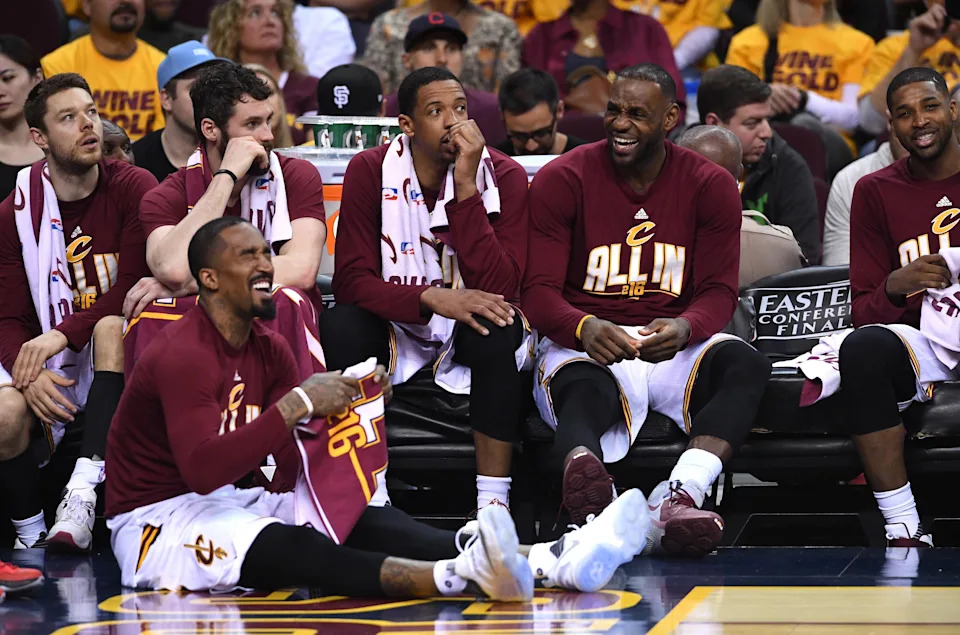
The 2016 Cavs overcame the 73-win Warriors because they were one of the only teams in the league that could punish Golden State’s small “Death Lineup.” Tristan Thompson’s ability to stay with guards on the perimeter, combined with his rebounding, neutralized a lot of the advantages Golden State had over their other opponents.
That Cavs team could also play against bigger teams if needed. Timofey Mozgov was serviceable against larger centers. Channing Frye and Kevin Love’s shooting also allowed them to have perfect, five-out spacing if the situation called for that as well.
The bubble Lakers could shift between playing big with Davis at the four, paired with either Howard or McGee, or play small ball with Davis moving over to the five. Switchable wings like Kentavious Caldwell-Pope and Danny Green fit great in this configuration as they could shift up or down as needed. Throw in Alex Caruso, and you had the perfect defensive personnel for any opponent.
How these four teams’ versatility showed through was different. Some teams could provide better options defensively. Others had more offensive counters. But all were able to pull multiple levers depending on the situation.
This is where the current Cavs team stands out most from the competition.
Versatility would be the Cavs’ best asset
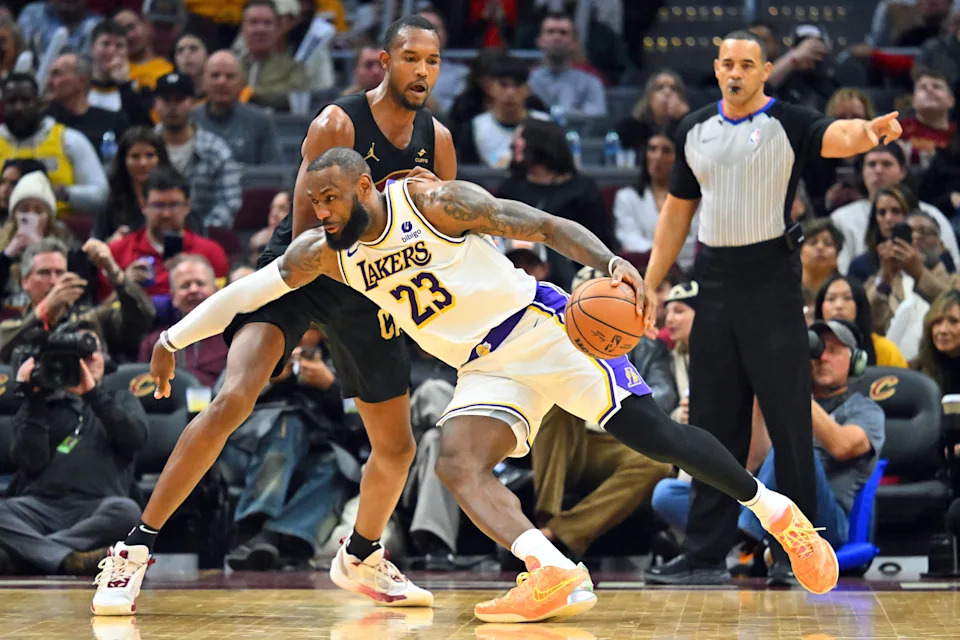
Evan Mobley is the perfect archetype for a big to play alongside James. Being able to easily defend the four and the five allows you to opt for more spaced-out lineups without Jarrett Allen, and imposing jumbo lineups with all three of James, Mobley, and Allen in the game.
Redundant skill sets have been an issue for the Cavs throughout the core-four era. Having guards and bigs that functionally have the same strengths and weaknesses has been an issue in certain playoff series.
The lack of a do-it-all connector has left something to be desired whenever they tried to play too small or too big. A small frontcourt with Dean Wade on instead of Allen was a clear talent downgrade. Additionally, Wade’s limited offensive skill set allowed defenders to cheat off him even though he was out there to provide additional shooting.
Conversely, going big with a Wade-Mobley-Allen frontcourt was too clunky offensively. Having three players who weren’t great on-ball creators placed too much of that burden onto the guards, leaving them susceptible to double teams.
Replacing Wade with LeBron is a difficult calculation entirely. Small-ball lineups would have much better spacing with three A+ creators on the court, with more offensive threats. Concerns about a jumbo lineup not working offensively would be significantly minimized with an additional playmaker in James on the court.
Optionality is important in a more parity-driven league. If you want to win a championship, you need to be able to match up with the San Antonio Spurs’ imposing frontcourt while also being able to hang offensively against spaced-out opponents like the Celtics and New York Knicks.
Having good three-point shooting helps in this conversation as well. Five of Cleveland’s current top-eight rotation players shot 35% or better from three. This includes Sam Merrill (42.1%), Jaylon Tyson (44.6%), and Max Strus (40.2%), all shooting above 40% from three last regular season.
Let’s Cleveland’s ability to play different styles if they had LeBron compared with other teams.
The Sixers don’t have a five-out small-ball option with either Adem Bona or Dominick Barlow. Playing Wade at center would be the only way they could get there, but we know the downsides of that. While Philadelphia would have an impressive starting unit when healthy, they wouldn’t have Cleveland’s optionality.
The same is true for the Heat. The two best players alongside LeBron are non-shooting bigs. Taking one of them off the floor would be a significant talent downgrade. Would they have the offensive firepower to hang with teams like the Celtics, Knicks, and Sixers? Would they be able to execute well enough offensively in a cramped half-court?
The current Warriors don’t have the multiple counters they did in the past. Draymond Green isn’t the same impactful, do-it-all center he was in his prime. He can still play the five, but there aren’t the supporting pieces elsewhere to give them the optionality you would like. This would be a different conversation if you could guarantee perfect health for Kristaps Porziņģis and Jimmy Butler.
There’s this idea that James would only come back to Cleveland for sentimental reasons. After all, there’s an undeniable poetry to finishing a career where it started — especially when that place also happens to be right next to your hometown.
Yet, there’s plenty of basketball reasons to return as well. The Cavs have built a team in dire need of the connective tissue James would bring. His game would slot in perfectly into a group that has needed his particular skill set for the last half-decade. In many ways, it seems like the Cavs have been trying to build the perfect team for James without him.
We don’t know what LeBron is going to do. There are plenty of reasons for him to sign elsewhere. But to act like the Cavs don’t offer a compelling on-court reason to return is nonsensical. Cleveland has assembled a team that fits the exact mold of what has worked during each of his championship runs. If he were to sign with the Cavs, they’d put him in an excellent position to grab his fourth ring.
Read the full article here