






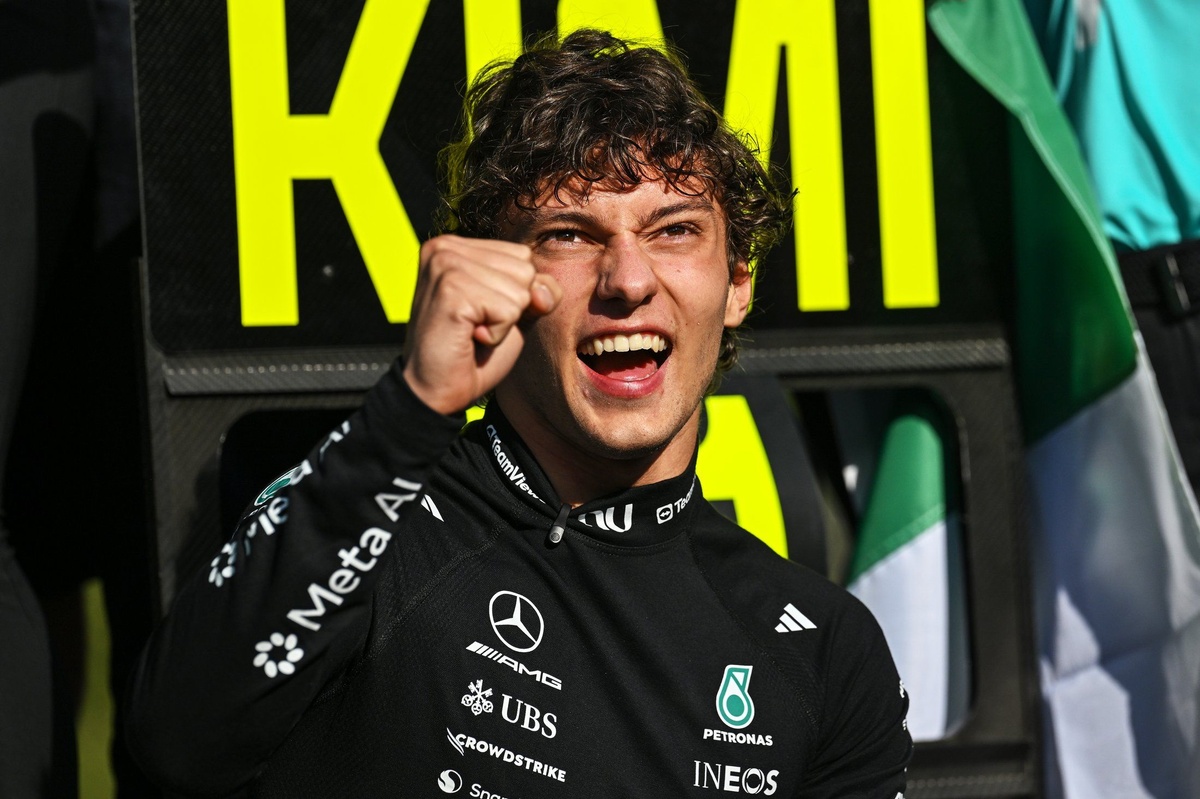
Six wins, six pole positions and the Formula 1 championship lead. While one year ago Kimi Antonelli had faced one of his toughest weekends in F1, he has now taken a sweet revenge, claiming a victory that will mathematically allow him to head into the summer break as the championship leader.
But the meaning of Spa goes well beyond that.
The Belgian round, where last season he struggled with a rear suspension set-up that never gave him the confidence he needed, offers a perfect opportunity to understand how much the Mercedes driver has grown over the past 12 months and why Antonelli’s driving style, beyond his considerable natural talent, is proving so effective with the 2026 cars.
To understand this, we need to look back to last season and the final phase of the previous ground effect regulations. Those cars were very stable yet notoriously unpredictable, which is why the development of flexible wings, designed to enhance stability and balance through corners, became such a critical element of technical development.
However, the moment that balance was lost, ground‑effect cars would betray the driver, snapping away suddenly and without any warning. It is no coincidence that over the years drivers repeatedly noted how difficult it was to save the car once they pushed beyond the limit. Yet the previous technical cycle carried another defining trait: the challenges of combined loading, when drivers brake and steer simultaneously on corner entry.
With the switch from 13-inch to 18-inch tyres, the reduced sidewall height resulted in a smaller contact patch. Some drivers suffered from this more than others because the combined phase had been one of their greatest strengths. As they were no longer able to attack corner entry the way they wanted, they were forced to adapt certain aspects of their driving style. Pirelli obviously worked to mitigate the effect, but it’s clear part of it is an inevitable consequence of a smaller contact patch.
“If you imagine the rolling of the tyre in the longitudinal direction, the length of the contact patch is shorter, and with a shorter contact patch, the transition in driving feel between having grip and losing it is more sudden,” Dario Marrafuschi, head of motorsport at Pirelli, told Autosport.
“This is why we understand the drivers’ comments; it was expected that these difficulties would arise during corner entry in managing adhesion, exactly because the snap gives you less warning.”
To understand why these two elements matter so much this year, we need to look at what has changed. This season, teams have found that combined phase has become even more complex, as the tyres are narrower to reduce aerodynamic drag due to the new rules. Having more front load helps prevent the lockups that can occur during corner entry, but it remains a difficult area to manage.
A quick steering input to stabilise the rear of the car
The 2026 cars have a more unstable rear end
Photo by: Sam Bagnall / Sutton Images via Getty Images
“We do observe that the phase of entering the corner when you brake and combine is very delicate,” McLaren team principal Andrea Stella explained in Monaco. “It’s very difficult to avoid the tyres to lock. When you don’t have front locking, you may have instability like the tyres don’t seem to have much capacity of transitioning from the pure longitudinal to the pure lateral in the corner.”
But there is another element: the behaviour of the rear of the car. These new cars have a more unstable rear end compared to ground effect, yet in some ways for the drivers they are also ‘easier’ and predictable. This allows drivers to play more with the overall balance. It is no coincidence that from the very first day of this new technical cycle, drivers pointed out that although there is less pure downforce, the 2026 cars are aerodynamically easier and more enjoyable to drive.
This dynamic makes corner entry and the initial phase of apex entry highly sensitive. “To react precisely to that difficulty in reading the car on corner entry, some drivers tend to saturate the front tyres entering the turn,” added Marrafuschi. “Saturating the front means they might enter the corner by giving a very sharp, quick steering input, so that the front end experiences a step-input towards a high steering angle, which causes the car to tend to go straight.
“What does going straight actually mean? It means it stabilises the rear more, and the front gains grip progressively. This driving style of over-saturating the front inevitably reflects on tyre wear and temperatures as well. I can confirm that when we analyse the tyres for each team, we measure and we do see differences.”
Antonelli has an aggressive style and tries to shorten the corner

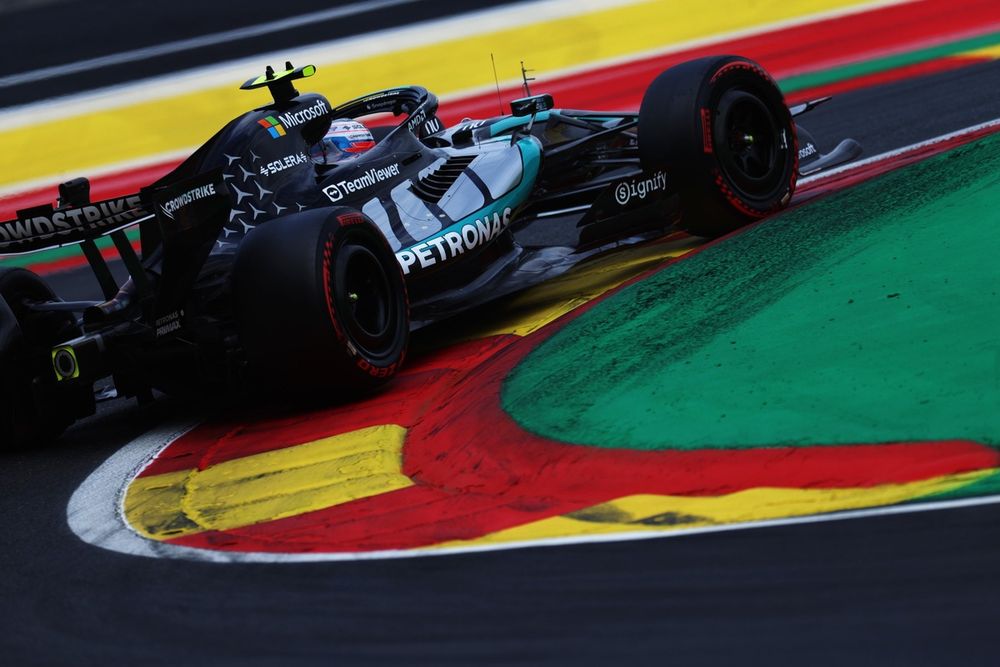
Kimi Antonelli often uses very sharp, rapid steering inputs
Photo by: Alastair Staley / LAT Images via Getty Images
One of the defining traits of Antonelli’s driving style is his aggressive approach, built around shortening the corner radius. What does that mean? In some corners, the rotation phase towards the end of corner entry does not happen smoothly, but rather through a very sharp, rapid steering input, leading him to use a significant amount of steering angle. It is a style suited to drivers with exceptional car control at low and medium speeds, allowing them to rotate the car and settle it quickly.
“It is mostly my style,” said the 19-year-old. “I try to shorten the radius of the corner, as well as the time I spend between braking and the dead zone. I try to fold the corner up like a handkerchief. I turn at the last moment, very aggressively. Let’s say I make the car work a bit more. My style is a bit more aggressive.
“Obviously the way you drive changes between qualifying and the race, but I have to say that in Barcelona I struggled a bit more in qualifying because I was asking too much of the car, also due to the very high temperatures. The tyre dropped off quickly, to the point that in qualifying the rear was already gone after Turn 7. Let’s say it is a style that helps on certain tracks, while on others you may need to adapt it due to the conditions.
“But in the end every track is different. For example, at Silverstone I had to readjust it a bit because all the corners are long and fast, and this style didn’t help all that much.”
And indeed, even at Spa this approach was evident, especially in Turn 1 and at the final chicane, where Antonelli would deliberately shorten the entry before delivering that sharp, rapid steering input.
With the 2026 cars the drivers need to attack to be quick
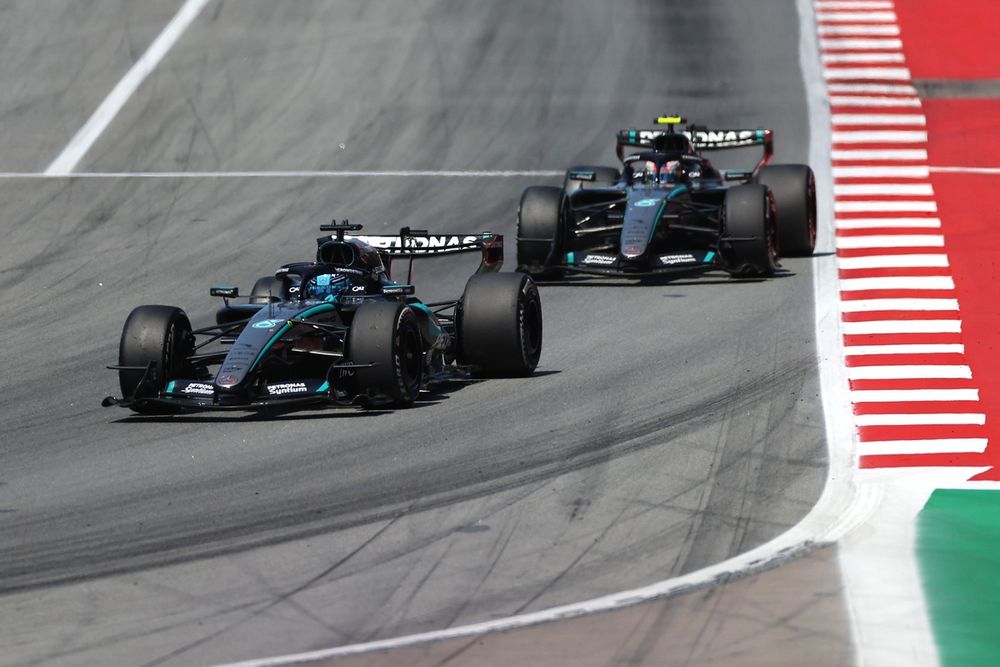
Kimi Antonelli and George Russell have very different driving styles
Photo by: Alastair Staley / LAT Images via Getty Images
This difference in style between Antonelli and team-mate George Russell is clear from the onboard cameras and has not gone unnoticed by their rivals. While the Italian favours a more aggressive style that seems well suited to the what the 2026 cars need, Russell has always been smoother and more progressive with his steering inputs, an approach that worked exceptionally well with the ground effect cars.
“If we look at Russell and Antonelli, we do see that there’s a different driving style. I think it’s quite noticeable in the onboard and the way they use the steering wheel,” Stella explained in Monaco.
“The driving style definitely has an effect. And we do see, looking at the lap times that Antonelli was able to do here and he was able to do in Canada, in the race, these differences compared to anybody else must come also from the way you deal with the tyres. Because if it was only downforce, then it would be an exaggeration and you wouldn’t have these differences to the team-mate.”
Clearly, this is just one aspect within a broader set-up context, but for now, the way Antonelli drives seems to be particularly effective with these new cars, but it also requires exceptional feeling to make it work naturally. According to team analyses, in order to extract their full potential, these cars need to be driven with an aggressive approach, especially in low grip conditions. It is no coincidence that in those low grip races where getting the tyres into the operating window is essential, Antonelli was often competitive last year as well.
Now having a smooth input may not pay off.
“Another factor, this year’s car requires drivers to constantly attack,” said Stella at Spa. “Basically, if you try to smoothen out your input, be clean, get the car to steer with the front tyres, which one would say, I guess, what you would expect, have a decent compromise between sailing a bit in entry to have a good exit, it doesn’t pay off for lap time.”
In a context that demands an aggressive driving style and extremely fine tyre management, qualities where he had already shown last year he could make a difference over long runs, Antonelli is showing not only that he can interpret the 2026 regulations effectively, but also that he can capitalise on a natural talent that allows him to exploit the strengths of his driving style.
We want to hear from you!
Let us know what you would like to see from us in the future.
Take our survey
– The Autosport.com Team
Read the full article here


