





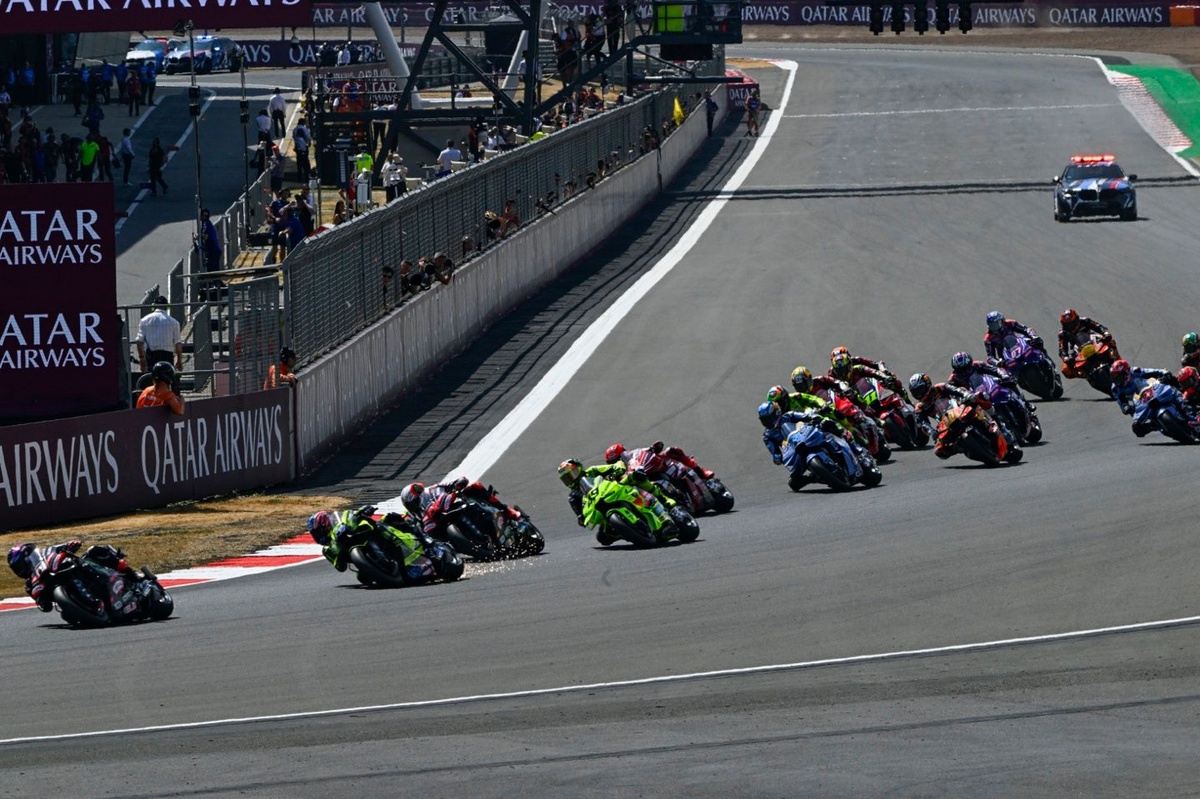
It may seem odd that two riders who qualified on the front row dropped places at the start with stuck ride-height devices, when MotoGP explicitly banned holeshot devices for that very phase of the race.
Polesitter Jorge Martin had already appeared set to lose the lead to eventual race winner Raul Fernandez when he ran deep into Turn 1. Ai Ogura, also on an Aprilia, suffered a similar problem and tumbled down the order.
In both cases, replays clearly showed the rear section of their bikes dragging on the asphalt, suggesting that the ride-height adjustment device had failed to disengage. This could have led to serious issues, but both were ultimately able to continue after freeing up their respective devices, with Martin even recovering to finish second behind winner Fernandez. Ogura crashed out later in the race after failing to regain ground on his rival.
Silverstone marked only the second weekend since MotoGP banned the holeshot device – located at the front of the bike – in the wake of a crash-filled Catalan GP. However, it is important to note that all bikes are still equipped with a ride-height adjusting device at the rear. This is primarily used while accelerating out of slow corners over the course of the race, but riders also deploy it at the start to get a better launch. It was this rear ride-height device that caused problems for both Martin and Ogura.
In the past, most of the complaints have been about the ride-height devices refusing to disengage despite the riders applying the required brake pressure. However, at Silverstone, both Martin and Ogura accepted responsibility for their poor race starts.
Raul Fernandez, Trackhouse Racing
Photo by: Gold and Goose Photography / Getty Images
“I didn’t start really well – or well, Raul started much better than me. I could hear his bike,” Martin explained.
“We went into the first corner, I just wanted to keep the first position and I didn’t brake enough, so my rear device didn’t come back. So, it is what it is. Then I went on the left and Marc overtook me, Ai overtook me, so I lost quite a lot of time.
“I think it was more of my mistake to try to keep the first [position], instead of braking a little bit. And then maybe I had the chance to be in second position behind Raul, but I was too optimistic.”
A stuck rear ride-height device can severely compromise the turning ability of the bike, but Ogura never felt the problem left him in a dangerous position.
“I wasn’t sure about Raul and Jorge,” said the Japanese rider. “I was just adapting to them, and I forgot to brake hard enough to unlock the rear. I lost a couple of positions, but nothing scary. I just couldn’t lean like usual.”
The British GP weekend highlighted that riders may continue to face issues with ride-height devices at race starts until they are explicitly outlawed in 2027 at the advent of the 850cc era.
There have been mixed opinions about how MotoGP should deal with such devices, especially with some manufacturers having developed more sophisticated systems than others.
However, there have long been calls from some quarters to ban them in the name of safety, amid various incidents over the years. While the change in regulations that came in effect at the Sachsenring specifically targeted the front holeshot devices that are developed only for race starts, some riders have also called for MotoGP to bring forward the ban on rear devices – which are used repeatedly through the lap – as well.
Riders, however, feel crashes at the start are inevitable – with or without such devices – as it is the easiest opportunity to gain multiple places in an era where aerodynamics have made it harder for bikes to follow each other later in the race.
To reduce the risk, MotoGP has also increased the space between each rider on the grid from three to four metres, starting with the German GP.
We want to hear from you!
Let us know what you would like to see from us in the future.
Take our survey
– The Autosport.com Team
Read the full article here


