







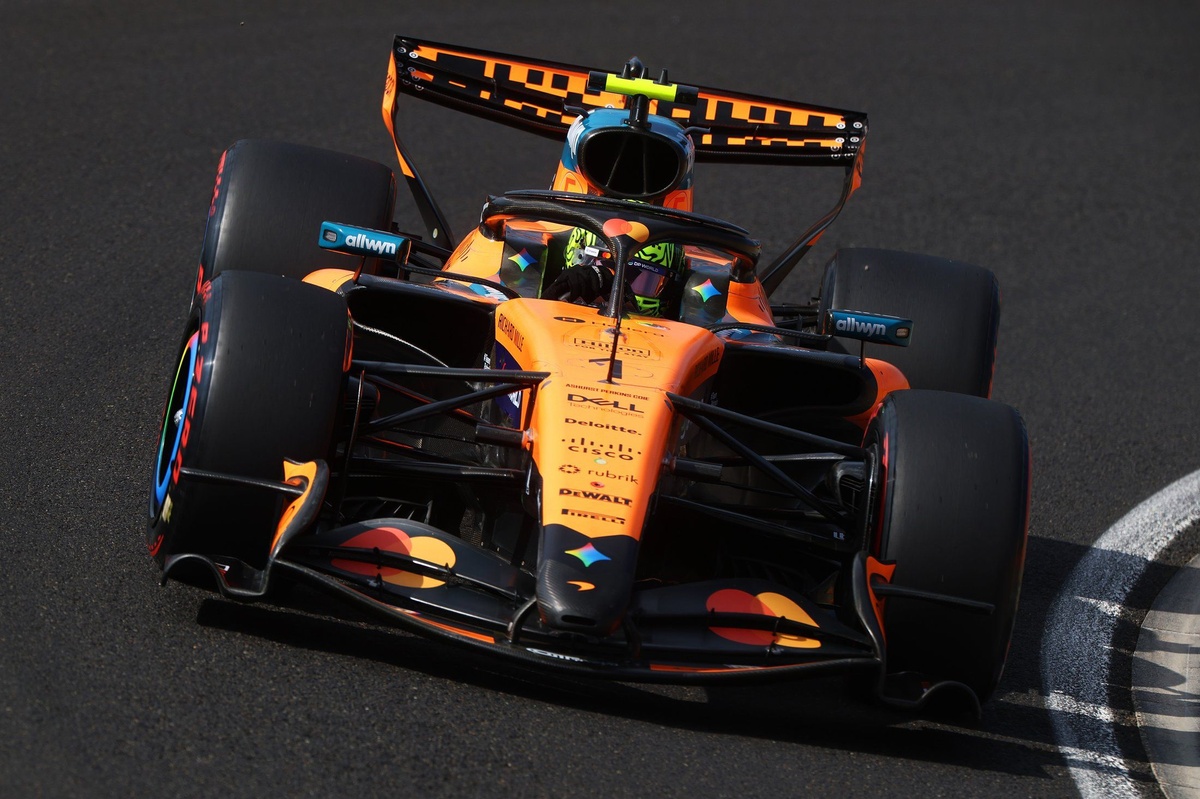
Andrea Stella has never been one to be tempted down the path of hyperbole and hubris, so it came as little surprise that his response to Lando Norris securing pole position for the Hungarian GP came freighted with caveats.
“I think today the pole position is a little bit of an overachievement thanks to execution and maximising the potential that was available,” he mused.
This was after Norris had become the first non-Mercedes driver to take pole for a grand prix this season, but before Lewis Hamilton was handed a three-place grid penalty, which subsequently expanded the gap between P1 and P2 from 0.012s to 0.226s. McLaren hadn’t appeared to be in the picture during Friday practice, focusing on back-to-back comparison of its latest upgrade package with Norris running the latest spec, and Leonardo Fornaroli and Oscar Piastri running the previous one.
On Saturday, though, it sprang into focus as Norris topped FP3 and then edged Hamilton out (on the road at least) by thousandths of a second. McLaren’s latest upgrade focussed on a new floor geometry with associated front and rear wing tweaks, while Ferrari’s spec has remained relatively static since it followed up a major update in Miami with another bodywork refresh in Barcelona, along with an engine step for Austria.
Lando Norris, McLaren
Photo by: Steven Tee / LAT Images via Getty Images
The only eye-catching difference for the Scuderia in Hungary was a tweak to the ‘Macarena wing’, featuring a McLaren-inspired ‘staircase’ of winglets in the central legality box.
“I think Ferrari still has the best chassis in terms of grip in the corners,” explained Stella.
“This is very apparent in braking. Their performance in corner one, in corner 12, when you brake and turn into low speed, is still a decent step ahead of everyone else.
“We have been able to improve the car in the medium-high speed, where we are more comparable to Ferrari. But if you take corner one, corner 12, 13, we still lose a decent amount of time.
“I have to say that despite Hungary being dominated by performance in the corners, we actually make some of our lap time difference to Ferrari in the straights. So, we improved in some areas where we are now, here in Hungary at least, comparable to Ferrari.”
The data backs this up, although Norris was something of an outlier in that he improved on his final Q3 lap where others didn’t – although the yellow flag induced by Max Verstappen’s spin at the final corner had an impact on that, forcing Mercedes’ Kimi Antonelli to lift. Even then, Antonelli reckoned his lap would only have been good for P3 at best had it not been interrupted.
By the time Norris arrived on his fastest lap, Verstappen had got going again so the yellows had cleared. The legacy of the spin was two penalties, one for Antonelli (for not slowing down enough) and another for Hamilton (for baulking Piastri’s push lap at Turn 1 after a miscommunication with his engineer in the immediate aftermath of Verstappen’s gyration).
Hamilton’s second flying lap was scrappy anyway, and slower than his first. We’ll compare that first push lap, which was good for provisional pole, with the Norris lap which surpassed it.

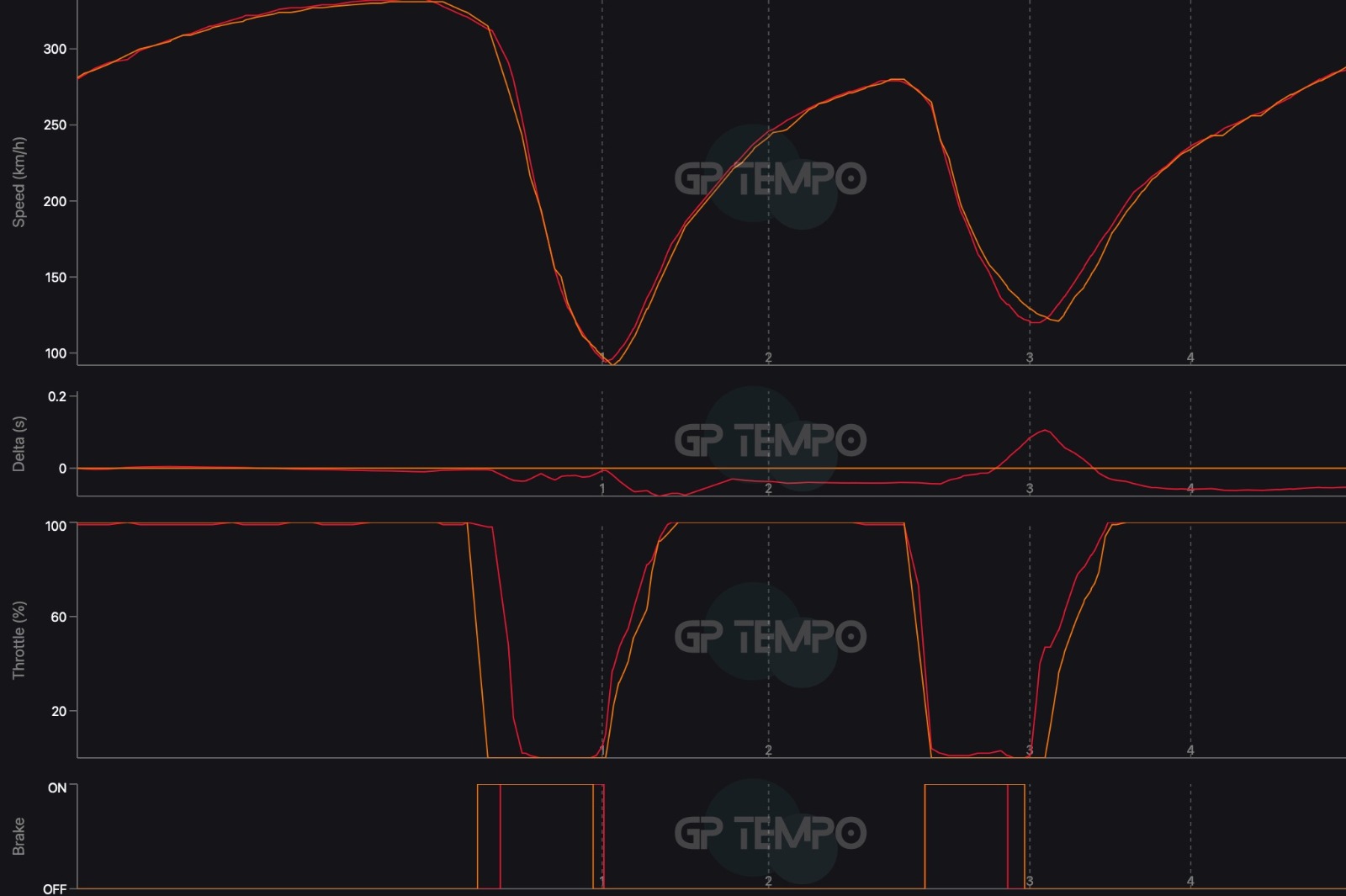
Hamilton (red trace) enjoys better poise under braking for Turn 1 than Norris (orange trace)
Ferrari rides the Turn 1 bump better
Reasons for disgruntlement are legion in Formula 1 these days, but in Hungary the principal target of ire temporarily shifted away from the botched 2026 technical regulations to the sorry state of the track surface. While the Hungaroring’s elderly pit facilities have received a much-needed improvement, demolishing the previous buildings and pouring more concrete appears to have sucked in all the budget.
The track itself, last resurfaced a decade ago, is now patched in places and the drivers concurred that these piecemeal repairs were of an inferior standard, offering much lower grip, along with discombobulating bumps. One of the worst was at the entry to Turn 1 and remedial work overnight into Saturday did little to improve the drivers’ opinion of it.
Comparison of the data and the onboard footage backs up Stella’s assertion that the Ferrari offers better grip and stability when turning into a slow corner under heavy braking. Hamilton tackles it with one smooth sweep of the steering wheel, the bump barely discernible although the ugly strip of patched asphalt is clearly visible.
Norris is slightly less assertive with his initial steering input, as if bracing for the effect of the bump, then has to make a bigger steering correction under power at the exit – all this despite this lap being later in the session, when the track has evolved to offer more grip.
The data reveals Hamilton (red trace) lifts off the throttle and applies the brakes much later, as is his wont, but he blends out of the throttle less steeply too – and only releases the brakes slightly later than Norris (orange trace). He’s able to get on the throttle more decisively, too, as reflected in the onboard which shows him needing to take less exit kerb and not having to manage a skittish rear end at the exit.
That gives Hamilton a laptime advantage in the order of 0.07s as they carve a broadly similar path towards the next corner, where they brake at the same point but Norris is able to carry fractionally more speed for longer, inverting the delta briefly. But Hamilton is able to pick up the throttle quicker and the momentum shifts back in the other direction.
Note that our GP-Tempo data source notates the corners slightly differently from the rubric used by the teams, so Turn 3 on the graphic is actually Turn 2 since teams discount the kink after Turn 1.
Hamilton’s laptime advantage peaks at the apex of Turn 3 (marked as Turn 4 in the data graph) before the superior deployment of the McLaren’s Mercedes engine begins to diminish the gap on the run uphill to the blind-entry Turn 4 at the end of the sector. Hamilton trips the timing at 27.329s, Norris 27.364s – a small but telling improvement on his first attempt (27.435s).
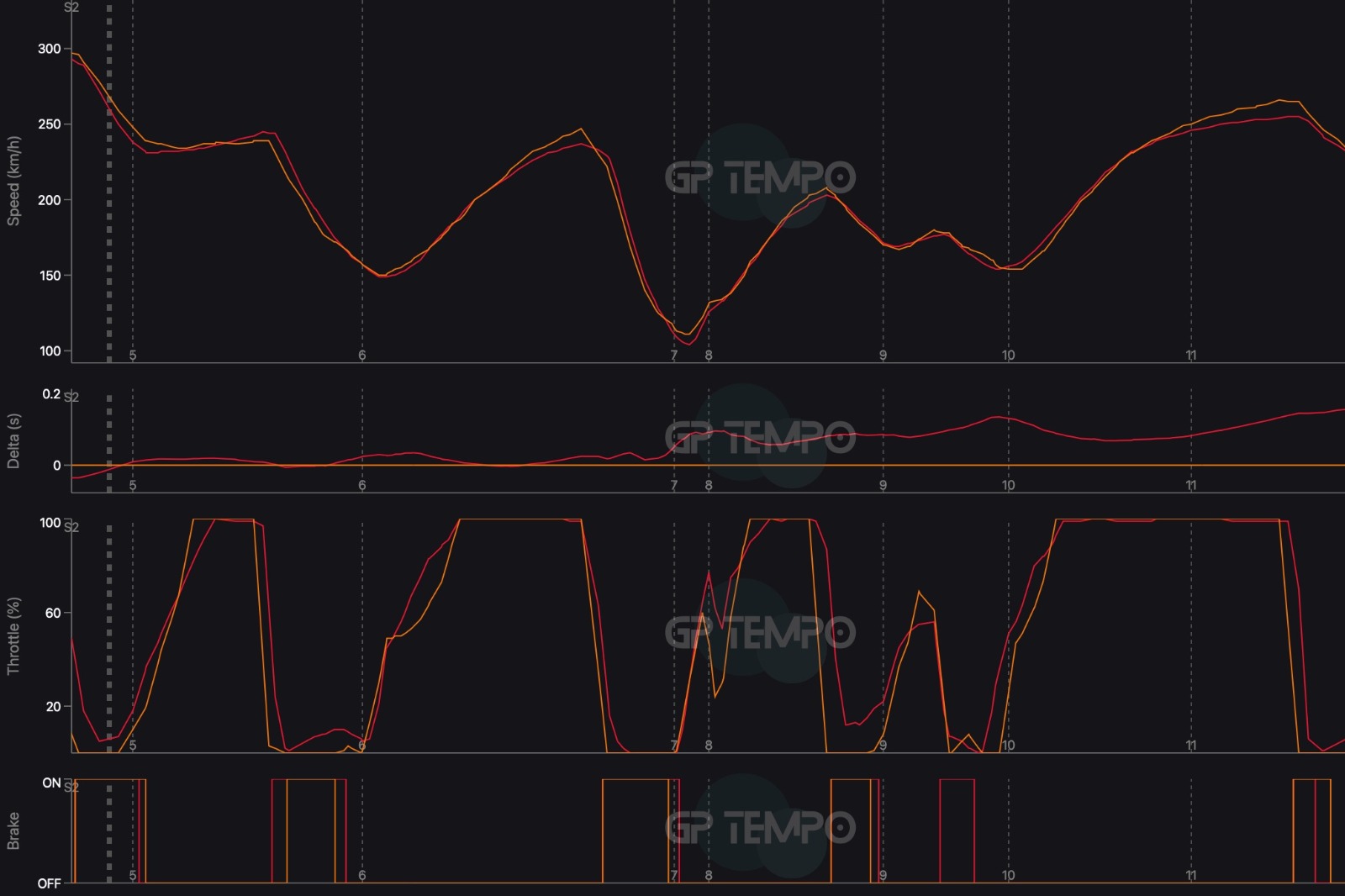
Mercedes powertrain helps McLaren on the Hungaroring’s straights
Sector 2 – deployment vs pliability
Through the second sector, where flowing corners are punctuated by a tricky chicane, Norris enjoys better punch out of Turn 5 (marked Turn 6 in the image) and a higher peak speed along the short straight that follows – again, likely a consequence of Mercedes deployment. Hamilton was able to blend throttle and brake more aggressively into the corner, but really this was just stemming the tide as Norris inverted their laptime delta again, albeit fractionally.
At the chicane exit, Norris has to feather the throttle more, and correct more assertively, but is still able to build a gap in the order of several hundredths of a second despite Hamilton lifting less while blending the brake through the left-hander at Turn 8 (Turn 9 in the graph). Norris again reaches a higher top speed before the right-hander at Turn 11.
At the exit of the sector he’s decisively up, 27.621s through here vs 27.842s.
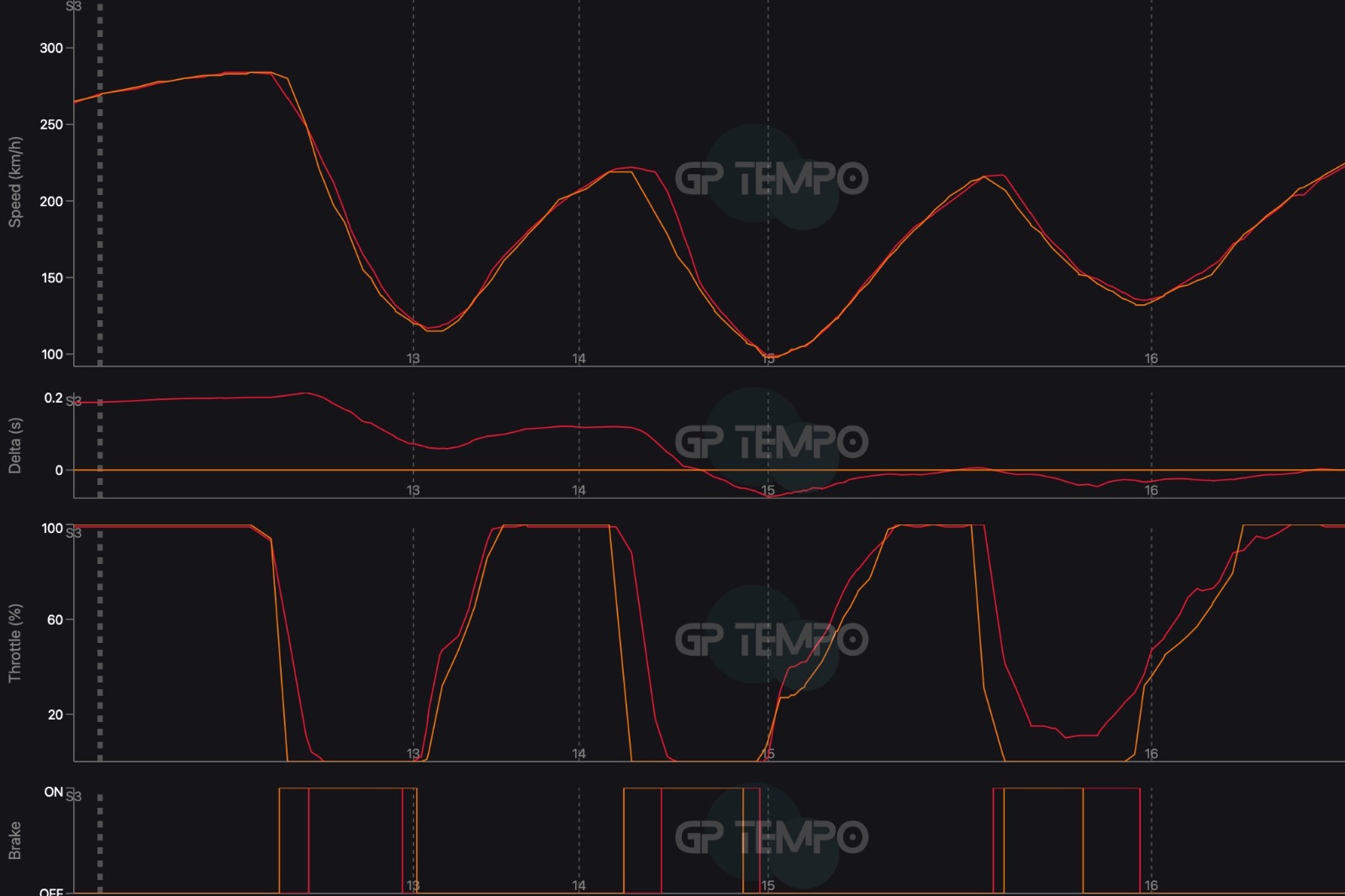
Ferrari is able to carry higher speed into slow corners
Slow-corner poise wins in sector three
The final sector is where, as Stella observed, it gets really interesting. At Turn 12 (turn 13 on the graph) there’s another patched strip of asphalt which the racing line traverses on its path to the apex. The fact that Norris has to brake earlier is clear on the onboards as well as the data. What’s less obvious from the onboard is his more aggressive blend of throttle and brake input to encourage the car to turn.
Hamilton, meanwhile, has the confidence to bleed out of the throttle less steeply and brake later. From being two tenths off at the point they start to back off the throttle, Lewis is in the order of just 0.06s in arrears at the apex.
Turn 13, which GP-Tempo splits into two (marking them as Turns 14 and 15), offers a similar picture. Again, Norris is off the throttle much more sharply and earlier on the brakes than Hamilton – the Ferrari is able to carry far more speed towards the apex of the long left-hander.
Both of them have to feather the throttle and unwind the steering to correct a twitch at the exit, but the McLaren gets better traction which enables Norris to reduce the laptime delta Hamilton has just inverted. The gap begins to widen again as Norris lifts earlier for the long final corner – and he’s off the throttle fully for longer as the Ferrari enjoys better grip and poise through the slowest part of the corner.
But then Norris is rewarded for his patience by being able to pick up the throttle earlier and more aggressively. By the time Hamilton is fully on the throttle, Norris has eaten up the gap and it then swings fractionally to the McLaren’s advantage.
It’s interesting to note, too, that Norris lifts just ahead of the timing line, suggesting McLaren has been able to mimic the trick Mercedes has been emplying since Silverstone. Hamilton is faster through the sector – 22.048s plays 22.222s – but not quite enough.
“We need to improve further in low speed,” concluded Stella.
“Some of the performance came in the straights, which I think is the benefit of running the HPP [Mercedes High Performance Powertrains] power unit. The upgrades we took here, they are part of a round of upgrades that is distributed over a few rounds.
“So this was the first part of these upgrades. There will be a few things coming for the next races.
“I have to say this year pretty much the top teams have always been successful in introducing upgrades to what I can see. And I think this is because the rules are still relatively immature and the opportunities in terms of developing the car are almost low hanging fruit to cash in.
“So I think it’s far too early to say whether this is a turning point for McLaren or not.”
We want to hear from you!
Let us know what you would like to see from us in the future.
Take our survey
– The Autosport.com Team
Read the full article here


