






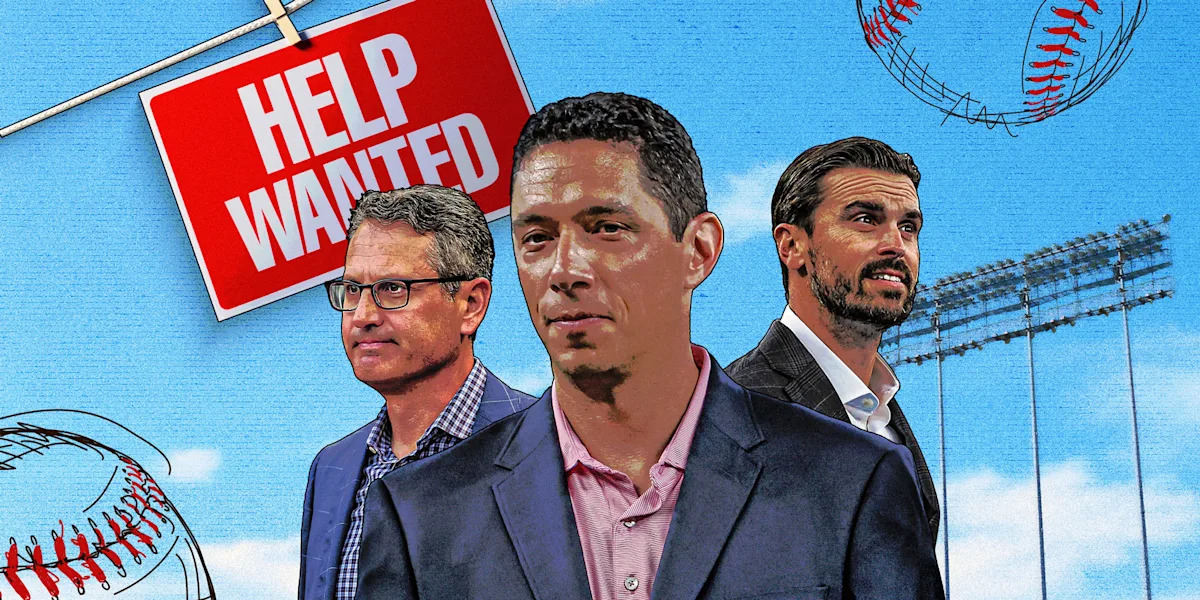
There is no decision more important for a franchise than who’s leading it. An organization’s choice for its head of baseball operations can chart the course for years of sustained success building a winner or years of aimlessly wandering in standings futility.
Three MLB teams — the Los Angeles Angels, Houston Astros and Athletics — are beginning the search for a new front-office head after midseason firings this year. And while there’s no guarantee, there’s a good chance that one or two more executive jobs become available at the end of this season.
So who are baseball’s top candidates for these jobs? Well, who better to ask than their peers around the industry, who know front offices inside and out?
Yahoo Sports spoke to 24 MLB executives over the past three weeks and asked them this question: If you were an owner with an opening and putting together a short list of candidates to be your next front office head, whom would you call?
Executives were asked to pick three candidates, excluding members of their current organization or another team’s current top executive (i.e. we’re not stealing Andrew Friedman from the Dodgers). They were granted anonymity in order to speak freely.
“It’s way more fun being on this side of it,” one high-level NL executive said. “There are so many great candidates around the game, man. Can I have more than three?”
Just so we’re clear: Some teams call the head of the front office the president of baseball operations, and some call it the general manager. It just depends on the team’s org structure. And the Boston Red Sox use the term “chief baseball officer” for their top executive, but the role is the same.
Subscribe to Yahoo! Sports MLB on YouTube for videos, podcasts and more
How valuable is experience?
One major factor ownership groups have to consider when hiring a top executive is the value of experience. While a majority of the execs consulted for this story agreed that the top job in an MLB organization can be done successfully without prior experience in the role, a few considered experience a non-negotiable.
“There is real value to having a guy that’s been in the seat,” one NL president of baseball operations said. “You don’t realize until you’re in the chair the amount of things and people that you’re responsible for.”
But the premium placed on a top executive having prior experience seems to be on the decline, especially as new executives get hired each year. Currently, only 10 of MLB’s 27 front office heads were another team’s lead exec before they landed their current role.
In this survey, just five of the 40 candidates named by current executives have experience leading a front office as its No. 1 decision-maker.
The 2 GM archetypes: The builder and the data savant
Among the 40 candidates named, a common theme developed as two types of executives emerged. For the sake of this conversation, we’ll call them “the builder” and “the data savant.”
The builder is the candidate with a keen ability to lead people. Their strength is creating buy-in throughout an organization and putting people in position to succeed. When the builder speaks, people listen. And not only do members of the organization believe them, but also they believe in them. Whether they have a background in scouting or acquisitions, their knowledge combined with their ability to connect with people cultivates a winning environment. Examples of this archetype include the Padres’ AJ Preller, the Phillies’ Dave Dombrowski and the Diamondbacks’ Mike Hazen
The data savant begins with a more numbers-based approach. Their aptitude for information and data helps them identify advantages and optimize on-field performance. They might have a background in research and development, data science or analytics integration, and they integrate data with baseball decisions to shape strategies across an organization. Current execs in this mold include the Mets’ David Stearns, the Marlins’ Peter Bendix and the Nationals’ Ani Kilambi.
Which archetype is better often depends on the fit within a specific organization. And of course, executives can and often do have skills from both types.
Said one AL executive: “Look around the game. There’s evidence that both methods work.”
While those surveyed acknowledged a shift across baseball from builders to more data savants in recent years, many pointed to a further trend of specialization within the position. After decades when general managers were more “well-rounded,” teams have started to focus on candidates with specific traits and skills.
“What’s really important to remember is that you are hiring the individual, not the organization that person comes from,” one high-level AL exec said. “Yes, they pick up a lot of things when they are there, but they better have an individualized plan of attack for the org they’re going to, or it won’t work.”
For many execs around the league, former Rangers president Jon Daniels tops the list of available candidates.
(Bruno Rouby/Yahoo Sports)
‘He should be on all the lists’
Let’s get to the survey results. Of the 40 candidates named by those surveyed, 16 received multiple votes. Los Angeles Dodgers general manager Brandon Gomes finished with five votes, second-most among candidates. Five execs were tied with four votes, third-most on the list. That’s Atlanta Braves assistant GM Ben Sestanovich, Cleveland Guardians GM Mike Chernoff and assistant GM Matt Forman, Toronto Blue Jays vice president of baseball strategy James Click and Chicago White Sox assistant GM Carlos Rodriguez.
But one name came up most consistently in these conversations.
“Have people been saying Jon Daniels yet?” one NL GM asked. “Because he should be on all the lists.”
It has been quite some time since longtime executive Jon Daniels led a front office, but the impact he made on baseball is still felt by his peers years later. Daniels, who’s currently a senior advisor with the Tampa Bay Rays, became the Texas Rangers general manager back in 2005 at the age of 28. During his tenure, the Rangers reached the World Series in 2010 and 2011. Daniels was promoted to president of baseball operations in 2013 and remained in the role until he was fired in 2022 after six losing seasons.
Said one AL longtime executive: “Jon Daniels is the type of guy that when the situation is most stressful, you’re going to see the best in him.”
“There’s just this calmness about him that speaks volumes. Salt of the Earth kind of guy,” one NL president of baseball operations added.
|
Name, Current/Former Role, Team |
Votes received |
|
Jon Daniels, Senior Advisor, TB |
8 |
|
Brandon Gomes, General Manager, LAD |
5 |
|
Mike Chernoff, General Manager, CLE |
4 |
|
Ben Sestanovich, Assistant General Manager, ATL |
4 |
|
Matt Forman, Assistant General Manager, CLE |
4 |
|
James Click, VP, Strategy, TOR |
4 |
|
Carlos Rodriguez, Assistant General Manager, CWS |
4 |
|
Thad Levine, Special Advisor, MIL |
3 |
|
Carter Hawkins, General Manager, CHC |
3 |
|
Justin Hollander, General Manager, SEA |
3 |
|
Michael Groopman, Assistant General Manager, BOS |
2 |
|
Derek Falvey, former President of Baseball Ops, MIN |
2 |
|
Josh Barfield, Assistant General Manager, CWS |
2 |
|
Randy Flores, Assistant General Manager, STL |
2 |
|
Amiel Sawdaye, Assistant General Manager, AZ |
2 |
|
Justin Horowitz, Assistant General Manager, WSH |
2 |
|
Jeff Greenberg, General Manager, DET |
1 |
|
Kevin Ibach, Assistant General Manager, TB |
1 |
|
Matt Kleine, Assistant General Manager, MIL |
1 |
|
Ani Kilambi, General Manager, WSH |
1 |
|
Vinesh Kanthen, Senior Director Baseball Operations, MIA |
1 |
|
Eve Rosenbaum, Assistant General Manager, BAL |
1 |
|
Farhan Zaidi, Special Advisor, LAD |
1 |
|
Dave Cameron, Director of Player Personnel, SEA |
1 |
|
Bobby Heck, Special Assistant, TB |
1 |
|
Josh Stein, Assistant General Manager, SD |
1 |
|
Rick Hahn, former General Manager, CWS |
1 |
|
Will Cousins, Assistant General Manager, TB |
1 |
|
Cole Figueroa, Assistant General Manager, TEX |
1 |
|
Matt Klentak, Special Assistant, MIL |
1 |
|
Billy Owens, Assistant General Manager, ATH |
1 |
|
Andy Green, Vice President, Player Development, NYM |
1 |
|
Will Hudgins, Assistant General Manager, MIL |
1 |
|
Sarah Gelles, Assistant General Manager, PIT |
1 |
|
Steve Sanders, Assistant General Manager, PIT |
1 |
|
Mike Murov, Assistant General Manager, TOR |
1 |
|
Jared Banner, Assistant General Manager, CHC |
1 |
|
Matt Blood, former VP of Player Development, BAL |
1 |
|
David Forst, former General Manager, ATH |
1 |
|
Jeff Luhnow, former General Manager, HOU |
1 |
But do they want the job?
Having a vacancy atop your front office doesn’t always mean you’ll make a home-run hire (no pun intended), and sometimes that has nothing to do with the candidates available. Sometimes it has everything to do with the job itself. Because while a team might want a certain candidate, the other side of the equation always is: Does the candidate want that team?
If a candidate is comfortable in their current role, sometimes they’ll choose to pass on an opening or withdraw their name after an initial interview. After all, baseball executive jobs rarely come open amid ideal circumstances. Just look at this fall’s openings.
The Athletics’ job comes with all the uncertainty of a team moving cities, plus some concerns about ownership.
“Things could change when they get to Vegas, but you have to make it to Vegas first,” a longtime AL executive said. “And you can make the case that they have the worst owner in the sport. He sucks.”
Meanwhile, the Astros’ job raises questions about just how much autonomy the top executive will actually have.
Said one NL exec: “Why would you want to go to Houston and have all of your decisions get undercut by Jeff Bagwell? It might be the worst job of the ones available.”
But the job the entire industry currently has an eye on is the one in Anaheim. The Angels’ GM was probably the least desirable gig just a few weeks ago, but after Arte Moreno’s sale of the team to billionaire Stan Kroenke, arguably the most successful owner in sports in terms of championships won, the outlook has changed. Kroenke will become the richest owner in baseball when the sale is official, and with that, the Angels’ job has gone from one of the worst in baseball to one of the best.
“The Angels job just shot to the top of everybody’s list,” one AL GM said. “That owner with those resources and an empty canvas — every executive not tied down is gonna want that job and should!”
Of course, as the vast majority of executives interviewed noted, even while dissecting each job, there are only 30 across the league, and if you pass on one, you never know how long it’ll be before a more desirable job becomes available.
‘That shows the game is in a good space’
As the season comes to a close, the three teams with exec openings will continue their search process and narrow down their list of candidates. If another team decides to make a change, it’ll likely happen shortly after the end of the season.
And with the CBA set to expire on Dec. 1 and the offseason likely to be disrupted by a work stoppage, it would behoove organizations to fill their open exec positions sooner rather than later.
But if this exercise shows anything, it’s that even in a sport that can be guilty of group-think, those within the industry believe the talent pool for executives is as strong as ever, and every team should be able to find what it’s looking for.
“When you have that many quality candidates, that shows that the game is in a good space,” a high-level AL exec said. “Lots of backgrounds and skills that can help a team.”
Read the full article here


