





Normally, entertaining a ‘What if?’ scenario is a fun exercise. You change one thing, start pulling on the thread and see how ridiculous you can make everything on the other end. Maybe Kevin Durant actually says yes to Tom Brady’s recruiting pitch. Maybe Danny Ainge finally cashes in the war chest on Anthony Davis without sacrificing either Jay.
Considering what if Gordon Hayward never got hurt is not a fun exercise.
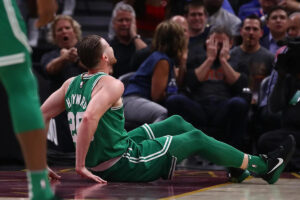
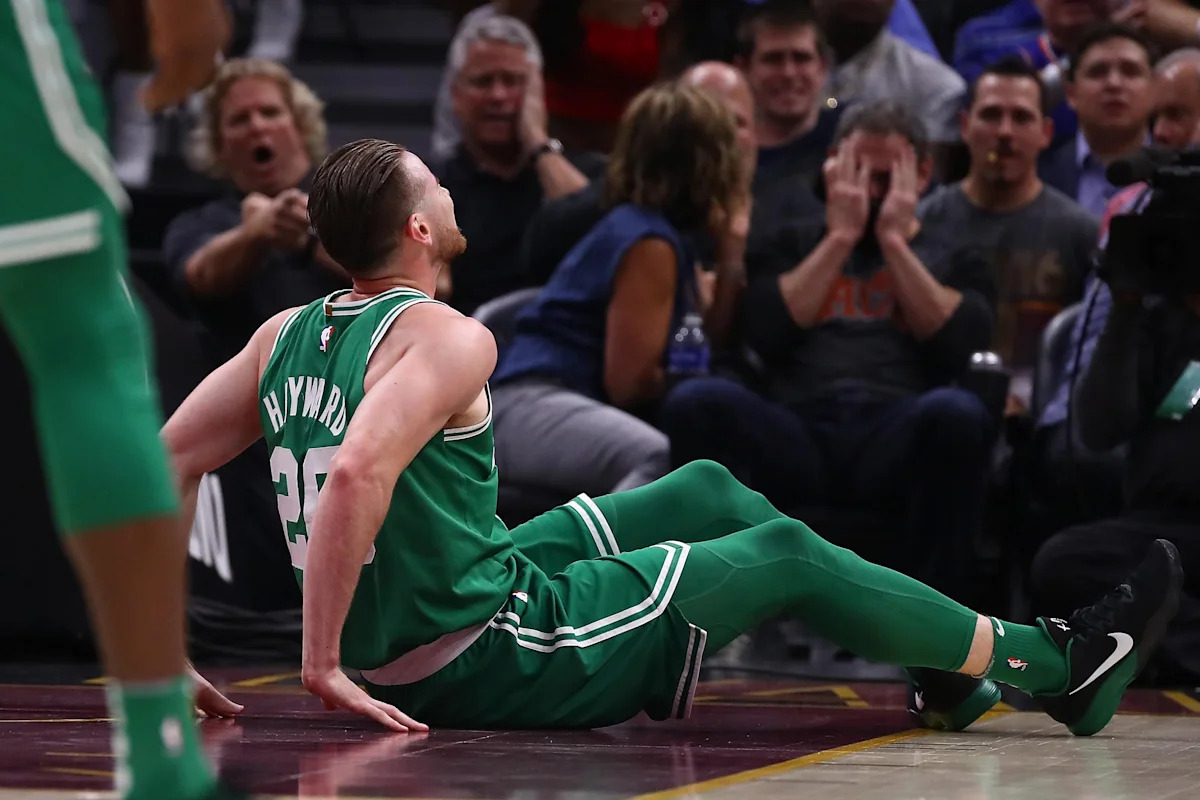
If you give me the power to go back to October 17, 2017, there is no debate: I’m grabbing Hayward out of midair like an overprotective parent catching a toddler jumping off the couch. I’m moving Jae Crowder six feet to his left. I’m running onto the court and blocking Kyrie’s lob pass. I’ll pull the fire alarm at Quicken Loans Arena if I have to.
Anything to keep Hayward from landing the way he did.
The problem comes after that.
Less than three weeks after the injury, Hayward spoke to reporters at the Celtics’ practice facility about what those first few weeks had been like.
“I still have negative thoughts; it’s hard not to, especially when you watch the games,” Hayward said during that November 2017 press conference. “I think I wouldn’t be human if I didn’t have those thoughts.”
There’s no version where I’m rooting for the injury because of what it may have accidentally set in motion. But for a franchise that eventually got Jayson Tatum, Jaylen Brown and Banner 18 out of the real timeline, I’m increasingly nervous about what else I’m undoing by preventing it.
So…how good was that team supposed to be?
In short? Really, really good.
I think time has flattened the 2017-2018 Celtics into “that team Gordon Hayward got hurt on,” which undersells how absurd the setup looked before Opening Night.
Hayward was 27 years old and coming off the best season of his career in Utah. He had averaged 21.9 points, had just made his first All-Star team and looked like the exact kind of big, versatile wing Brad Stevens could build an offense around.
On top of that, Boston had just traded Isaiah Thomas for Kyrie Irving.
All of a sudden, Stevens had Irving, Hayward and prime Al Horford, plus a 21-year-old Jaylen Brown and this 19-year-old rookie named Jayson Tatum who seemed mildly promising.
Golden State was still the championship favorite, but Boston entered the season looking like Cleveland’s biggest threat in the East, if not the favorite.
We technically saw that team for about five minutes, which is roughly enough time to decide whether I want leftovers for lunch, not enough to evaluate an NBA contender.
Boston responded to losing Hayward by winning 55 games anyway.
That’s the part that makes this thought experiment immediately dangerous. The Celtics lost the player who was supposed to be their second-best offensive option. They eventually lost Irving for the playoffs, too.
And yet, they still came within one home Game 7 of reaching the Finals. Boston lost that game by eight while Terry Rozier shot 2-of-14 from three and Tatum, who was technically still supposed to be figuring out where the team cafeteria was, became its best offensive player.
With a healthy Hayward, I think Boston reaches the Finals. Boston already had an elite defense, and he would have given them another half-court creator when possessions slowed down and Tatum was being asked to carry far too much offense for a 20-year-old. Beating the Durant-Curry Warriors is another matter. I’m not turning this into fan fiction.
Still, even getting to the Finals changes everything that comes next.
Brad Stevens said at the time that his focus was on Hayward and “trying to make sure that we maximize this group that we have right now.”
Maximizing that group meant finding out much sooner than expected what Tatum and Brown could handle.
The Jays were asked to grow up, then showed up
Hayward’s injury didn’t create Jayson Tatum or Jaylen Brown. Suggesting two future All-NBA players needed somebody else to suffer a catastrophic injury to become great feels both ridiculous and kind of gross. What the injury changed was the timeline.
Tatum went from talented rookie joining a contender to starting 80 games. Brown jumped from 17.2 minutes per game as a rookie to more than 30 in Year 2. Suddenly, Boston wasn’t developing its future somewhere behind Irving and Hayward. The future was suddenly playing 30+ minutes a night because Boston no longer had the luxury of bringing it along slowly.
If the regular season was an audition, the playoffs proved the Jays were ready for much bigger parts.
Tatum averaged 18.5 points over 19 postseason games. Brown averaged 18.0. By May, neither looked particularly interested in waiting for permission to become important.
We all remember the defining image from that postseason run. Tatum gets downhill in Game 7 against Cleveland, rises over LeBron James and absolutely detonates one on his head, then has the audacity to chest-bump him on the way back down the floor.
He was 20. At 20, I was leading my co-ed intramural basketball team to a hard-earned second-place finish and cramming for a Greek mythology exam I was woefully unprepared for.
That playoff run was massively important. Not because it magically turned Tatum and Brown into stars, but because Boston learned something about their two young wings much earlier than expected.
So did they.
Years later, Hayward essentially said as much himself. During a 2024 appearance on Podcast P with Paul George (ha), he described what Tatum, Brown and Rozier brought back with them after that unexpected run.
“They’re all trying to prove, like, ‘We’ve arrived,'” Hayward said.
Of course they were. They had just spent two months proving it.
Sign up here to participate in the weekly emailed surveys:
Now put Hayward back into the mix.
Tatum is still playing, obviously. Brown is still playing. But Hayward needs the ball. Kyrie needs the ball. Horford is central to everything Boston does. Marcus Morris exists and, as Celtics fans may recall, Marcus Morris did not consider shot attempts a finite natural resource.
Maybe the Jays develop exactly the same way with fewer touches, or maybe Boston delays discovering exactly how ready they already were.
Boston found out earlier than expected that they were more than ready.
Okay, but what about 2019?
This is actually the season I keep coming back to.
It might feel like ancient history at this point, or people may be choosing to forget as quickly as possible, but the 2018-19 Celtics were…weird. Bad weird.
Boston entered the year with a roster that looked awesome on paper. Irving was back. Hayward was ready to make his grand return. Tatum and Brown had just taken LeBron to Game 7. Terry Rozier had evolved into Scary Terry. Horford, the ageless wonder that he is, was still Horford.
There were approximately nine players who could make a reasonable argument that they deserved more touches going into the season.
Hayward eventually gave that season a wonderfully blunt autopsy. Speaking on that same Podcast P episode, he said, “We all had too many agendas, and the agenda to win the whole thing was not the main one.”
Oof. Again, bad weird.
Hayward also pointed to the roster construction. Boston had, in his words, “too many of us in the exact same position.” A whole lot of very talented people needed the basketball, and the NBA had stubbornly refused to introduce a second one.
What was supposed to be a successful year turned into the Celtics winning 49 games and spending most of the season looking like a group project where everybody had completed their portion separately.
Hayward was part of that traffic jam through no real fault of his own. He was trying to become an NBA player again while reclaiming a role on a team that had learned how to win without him. Across three seasons in Boston, he appeared in only 125 regular-season games and started 71.
A healthy Hayward changes the hierarchy entirely. Instead of fighting to rediscover Utah Gordon, he enters 2018-19 with an established role beside Irving as a scorer, creator and connective piece. Tatum and Brown are still ascending, but Boston isn’t simultaneously reintegrating an All-Star and asking its young guys to surrender responsibilities they had just earned in May.
Even when Hayward finally began looking like himself again in 2019-20, he fractured his hand eight games into the season and needed surgery.
Maybe, if Hayward stays healthy, he stabilizes the whole thing. Maybe Kyrie even enjoys himself.
Okay, perhaps too far. But this is my ‘What if?’ article, let me dream!
If that 2019 season goes differently, everything afterward becomes impossible to predict. Kyrie’s departure suddenly feels less inevitable. Maybe Horford stays, too. Hayward may actually finish his contract in Boston.
And Tatum and Brown are sitting there waiting.
The Trader Danny dilemma
Any interest in playing a stress-inducing little game? No? Well, we’re going to play anyway.
It’s 2020. Hayward is healthy, Tatum looks like a star, and Brown remains a tantalizing young wing but hasn’t gotten quite the same runway.
Then, in November, James Harden asks out of Houston.
Now we’re having a real conversation.
A Woj bomb hits your brand-new iPhone SE while you’re washing bananas in the sink because it’s 2020. Woj says that Boston is monitoring the situation. Danny Ainge begins lurking, as Danny Ainge is prone to do.
Houston wants a young star and draft capital. In our altered timeline, Brown may not yet have become the no-doubt untouchable player he eventually became in Boston. A package built around Brown, Marcus Smart and first-round picks is suddenly sitting there on Ainge’s desk.
With Hayward healthy, Tatum already looking like a star and Kemba still running point, does Ainge decide Harden is the scorer who puts Boston over the top and cash Brown in for the superstar he spent years hoarding assets to chase?
We know what happened in reality. Boston kept Brown. He developed into an All-NBA player, won Finals MVP and eventually helped hang Banner 18. Does Ainge make the same decision if Brown’s early career looks different because prime Hayward has occupied one of those wing spots?
Like I said, stress-inducing.
We tend to imagine alternate history while keeping all the things we liked from the original version. Hayward stays healthy, Boston gets better, Tatum still becomes Tatum, Brown still becomes Brown, everybody remains happy, and eventually several championship banners descend from the Garden rafters while Al Horford is elected mayor of Boston.
Sorry, but that’s cheating. If Hayward doesn’t get hurt, you don’t get to keep everything else.
There’s absolutely a timeline where a healthy Hayward helps Boston win Banner 18 years earlier. Maybe Banner 19 comes after it.
There’s also one where changing 2017 costs Boston pieces of the future we now know worked.
Nine years later, we know where the road led
Eventually, Boston got back to the mountaintop.
Not cleanly. Good lord, not cleanly.
Irving left. Hayward left. Horford left, eventually came back, and then left again. Coaches changed. Kemba’s knee stopped cooperating. Somehow Joe Mazzulla inherited the whole thing under circumstances that would have plunged plenty of franchises into the deepest depths of the standings.
Through all of that churn, Tatum and Brown were the part Boston never had to replace. They kept getting better until eventually they led a dominant team to Banner 18. Now they’ve finally been separated, and both still seem capable of adding another chapter to careers that started accelerating the night Hayward went down.
That’s what makes this particular ‘What if?’ so uncomfortable for me. Hayward is the rare one where I desperately want to change the event while being terrified of changing the outcome.
A couple weeks after the injury, Hayward was shooting from a chair while he began a recovery that would consume most of the next year. At the time, I remember being ecstatic to hear even that much progress.
“Just to be out on the court and holding the basketball, that was an incredible feeling,” Hayward said during his first post-injury press conference.
That quote hits differently now. At the time, it sounded hopeful. Gordon was back in the gym. The rehab had started. Eventually he’d return, and maybe everything the Celtics envisioned in July 2017 was still sitting there waiting for him.
Knowing how his Boston career actually unfolded, it reads much sadder. The Hayward story here never really became a comeback story. He had good stretches and moments where Utah Gordon seemed ready to reappear, but another injury always seemed to arrive before the story could fully materialize.
His Celtics tenure is remembered far more for what disappeared on that first night than for anything he ultimately got to build afterward.
Despite it all, given the choice, I’m still saving Gordon Hayward. Every single time.
Beyond all the basketball calculus, Hayward always seemed like someone worth rooting for. I care about that stuff. It’s easier to invest in the people wearing Celtics jerseys when you like who they appear to be outside of them, too. If I have the power to erase something that took that kind of physical and mental toll on him, I’m doing it.
Could that delay the development of Tatum and Brown? Sure. It also might have given Boston a much better team while they developed and became superstars all the same.
So if someone hands me the keys to Doc Brown’s DeLorean, I know where I’m going first: October 17, 2017. After that, maybe I’ll punch 2046 into the dashboard and see whether Deuce Tatum and Hendrix White have finally delivered Banner 27.
One Celtics timeline crisis at a time.
Read the full article here


