





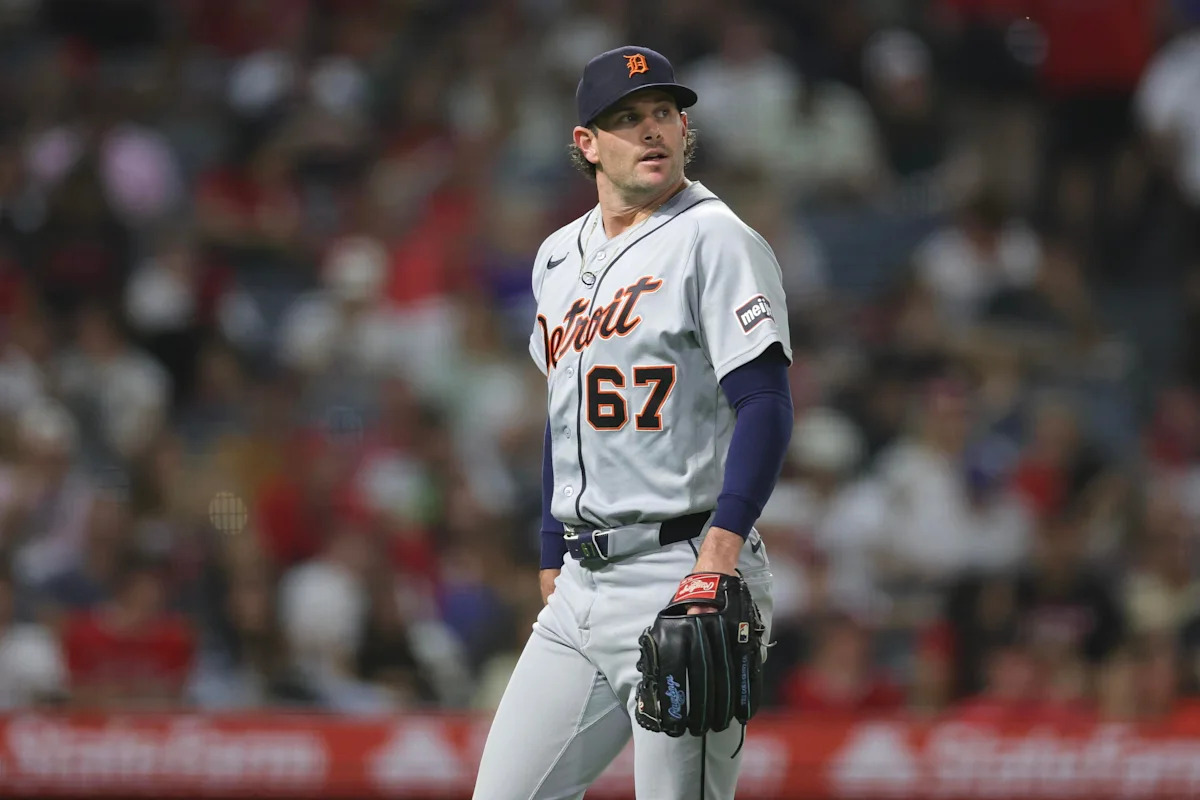
When the Detroit Tigers signed reliever Kyle Finnegan to a two-year, $19 million contract last offseason, it seemed like a decent idea. Scott Harris and Jeff Greenberg were well aware that their relief corps was perilously thin, relying heavily on Will Vest turning in a fourth straight excellent season. That’s generally asking a lot of all but the most durable high leverage arms in the game. While their efforts to reinforce the pen went very badly, it wasn’t because they didn’t see the problem developing or simply ignored it. They haven’t developed much pitching, leaving them minimal options, and once again, the pro scouting side of the Tigers’ operations failed to identify free agent pitchers that were moving into an uptrend or whom the coaching staff could tune up into qualified high leverage relief help. Kyle Finnegan and Kenley Jansen were central to their mitigation plan, and in both cases, things went very badly indeed.
On Monday, Finnegan’s season came to an early end, as he hit the injured list with a groin strain. In a sense, it was a merciful conclusion to his season, as his trendline wasn’t getting any better in the final third of the season. The Tigers will have to hope he can get himself healthy and turn things around in the second year of his deal. Still, at this point in his career, they’ll also have to have a quick hook ready if things don’t look markedly better for Finnegan next spring, or whenever the 2027 season gets underway. The Tigers certainly have other issues to address, but without much improved work protecting leads, the 2027 Detroit Tigers will probably suffer the same fate as this year’s model no matter what they do.
So let’s try to zoom in on Finnegan and figure out why he struggled so much this year. My initial hypothesis was that work on his slider and improved use of that pitch cut into his splitter’s effectiveness as it abandoned him for long stretches this season, putting pressure on a fastball that is usually average at best, and was much worse this season. Certainly the spike in walks indicates worse command, but for much of the season it felt like his stuff just wasn’t as good either. We’ll see if that holds up to a deeper dive.
It’s important to start out with a clear picture of who Finnegan was as a pitcher coming into this year. While he’d saved a lot of games for the Washington Nationals from 2023-2025, his metrics never supported a high leverage relief role, at least not for a team with a good bullpen in the first place.
From 2023 through the 2025 season, covering Finnegan’s age 31-33 seasons, he racked up 190 innings with a 3.65 ERA and a 4.03 FIP. That’s pretty pedestrian middle relief caliber work. The Nationals just didn’t have much of a bullpen in those years, and as a solid enough veteran with plenty of experience, Finnegan was their best among a lot of mediocre options to close games. It really clarifies things to look at his FIP components year by year. A quick and simple interpretation is that the Tigers bought into a single season of good home run suppression that doesn’t line up with the rest of Finnegan’s recent history, and overpaid for it. That’s the most straightforward explanation, but if we’re trying to figure out if there’s any hope for 2027, we’ll have to look a little deeper.
|
Season |
IP |
K% |
BB% |
HR/9 |
ERA |
FIP |
|
2023 |
69.1 |
21.9 |
8.3 |
1.43 |
3.76 |
4.58 |
|
2024 |
63.2 |
22.1 |
8.9 |
1.27 |
3.68 |
4.25 |
|
2025 |
57.0 |
24.0 |
7.9 |
0.63 |
3.47 |
3.12 |
|
2026 |
60.2 |
17.4 |
12.6 |
1.48 |
4.30 |
5.42 |
Obviously, the huge decline in home runs in 2025 was a mirage. Finnegan regressed right back to his previous numbers, and that’s a pretty bad sign for 2027. Things go much deeper though, as his strikeout and walk numbers were atrocious, and the worst of his recent career.
Simply looking at pitch values, the big culprit was Finnegan’s fastball, which was far worse this season. His slider was used a lot more, but its value declined a bit, while his splitter mostly held up. That’s a bit deceiving though, as he threw it a little less (-5.5 percent from 2025), while the whiff rate on it declined from a strong 37.3 whiff rate in 2025 to a still solid but worse 31.9 mark in 2026. Even so, Finnegan used his fastball less and his velocity held up, and yet it was mauled for a .444 wOBA and a .225 ISO. Whenever he didn’t quite have the confidence to command the splitter-slider combo, he leaned into the fourseamer and got routinely hammered.
And yet, the fourseamer looked much the same as well. His 6.6 feet of extension was unchanged from 2025. He actually averaged 17.7 inches of induced vertical break (IVB), which is essentially riding action on the pitch, compared to 17.1 IVB last year. Somehow, with basically the same fastball, he produced a .299 wOBA, and a .152 ISO against the heater in 2025.
Below are Finnegan’s fastball heatmaps for 2025, and then 2026 below.


That may tell the tale as much as anything. Finnegan simply threw far more fourseamers right down the middle in 2026 (bottom image) instead of pounding the top of the zone like he did in 2025. His IVB is pretty average, and his 96.2 mph average is also pretty par for the course for major league relievers these days. But, when he was spotting the fourseamer more effectively, he was still a solid reliever. This year? Gas can city.
The issue with trying to be optimistic here is that Finnegan just turned 35 years old. That’s not outrageously old for a reliever, but it wouldn’t be a surprise if high leverage relief work just wore on him more this season. Fatigue from slower recovery can certainly show up in fastball command, and it’s not as though Finnegan was known as a guy with high end command in the first place. Not too many guys get better beyond the age of 35.
It certainly doesn’t help when the the guys around you aren’t pitching well either, because suddenly the fine line that A.J. Hinch and Chris Fetter have walked in recent years with Will Vest and otherwise a batch of pretty unimposing bullpen arms dependent on matchups and optimal usage, falls apart. Once your bullpen is out of order, as the Tigers was for much of the season but most particularly in May, the effects cascade unless you have a really dominant reliever or two to act as stoppers, or a true ace who can routinely pitch into the seventh inning.
None of this is going to inspire any joy from readers about the Tigers owing Finnegan $8 million for 2027. Pro scouting continues to be a real blind spot for the Scott Harrs-Jeff Greenberg front office, and they aren’t going to get a do-over with a clean slate next year. Finnegan is on the books, and so he’s going to come to camp and pitch in the bullpen on Opening Day, unless injury interferes.
Nothing found in Finnegan’s season numbers suggests that this is a pitch mix issue, or ever really a major issue with the splitter and slider. Neither is a big time weapon, but both were reasonably effect when he was in command of them this season, and the work on the slider is still in progress and could bear a little better fruit in 2027. But turning things around next year is going to rely on Finnegan getting his fastball command back in form, and whether he can or not is really anyone’s guess. All he can really do is try to get into optimal shape coming into the season and hope that helps, but visually at least, there doesn’t appear to be much meat left on the bone for him in terms of conditioning.
Hopefully, Will Vest comes back strong, and the Tigers do at least have Drew Sommers looking like an emerging dominant relief arm. They need much more, and they’re probably still a year away from the farm system restocking them with arms they can convert to relief roles. If Finnegan is in middle relief next year? Fine. It’s a poor expediture of money, but it’s already spent, and he could be effective in lower leverage situations if he can locate the heater more consistently again. If the Tigers find themselves forced to use Finnegan in high leverage situations with any regularity? They’re probably going to have another major problem on their hands yet again.
Read the full article here


