




When the Phoenix Suns acquired Miles Bridges, a plethora of questions entered my mind. And one of the first was whether or not they would extend him. He is entering the final year of his contract at $22.8 million, so the possibility existed that Phoenix moved off the $29 million owed to Grayson Allen and Royce O’Neale to save money in the short term while creating more financial flexibility moving forward. But when I saw that the Suns attached their unprotected 2033 first-round pick to make the transaction work, my thinking changed.
I don’t believe it would be responsible to attach an asset that valuable simply to move off money. That leads me to believe the Suns have a longer-term vision for Bridges, which got me thinking about two questions. What would an extension look like, and when should Phoenix offer it?
My opinion? This isn’t a decision that should be rushed. Bridges becomes eligible for an extension on July 14, but eligibility doesn’t mean the organization needs to immediately put a contract in front of him. The reasonable and responsible way to navigate this is to wait and see. How does Bridges fit within the system Phoenix is building? How does he respond to his teammates? More importantly, how does he look on the court alongside them?
For all the numbers and analytics you can gather, the one thing that remains difficult to quantify is chemistry. The Suns should give themselves time to determine whether that chemistry exists between Bridges and the team they’re building. If it does, give him the contract. If it doesn’t, start thinking about an exit strategy.
The Suns don’t have to be in a rush because there are two options relative to a Miles Bridges extension that currently exist. The first is if they opt to sign him within six months of the trade. Seeing as the trade becomes official tomorrow, July 6, that would put the six-month mark at January 6, 2027.
That gives Phoenix plenty of time to execute the strategy laid out above and evaluate how Bridges fits within the confines of this roster. They can see how he plays alongside Devin Booker and Jalen Green, how he responds to Jordan Ott’s system, and whether the chemistry exists to justify a long-term commitment.
If the Suns opt to extend Bridges within that six-month window, they would be limited by the extend-and-trade rules. Essentially, the maximum amount Phoenix could offer him would begin at 120% of his previous $22.8 million salary, with 5% raises in each additional season and no more than four total seasons, including the current year.
So what does that look like financially? The new deal would be three years, with a maximum of $86.3 million, structured as such:
|
Season |
Salary |
|---|---|
|
2026-27 |
$22,826,087 |
|
2027-28 |
$27,391,304 |
|
2028-29 |
$28,760,87 |
|
2029-30 |
$30,130,435 |
|
Extension Total |
$86,282,609 |
Here is how it would look on the Suns’ five-year cap sheet:
If the Suns opt to wait, Miles Bridges could become eligible for a larger extension.
Once that six-month restriction passes, post-January 6, if you will, Phoenix could offer him a standard veteran extension. This is the deal that provides Bridges with more long-term security and comes with a potentially higher price tag. The standard extension can begin at up to 140% of the final year of his current contract with 8% annual raises.
How does that look on the cap sheet? Four years, $143.2 million.
|
Season |
Salary |
|---|---|
|
2026-27 |
$22,826,087 |
|
2027-28 |
$31,956,522 |
|
2028-29 |
$34,513,044 |
|
2029-30 |
$37,069,565 |
|
2030-31 |
$39,626,087 |
|
Extension Total |
$143,165,218 |
And the cap sheet, where Bridges finds himself alone as the only player under contract in the 2023-31 season:

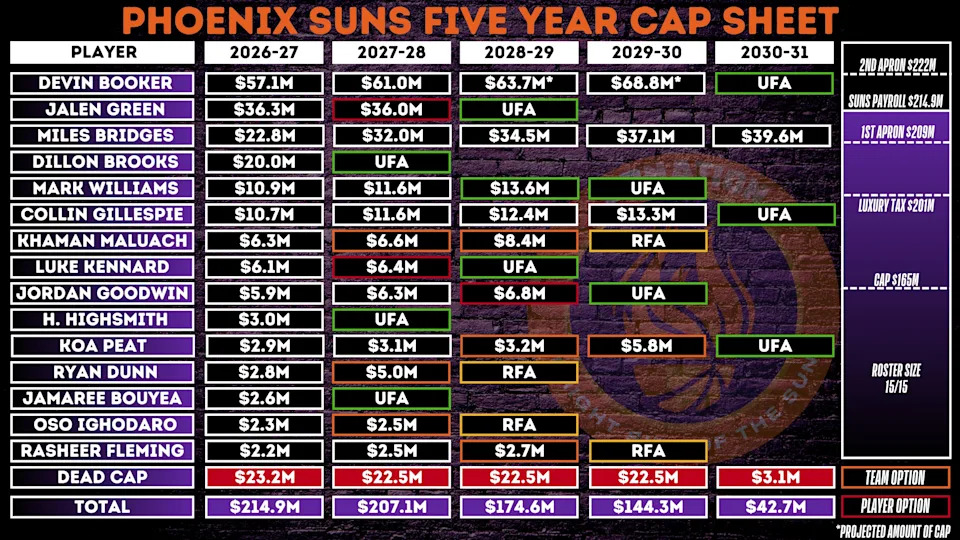
What is alarming about that number in both scenarios is the Suns’ total cap figure for the 2027-28 season. Yes, the salary cap will increase, along with the luxury tax and apron thresholds, but Phoenix would still be committing a significant amount of money to the roster. And all of this is without a Dillon Brooks extension, which could tack on another $25 million to the cap sheet.
Both of those contract structures represent the maximum amount Phoenix could offer. The Suns could offer Bridges less than 120% of his current salary in the three-year scenario or less than 140% once the six-month restriction passes. I’m providing the maximum values simply to illustrate the high-end possibilities and establish the ceiling of what a potential extension could look like.
It all depends on how the Suns believe Bridges aligns with their future. I wouldn’t be surprised if Phoenix ultimately takes the swing and signs him to one of those extensions. Why? Because the timelines align pretty well with the current path of the organization.
The Suns have young talent they’re in the process of developing, and those players can continue to grow alongside this current era of Suns basketball. Rasheer Fleming is the obvious player to watch as it pertains to a Bridges extension because he plays the same position at the four. We know injuries will occur, opportunities will arise for Fleming to earn playing time, and ultimately it comes down to how well he develops when those opportunities present themselves.
There is also a world in which the Suns opt not to extend Dillon Brooks, something they have yet to do, and Miles Bridges eventually moves to small forward while Fleming takes over as the starting power forward. Theoretical? Absolutely. But it’s a possibility nonetheless.
If the Suns were to extend Bridges for three years, Rasheer Fleming would be 25 years old when that contract expires. Fleming will also become eligible for a rookie extension next summer, even though he remains under contract through the summer of 2029 if the Suns exercise his team option in the summer of 2028. That gives Phoenix time to evaluate Fleming’s development while maintaining stability at the position with Bridges.
Then there is the money timeline. Devin Booker is under contract through 2030, the same timeframe in which the dead money finally comes off the Suns’ cap sheet. Extending Miles Bridges would align with that timeline.
Between now and 2030, the Suns have first-round draft picks. They might not be the most valuable first-round picks, but they do have ammunition in the proverbial draft gun to continue adding young players and prospects to the organization. That gives Phoenix multiple swings at development during the same timeframe in which they have NBA starting-caliber players attempting to remain competitive.
Why does that matter? Because there is no benefit to losing for the Suns over the next four years. They don’t control their own draft capital, so there is no reward for mediocrity. The best-case scenario for Phoenix is to continue fielding a competitive team that showcases the identity and culture the organization desires while winning basketball games. That environment also allows young players to earn minutes rather than having them gifted. For players who aren’t lottery picks, I believe that’s the best way to develop.
We should know in the coming weeks what the Phoenix Suns’ strategy is as it pertains to Miles Bridges’ contract. If July 14 arrives and they offer him the three-year extension, don’t be surprised.
While I believe the organization should be prudent and see how Bridges fits within everything the Suns have developed, they did give up that unprotected 2033 first-round pick. They most likely did so with a contract extension in mind. If they do extend him, the hope is that Phoenix doesn’t go all the way to the maximum 120% of his previous salary. The Suns have done an outstanding job this offseason bringing back their players while getting them on appropriate discounts. We’ll see if Brian Gregory can showcase those contract negotiation skills once again when it comes to Miles Bridges.
The other thing to remember, regardless of the length or value of the extension Bridges might receive, is that nothing is permanent. Giving him a contract now doesn’t mean the Suns couldn’t move off of it at some point down the road. If Rasheer Fleming pops as a player, Bridges naturally becomes more expendable.
Granted, we don’t know what the market for Bridges would look like at that exact time or what circumstances might lead to a trade. But if this offseason has taught us anything, it’s that almost any contract can be traded. I never thought Paul George would be moved given his production and the two years, $110 million remaining on his contract, but the NBA continues to find ways to surprise us.
So whenever that Bridges extension comes, it isn’t the end of the world or some permanent declaration about the future of the franchise. It’s simply where the Suns are now.
Read the full article here


