







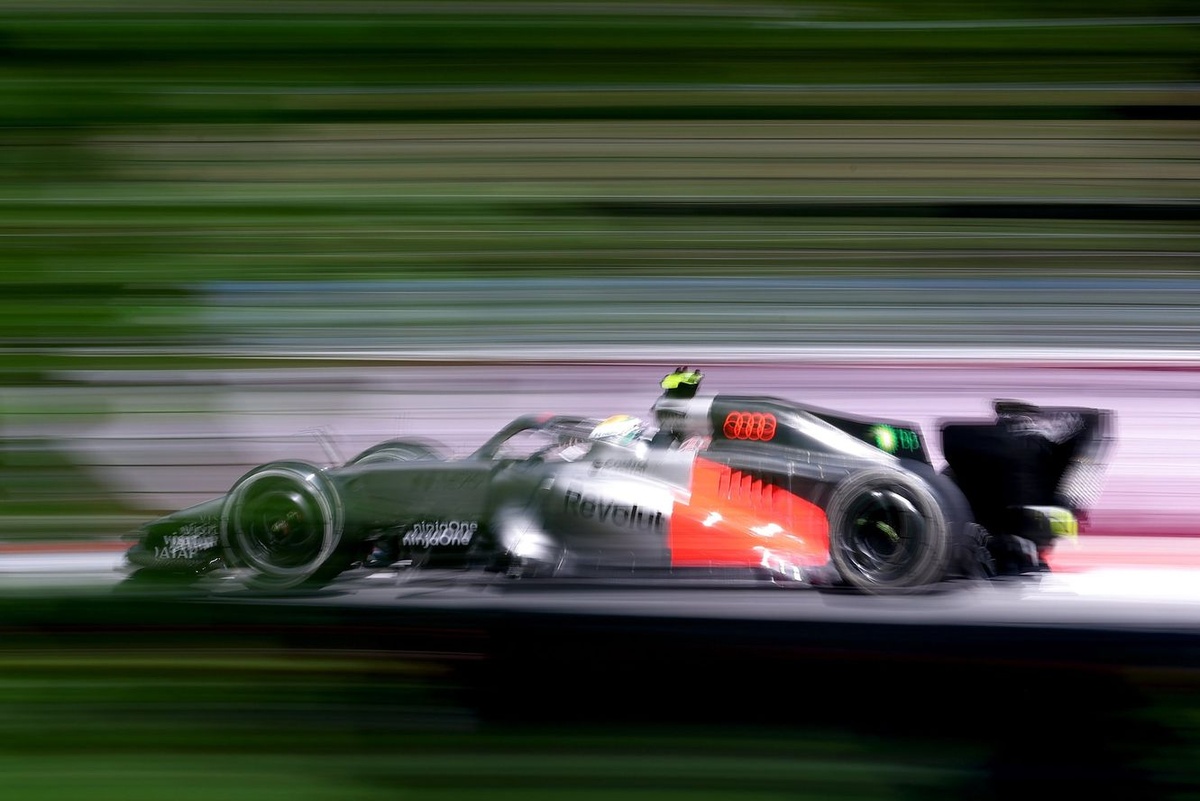
Although 2026 only marks the first season under the new Formula 1 technical regulations, extensive discussions are already taking place behind the scenes about the next regulatory cycle – formally scheduled to begin in 2031, but one that could be brought forward if sufficient support exists.
Both FIA president Mohammed Ben Sulayem and F1 CEO Stefano Domenicali have spoken positively about the prospect of V8 engines running on sustainable fuels, combined with a much smaller electrical component.
In a recent interview with Autosport, Domenicali explained that F1 should become less dependent on OEMs when shaping future regulations, although he stressed that broad support from manufacturers remains crucial for the sport.
That raises the question of whether Audi – which entered F1 with a strong sustainability-driven vision – could also accept a potential switch to V8 engines in 2030 or 2031.
“Yes, why shouldn’t we accept that? I mean, the Nuvolari has a V8 so we don’t have problems with V8 engines,” Dollner said, referring to the new hybrid supercar that Audi officially launched on Thursday.
“But you have to see that in the overall context. To just pick one question of a regulation is not really answering the overall question of where do you want to go with the regulation. The FIA is leading the process, we are part of that process, and I’m very optimistic that the outcome will be a good one.”
Gernot Dollner, Audi CEO
Photo by: Audi Sport
According to Dollner, it is even more important for Audi that the engine remains turbocharged, as efficiency is a crucial pillar of the Ingolstadt-based manufacturer’s long-term vision: “That’s definitely more important than talking about the number of cylinders. That’s crystal clear from an Audi perspective. We prefer turbo due to the efficiency aspect. That is more important than the number of cylinders.”
The Audi CEO also stressed that F1’s future regulations cannot be reduced to a discussion about cylinders alone. In his view, the broader vision for the series matters more.
“Talking about Formula 1 regulations, the most important aspect for Audi is that we keep the idea of being sustainable and having a regulation that has energy efficiency in the focus as a main pillar of Formula 1 regulations,” he said.
Why Audi is not surprised by F1’s changing direction
Audi is not surprised by the way F1’s long-term outlook appears to have evolved over recent months.
When the four-ring brand committed to F1, it did so amid a strong push towards electrification. However, Domenicali has argued that the automotive industry has shifted course since then and is placing greater emphasis on the combustion engine.
It is a view shared by Dollner, who acknowledged that Audi itself has also adjusted what were initially very ambitious electrification targets.

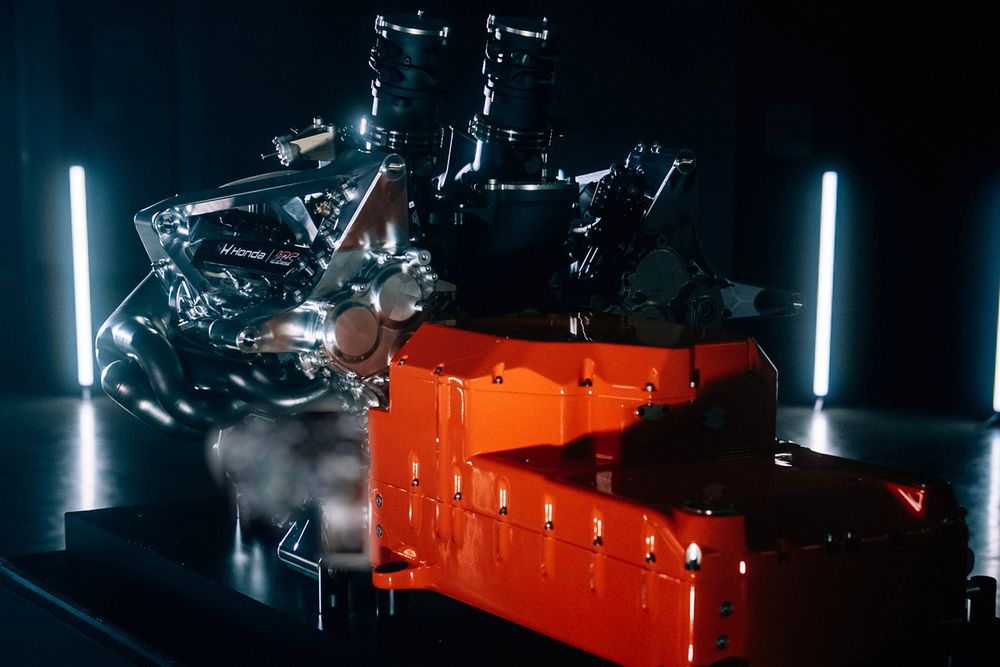
Changes for the 2027 power units are under discussion
Photo by: Honda
“In the automotive industry there was a global push towards electrification. Now we have a little bit of a backswing, but to put that into perspective, on the long end we will still see more and more electrification in the world,” he said when asked by Autosport.
“But for the next one or two, maybe three decades, we will still see combustion engines in high performance cars. That’s for sure. Formula 1, with the sustainable fuels, is showing that you can have a combustion engine and be sustainable at the same time. I’m not surprised by that discussion.”
In fact, this direction is directly reflected in Audi’s corporate strategy.
“When I became responsible for Audi as CEO, there was a decision within Audi to go all electric by 2032, and we also changed our strategies. They are being more realistic in that approach to be more flexible.
“So, flexibility in the technologies, combustion engine, plug-in hybrids, battery electric is our path to the future and we will need regional differences to meet the customer requirements.
“And so, a little bit it’s the same in Formula 1. You have to see where the trend is but definitely hybridisation, sustainability will play a role and that’s in line with our strategy.”
That means a V8 engine could be acceptable for Audi, provided that the bigger picture – and the FIA-led process behind it – develops in the desired direction: “We trust the process and we believe that the result will be a regulation where Audi is able to tick all the boxes.”
We want to hear from you!
Let us know what you would like to see from us in the future.
Take our survey
– The Autosport.com Team
Read the full article here


