

Free agency ain’t what it used to be.
When NBA free agency officially opens at 6 p.m. Eastern on June 30, there will be a rash of signings, but the biggest deals of the summer likely will already have happened. Free agency is not how the best players change teams anymore — if Giannis Antetokounmpo is leaving Milwaukee this summer, it’s via trade. That’s essentially how all the top players change teams — a year ago at this time, it was Kevin Durant being traded to the Houston Rockets. When it comes to free agency, changes to extension rules and unrestricted free agency make it generally smarter for a player to re-sign with his existing team (and then force a trade later, if that’s the goal).
Still, free agency saw some signings worth noting — last summer, it was how Myles Turner ended up in Milwaukee, Al Horford landed in Golden State, and Nickeil Alexander-Walker in Atlanta. Who will be on the move when free agency opens on June 30? Here are the biggest names on the board. (Reminder, a “restricted” free agent means his current team has the right to match any offer from another team.)
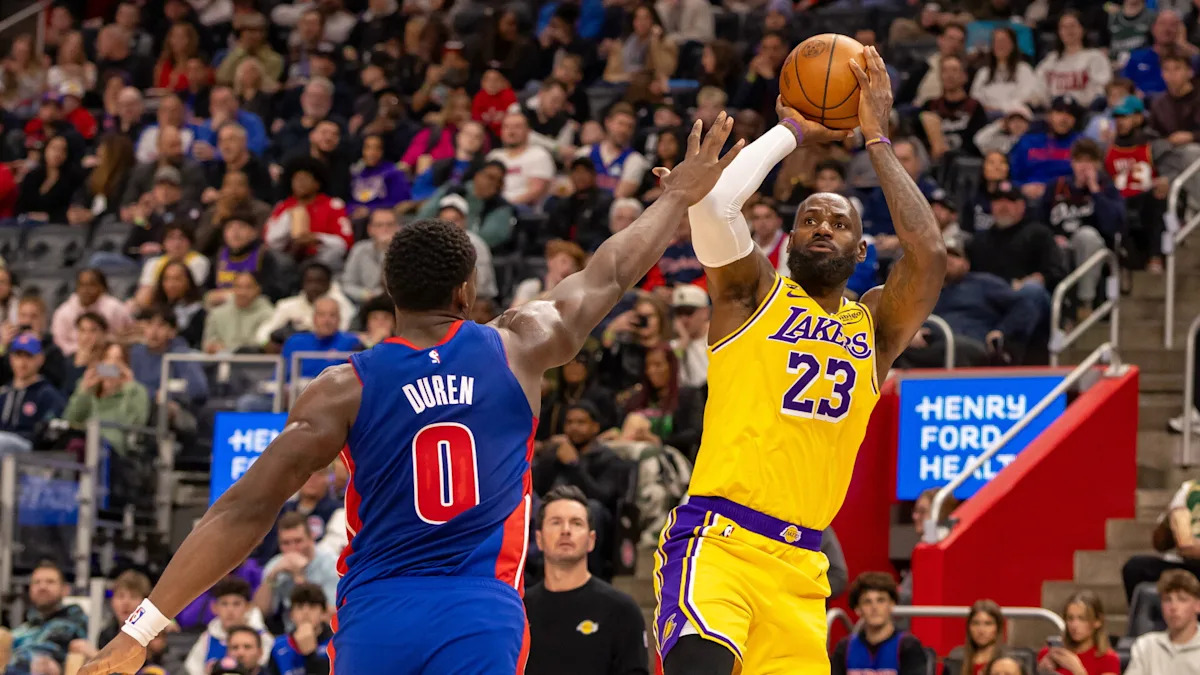
Detroit will re-sign Duren, who proved to be a critical core player for the No. 1 seed Pistons, averaging 19.5 points and 10.5 rebounds a game, shooting 65% and playing high-level defense.
The only question is, did his playoff swoon cost him money? After making All-NBA last season, his max is five years, $287.1 million. The Pistons would like to get him at a slightly lower number, but if they get too cute, there are teams with cap space — Chicago and Brooklyn are rumored to be lurking — who could put a max offer sheet and force the Pistons to match. All that said, Detroit can’t afford to lose him.
There’s a theme to the top of this list: The team with a player’s rights can’t afford to let the player walk, but would like to get them in at a lower number than the max. Enter Austin Reaves and the Lakers.
Reaves has proven to be a quality second option next to Luka Doncic and averaged 23.3 points and 5.5 assists a game. At 28, this is Reaves’ shot at generational wealth and he will opt out of the $14.9 million on his contract and is not giving the Lakers a steep discount this time around. Do the Lakers lock him up for five years at around $200 million or less, or something more like four years and $160 million? If the Lakers mess around here, Brooklyn is lurking, has cap space and can offer a max of four years, $178 million, forcing the Lakers to match. However it plays out, Reaves will be back with the Lakers next season.
Harden will be back in Cleveland, that’s a done deal. Harden and his team pushed to be traded from the Clippers last season because they did not want to extend the 36-year-old future Hall of Famer, but there is no way Harden signed off on a trade to Cleveland without a handshake deal for an extension already in place. The question is the number. Harden will decline his $42.3 million player option and sign a deal with a lower per-season number but a higher total, maybe something like two years, $70 million. Whatever the number, Harden is staying put.
There is a growing sense that LeBron James will re-sign with the Lakers, according to league sources NBC Sports has spoken with. Nothing else fits quite right. Part of that is simply money. LeBron is taking a steep pay cut from the $52 million max he earned last season, but if he goes to a team like Golden State, the best they can do is the $15 million mid-level exception (and if things break down with Los Angeles, expect that to be the outcome).
The Lakers have LeBron’s Bird rights and can (and likely would) pay more. Plus, LeBron is playing with his son, Bronny, in Los Angeles, and his family has established a life here. It’s a big ask to think he would give that up to go to Cleveland (who could only offer the $3.9 million veteran minimum — LeBron is not a minimum player). The Lakers have other priorities this offseason — re-signing Reaves, improving the center and wing positions around Doncic — but LeBron and Doncic mesh well, and it just seems like the best fit.
Watson’s value to the Nuggets was on clear display through his absence in the playoffs — he was out injured, and Denver was not the same team without his two-way wing play. Other teams noticed — the Lakers would love to bring Long Beach Poly’s own back to SoCal, he’s the kind of player they need — but Denver knows what they have and very likely re-signs him. Watson averaged 14.6 points a game last season, played well off Nikola Jokic, is a plus defender on the wing and shot 41.1% from 3-point range. The reported plan in Denver is to re-sign Watson and trade someone such as Christian Braun. Watson has some injury concerns, so the likely number he signs for is a little less than Braun’s five years, $125 million, but Watson should make something like five years, $95 million or more.
Hartenstein’s defensive physicality against Victor Wembanyama in the playoffs — he did a very respectable job on the Spurs’ alien — showed why the Thunder need to work out a long-term deal to keep the German big man. He’s not really hitting free agency, the Thunder will work out a deal where the team declines its $28.5 million option for next season, and he signs for three or four years at a slightly lower per-year number (maybe four years, $110 million).
The widely held expectation around the league is that Young will decline his $48.9 million player option for next season and re-sign with the Washington Wizards on a multi-year deal at a lower number (something like three years, $120 million, maybe with a partial guarantee on the final season). That said, the Wizards are a rebuilding team, and teams are eyeing Young as a potential trade target if they strike out in the Giannis Antetokounmpo sweepstakes (Miami has been mentioned). If Young picks up that player option, it’s a sign he’s on the move. That said, his staying in Washington on a more team-friendly deal seems the most likely outcome.
For a guy who played just five games last season due to shoulder surgery, there is a lot of buzz around Kessler. That’s because the 7’2″ big man brings to the table what a lot of teams are looking for: rim-protection, good on the glass, efficient scoring, and can body up Wembanyama defensively. Utah wants to keep him and pair him in a front line with Jaren Jackson Jr. and Lauri Markkanen.
The sticking point is money. The latest report, via ESPN’s Tim MacMahon, is that the Jazz offered five years, $140 million ($28 million per year average) and Kessler is unhappy with the negotiations and what’s on the table. For comparison, that salary is slightly higher than what Myles Turner got from Milwaukee a year ago and slightly lower than what Jarrett Allen is making in Cleveland ($30.2 million per season). While the Lakers and other teams are interested, they are not coming in much higher than what the Jazz have on the table, if at all. Expect the Jazz and Kessler to work out a deal, and we can debate if he holds a grudge about how this went down the next time his free agency comes up.
If Miami lands Giannis Antetokounmpo — and has to trade away players such as Tyler Herro and Kel’el Ware to make it happen — then they need to re-sign Powell for the depth. Powell is coming off an All-Star season in which he averaged 21.7 points per game, but at age 33, he has physically broken down before the last two playoffs. Miami likely re-signs him for a little more than $20 million a season (two years, $45 million?). If the Heat make the big trade, then Powell has leverage because the Heat need him. If the Heat strike out, it’s worth noting that it proved hard to play Herro and Powell together on defense last season, and Miami might want to rethink its options.
Minnesota may end up paying more than it wants to keep Dosunmu because he has all the leverage here. The midseason pickup proved his value in the playoffs, where he averaged 15.6 points a game off the bench, dropped 43 on Denver and showed he can be part of a dangerous team in Minnesota. With Donte DiVincenzo out most or all of next season, the Timberwolves need Dosunmu back. While they could offer the non-taxpayer mid-level exception at $15 million a season, to keep the unrestricted free agent, they may need to go a little higher (three years, $55 million?). If Minnesota tries to low-ball him, teams like Detroit or Miami could try to poach him.
After a championship run, New York has let it be known they want to re-sign Robinson and run it all back — and he earned his next check with some critical plays and minutes off the bench in the NBA Finals. He’s a starting-level center who pretty much has to come off the bench and play limited minutes due to health issues — expect 15-20 minutes a night for 60 games, then hope he’s healthy for the playoffs. Combine that with the Knicks being deep in the tax, and there start to be questions about the future, with teams like Boston, Los Angeles and Atlanta lurking. Still, after that run, expect Robinson to re-sign in New York at a little below the mid-level exception (three years, $40 million?).
There are not a lot of 6’8″ players who shot 44.7% from 3-point range last season and have shown the last couple of years they can step up and be better on the big stages in the postseason. Hachimura — and Luke Kennard — are players on the bubble to return to the Lakers as they rework the roster around Doncic, would a team like Detroit take a look at Hachimura and think he could slot nicely into the Tobias Harris minutes? Wherever he signs, look for him to make a little more than the mid-level exception ($18 million per season, or does that go up to $20 million?).
Collins has proven to be a rock-solid NBA rotation big man, a quality pick-and-roll big who can pop out and hit the 3 (he shot 40.6% from 3 last season) and is a respectable shot blocker and rim protector. The Clippers have his Bird rights and need him at the five with Ivica Zubac gone, so expect him to re-sign in Los Angeles, but other teams in need of a big man could do worse than to talk to Collins and see if they can get him at a fair price.
White is good enough to be a starter somewhere, but thrived after the trade deadline coming off the bench in Charlotte, where he averaged 15.6 points and shot 39.1% from 3. The expectation around the league is that he re-signs with the Hornets (and he might be an early Sixth Man of the Year favorite if he does). However, if a team looking for more shot creation, like Detroit, came calling, he’d have to listen.
One of the more interesting free agents on this list. He’s a 6’8″ high-level defensive wing player who has started to find his shot and hit 35.8% from 3-point range last season. He is exactly the kind of guy a lot of teams looking for two-way wings could use, and if teams like the Lakers can’t poach Peyton Watson from Denver, they might call about Eason. All of that is driving up his price, and he may find a deal in the $25 million a season range. Houston likely pays that to keep him, but it’s worth watching on a Rockets roster that is going to get expensive in the coming years.
He may be 34 and an undersized guard, but he was one of the biggest problems for the Knicks in the playoffs and showed he is still a threat. He was a great veteran fit with Atlanta after the trade last season, averaging 18.7 points a game, and the Hawks want him more than other teams. The buzz in league circles is that the Hawks want to re-sign him for one year with a big number ($30 million or so) as they continue to pivot to what is next.
Gillespie played himself into a healthy raise at age 26, showing he could be a starting point guard in this league and fitting well with Devin Booker in Phoenix. The max that Phoenix can offer is $15.6 million, but that (or a little less to keep the Suns out of the luxury tax) should be enough to get a deal done.
Can a team sign him and then put him in bubble wrap until the playoffs? Porzingis is exactly the kind of stretch big and elite rim protector who can help lift a team’s ceiling — he was huge for Boston’s title run. However, his injury history is too long to list here, and teams can’t bank on him. For a playoff team looking to take the next step, it’s a risk-versus-reward debate. Porzingis is only going to get a one-year contract (two at most), maybe around $15 million per season?
Green isn’t leaving the Warriors, the only question here is money and years. Green has a $27.7 million player option for next season, the expectation is he opts out and re-signs for two years at a slightly lower number (two years, $40 million?). Expect a deal to get done.
What is the going rate for a guy who can get you a bucket but is not really efficient (at or below the league average true shooting percentage the past few years) and is a defensive liability? He averaged 14.3 points per game and shot 38.5% from 3-point range. Look for a shorter-term contract, and he might well stay with the Bulls.
Read the full article here