







I am not a prospect hound. I don’t spend my time poring over scouting reports or watching tape. But that doesn’t mean that I am not interested in what’s happening on the Kansas City Royals farm. Those players playing in Omaha and Springfield and Davenport and Columbia have the potential to be future big leaguers, the potential to change the fortunes of the entire franchise.
So every year I like to peruse what I have access to: Minor League stats. And when I’m looking at those stats, I keep an eye out for guys with lines that interest me in one way or another. I have a system of sorts that I use, and though it’s basic I think it does pretty well. I look at four aspects of the stats:
-
Performance. I get that tools are important. But tools are meant to accomplish things on the field, and I value players who are productive.
-
Age. Until you get to the big leagues, you generally expect older players to dominate younger players. How often a player competes against older talent is an important indicator.
-
Skillset. How is a player accomplishing their production? Some skillsets translate better to big league play than others, and some deficiencies can be exploited more than others.
-
The Double-A line. Lots of guys are good in A ball. The upper minors are a crucible that separates guys who have a potential big league future and those who have a potential Banana Ball future.
Is this approach perfect? No. But I’m not in search of perfect. I’m in search of players who intrigue me and who I might want to spend time learning about because they could be future Royals.
Back in February, I applied this framework to Carter Jensen’s 2025 campaign. I argued that people were sleeping on Jensen, and that his track record and skillset at his age suggested that chances were really high that he’d end up as an effective big leaguer. Sure enough, Jensen has cruised to a 3.3 WAR season per Fangraphs this year–an incredible achievement for a rookie catcher. He’ll end up in the top three of the American League Rookie of the Year vote.
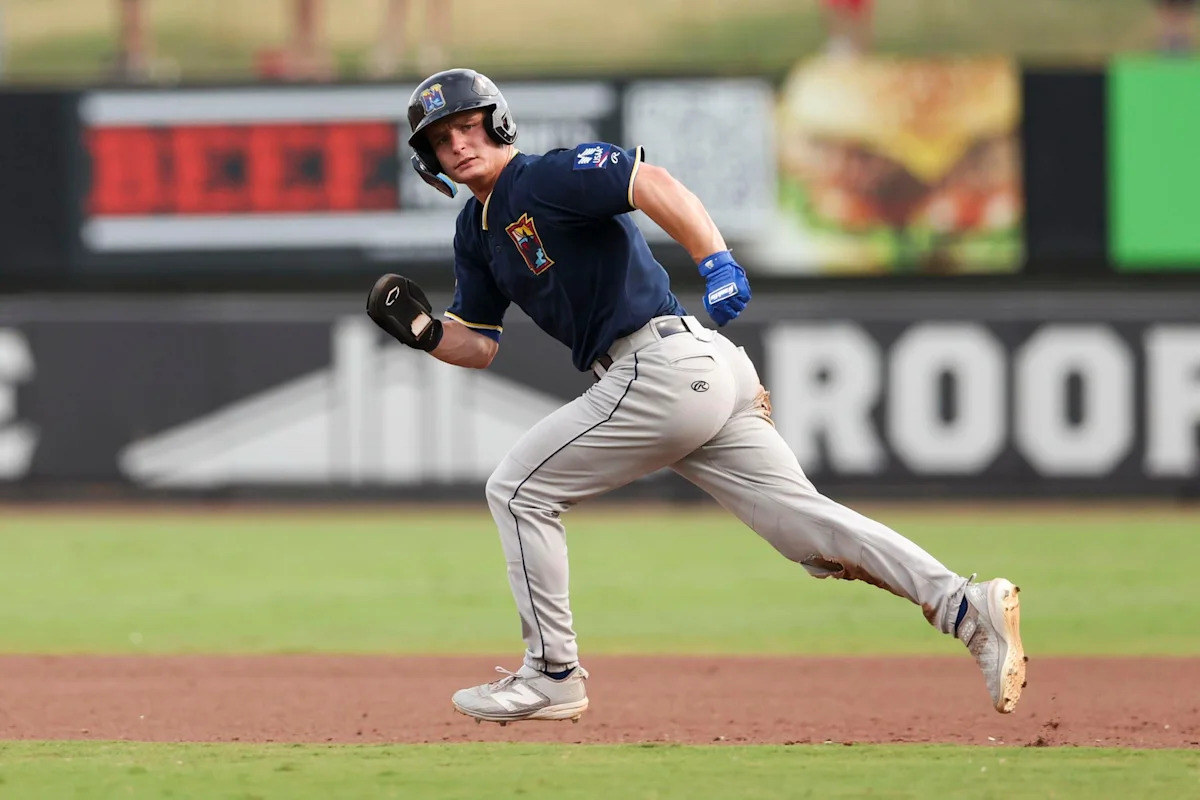
And now, I’m applying this framework to somebody a lot of Royals fans have no idea about: a 5′ 10″ utility player from Wisconsin by the name of Luke Pelzer. What, you might be asking, is so interesting about a guy drafted in the 17th round from the University of Illinois Chicago? I’ll tell you what: dude just hits.
After two full seasons in the minors with time in Columbia, Northwest Arkansas, and the Quad Cities, Pelzer has a robust .351/.429/.482 line. Oh, and this is coming off his senior year with the Flames where he hit .387/.455/.559.
Normally, you could chalk this up to a guy just being on a heater for a while–after all, batting average is a notoriously luck-dependent stat. Normally, you could chalk it up to your average late-round, no-power guy and point to Pelzer only having four home runs in those 565 minor league innings.
But I think there’s something there with Pelzer, for two key reasons. First: Pelzer’s swing is optimized to produce batted balls that result in hits. This year, Pelzer has posted a hilarious line drive rate of 27.5%. For context, there isn’t a single qualified hitter in Major League Baseball who has a line drive rate at 27% this season. Pelzer also limits fly balls, hitting them at a rate of 25.9% this year. And again, for context, only two of the 137 qualified MLB batters this year have hit fewer fly balls. Pelzer maximizes the types of batted ball events that could become hits and avoids the ones that become outs at a high rate.
The other reason is Pelzer’s plate discipline. Luke has walked 10.4% of the time this year and hasn’t walked below 10% in any of his three stops so far. It is pretty rare for a player with a contact-oriented swing to also have the eye to be able to take walks at the same time.
How rare is it? I took a look at all Minor League seasons dating back a decade with these qualifications:
-
At least one plate appearance in Double-A
-
Batting average at least .300
-
Line drive rate 27% or higher
Pelzer is one of only nine guys who qualify, and he has the highest batting average of anybody. Take a look:
|
Year |
Name |
Team |
Level |
Age |
PA |
BB% |
K% |
AVG |
OBP |
SLG |
wRC+ |
|
2026 |
Luke Pelzer |
KCR |
A+,AA |
23 |
482 |
10.4% |
20.7% |
0.336 |
0.407 |
0.466 |
128 |
|
2024 |
Kristian Campbell |
BOS |
A+,AA,AAA |
22 |
517 |
14.3% |
19.9% |
0.330 |
0.439 |
0.558 |
177 |
|
2023 |
Vaughn Grissom |
ATL |
AAA |
22 |
468 |
12.0% |
14.1% |
0.330 |
0.419 |
0.501 |
138 |
|
2016 |
Chance Sisco |
BAL |
AA,AAA |
21 |
497 |
12.3% |
17.7% |
0.317 |
0.403 |
0.430 |
130 |
|
2025 |
A.J. Ewing |
NYM |
A,A+,AA |
20 |
564 |
12.1% |
18.6% |
0.315 |
0.401 |
0.429 |
147 |
|
2025 |
LuJames Groover |
ARI |
AA |
23 |
547 |
11.5% |
14.4% |
0.309 |
0.399 |
0.434 |
120 |
|
2026 |
Murf Gray |
PIT |
A,A+,AA |
22 |
558 |
11.8% |
20.4% |
0.305 |
0.402 |
0.567 |
146 |
|
2026 |
Josue De Paula |
LAD |
AA |
21 |
588 |
13.8% |
14.8% |
0.303 |
0.401 |
0.547 |
145 |
|
2024 |
Nick Yorke |
PIT |
AA,AAA |
22 |
541 |
11.1% |
18.7% |
0.303 |
0.385 |
0.449 |
127 |
Now, none of those guys are world-beaters, at least not yet. But you know what they are? Big league players. Kristian Campbell, Vaughn Grissom, Chance Sisco, AJ Ewing, LuJames Groover, Josue De Paula, and Nick Yorke have all debuted with an MLB team. Murf Gray is a Top 100 prospect who is setting up a 2027 debut.
And then there’s Pelzer.
I want to be clear: I’m not saying that Pelzer is going to be the next Big Thing. The fact that he doesn’t hit for much power lowers his overall ceiling, and Pelzer is probably going to end up as a left fielder as opposed to a center fielder. That’s nice, but not a cornerstone defender or anything.
But what I am saying is that I think Pelzer is going to be a big leaguer, and it could happen as soon as next year. Keep an eye on him, because players with his performance and skillset don’t come along very often.
Read the full article here


