




The Hungarian Grand Prix may well prove to be a turning point for MotoGP, both in the short and long term. On track, Marc Marquez returned to winning ways, raising doubts among those who assumed the title was Aprilia’s to lose. Off track, however, attention has increasingly shifted toward next season and, more specifically, to the impact of the Manufacturers’ Association (MSMA) proposal to run just one bike per rider during practice sessions.
Autosport first reported on the possibility last month, and since then manufacturers have continued to move toward formalising the measure. What many initially dismissed as an unlikely idea is now close to becoming reality following the latest MSMA meeting, held on Sunday at Balaton Park.
Most manufacturers were represented by two senior executives and it will ultimately be the Grand Prix Commission that must formally approve the regulation change through a vote. However, Autosport understands that most teams already regard the proposal as highly likely to pass, despite significant reservations within garages and growing criticism of its potential consequences.
The origins of the proposal are worth highlighting. Manufacturers first introduced the idea as leverage in negotiations with MotoGP SEG, seeking a larger share of the financial benefits tied to the next commercial agreement covering the 2027-31 period. Cost reduction was presented as the central argument.
According to estimates from several executives consulted by Autosport, the savings could amount to roughly €1.5million per team. Those reductions would come primarily from two areas: smaller staffing requirements and lower mileage accumulated by the prototypes. At the same time, manufacturers are also pushing for shorter practice sessions, an idea that first emerged during the Italian Grand Prix at Mugello.
Teams left Mugello with what was effectively a verbal consensus in favour of the one-bike concept. That perception only strengthened the following Thursday at Balaton, where another meeting lasting more than three hours further consolidated support for the proposal.
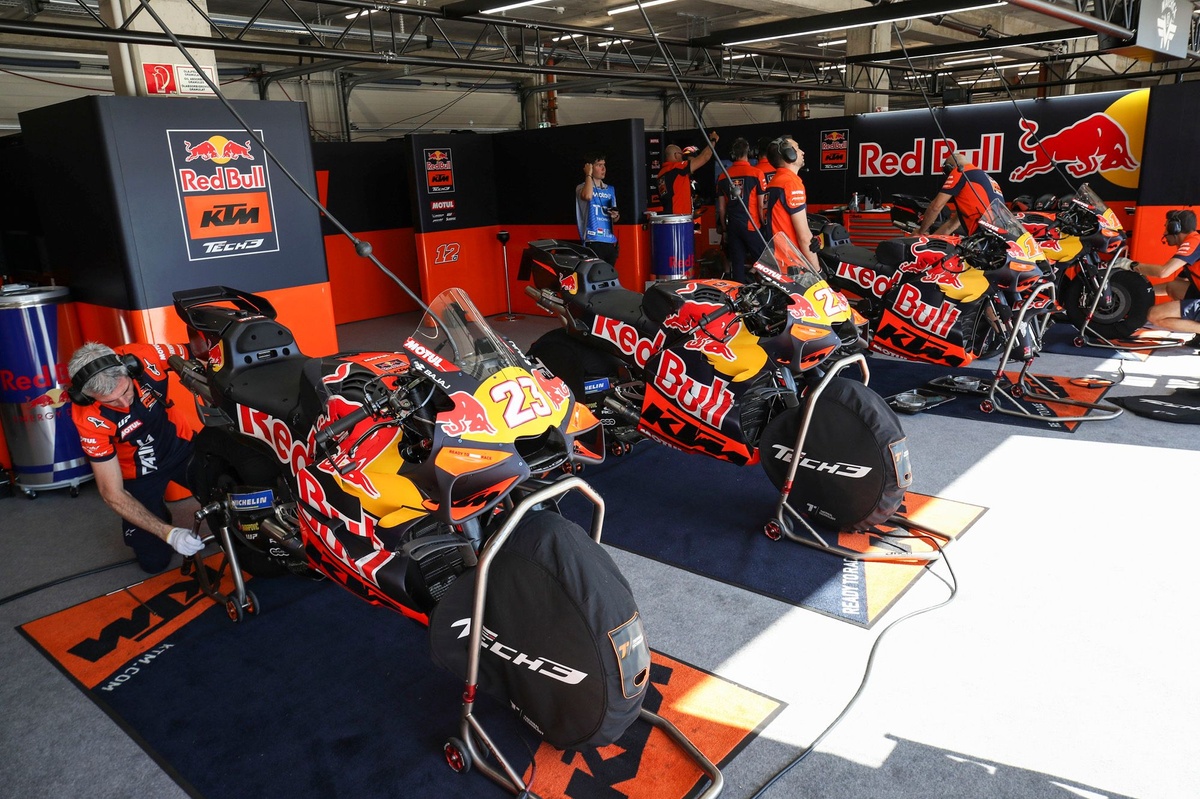
The proposal would still allow riders to have access to two bikes on race day
Photo by: MotoGP
The prospect of removing one of the two bikes from public view – with the spare machine kept at the back of the garage or inside the transporter during practice sessions – remains highly controversial. Not only would it have a major sporting impact, but it would also significantly slow motorcycle development at precisely the moment MotoGP is preparing to introduce an entirely new technical regulations package in 2027.
“From a development perspective, it would double the time needed to evaluate new parts,” a KTM engineer told Autosport. “At the moment, if we receive a new swingarm or chassis, we fit it to one bike and compare it directly against the other. With only one machine available, that process becomes much longer and far less efficient.”
MSMA members are scheduled to meet again on Wednesday via video conference. Yet after the developments in Hungary, it appears more realistic to expect discussions to focus on the finer details still to be defined – including a possible curfew to limit working hours and restrictions on which personnel can work on the bikes – rather than any serious attempt to reverse course.
Beyond the sporting and operational implications, the proposal also raises significant commercial questions.
Since Liberty Media’s acquisition of MotoGP, championship executives have pursued an ambitious growth strategy aimed at expanding the series’ global appeal and maximising the spectacle on track. It is difficult to reconcile that objective with a regulation that effectively removes one of the two motorcycles currently available to each rider.
The issue becomes particularly significant in the event of crashes. Under the proposed system, riders who fall at certain points during the weekend would be unable to return to the track until the next session. That would inevitably reduce on-track exposure for sponsors, potentially prompting commercial partners to revisit agreements that were negotiated under very different assumptions.
For a championship seeking to increase visibility and attract new audiences, the contradiction is difficult to ignore. What began as a cost-saving proposal may ultimately reshape not only the sporting landscape of MotoGP, but also the way the championship presents itself to manufacturers, sponsors and fans alike.
We want to hear from you!
Let us know what you would like to see from us in the future.
Take our survey
– The Autosport.com Team
Read the full article here


