

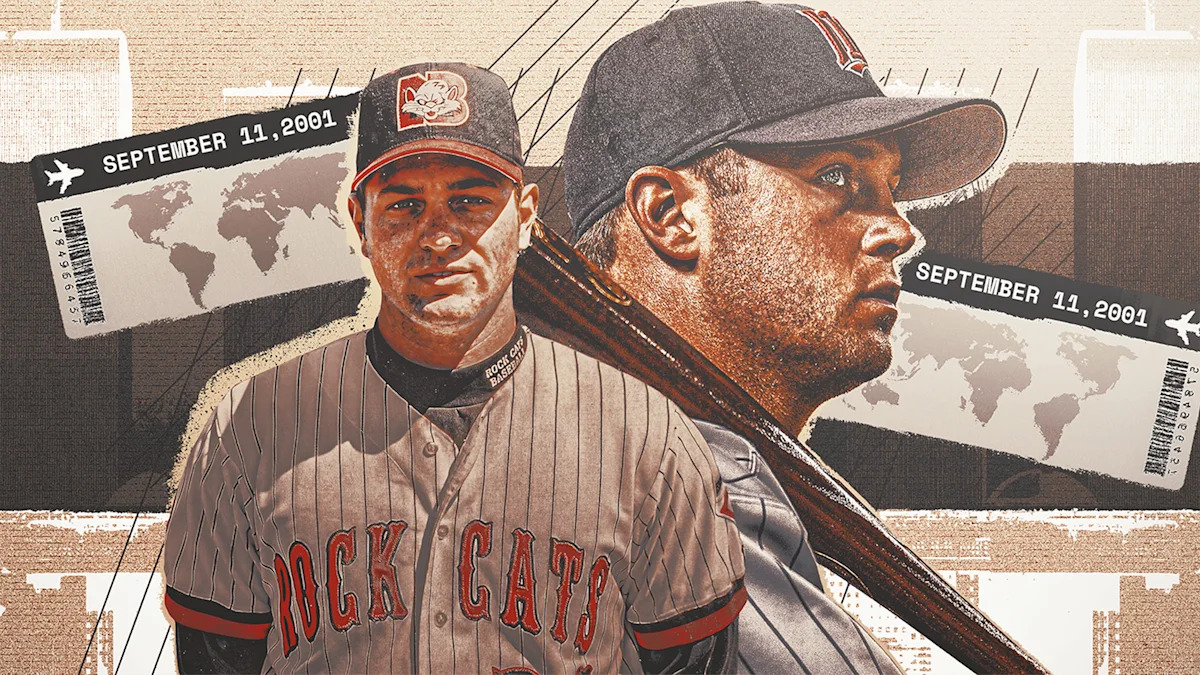
Michael Cuddyer was his team’s last hope when he stepped into the batter’s box at New Britain Stadium a quarter century ago.
There were two outs in the bottom of the ninth inning, the tying run was at first base and the New Britain Rock Cats trailed cross-state-rival Norwich by a run.
Over the course of a tense eight-pitch at-bat, Cuddyer validated his reputation as one of the crown jewels of the Minnesota Twins’ minor-league system. The 22-year-old slugger worked the count full against hard-throwing Norwich closer Domingo Jean. Then he got the fastball he was looking for and smashed it over the left-field fence to secure a dramatic walk-off win and send his teammates spilling out of the dugout.
If all Cuddyer’s blast did was alter the course of a best-of-five Eastern League divisional playoff series, it “would forever be part of New Britain’s baseball history,” the Double-A team’s longtime radio and TV voice Jeff Dooley told Yahoo Sports. After all, New Britain went on to eliminate Norwich in four games on September 9, 2001, with Cuddyer accumulating six hits in 12 at-bats during the series, including a second massive home run late in the clinching victory.
The legacy of Cuddyer’s exploits forever changed that fateful September 11 when al-Qaeda terrorists seized control of four commercial planes and deliberately crashed two of them into the World Trade Center’s Twin Towers. Before long, bewildered New Britain players and staffers discovered that Cuddyer hadn’t just won a playoff series with his home runs. He had also indirectly saved a teammate’s life.
Brad Thomas, an athletic, late-blooming, left-handed pitcher, planned to fly home to Sydney, Australia, whenever New Britain’s season ended. Team officials booked Thomas’ flights before they knew whether New Britain would win the divisional playoff against Norwich and advance to the Eastern League championship series.
On the morning of September 11, Thomas and his future wife Kylie were originally supposed to fly from Boston to Los Angeles on American Airlines Flight 11, the aircraft that hijackers rammed into the World Trade Center’s North Tower. Thomas and his girlfriend only avoided that doomed flight after Cuddyer’s walk-off bomb turned the playoff series against Norwich in New Britain’s favor and extended the Rock Cats’ season by another week.
“In light of what we later learned from Brad Thomas, that home run has taken on an entirely different meaning,” Dooley said. “What we thought was simply a great baseball moment turned out to be something much more.”
Brad Thomas spent parts of five seasons at the Major League level, just the 13th Australian to make it to the big leagues.
Brad Thomas spent parts of five seasons at the Major League level, just the 13th Australian to make it to the big leagues.
(M. David Leeds via Getty Images)
From Australia to Major League Baseball
Long before Brad Thomas pitched in the Minnesota Twins organization, the native of Sydney, Australia, considered soccer to be his first love. His parents only signed him up for baseball as a 9-year-old because they were hunting for activities to keep him occupied during the summer when soccer wasn’t in season.
Thomas showed immediate promise in baseball despite having little-to-no previous exposure to the sport. He doesn’t even recall watching the sport at all until he turned 11 and stumbled across a video of Kirk Gibson’s iconic pinch-hit home run in the 1988 World Series.
Even when Thomas did start watching more MLB games as a teenager, he seldom spotted any players with Australian ties. Second baseman Joe Quinn was the first Australian to reach the Major Leagues way back in 1884. It took 102 years before another Aussie achieved the same feat.
“I never thought I could play baseball as a job,” Thomas told Yahoo Sports with a chuckle. “Coming from Australia, it just wasn’t really happening back then.”
Thomas’ outlook changed as a 17-year-old when he participated in a national tournament that showcased many of Australia’s top young players. Major-League scouts in attendance came away intrigued by Thomas’ overpowering fastball and fluid, easy delivery. The tall, broad-shouldered teenager suddenly had a trio of teams willing to overlook his lack of guile and experience and bet on his physical upside.
Though the Los Angeles Dodgers won the initial battle for Thomas in 1995, a visa issue forced the club to release him in 1997. Thomas signed instead with the Minnesota Twins, one of the other teams that aggressively pursued him in Australia two years earlier.
One of Thomas’ first friends in the Twins organization was the team’s 1997 first-round draft pick, a right-handed power hitter with middle-of-the-lineup potential. Cuddyer and Thomas roomed together for six weeks in the fall of 1997 while participating in the Florida Instructional League, bonding over late-night meals and endless hours playing Playstation. They then spent parts of the next few seasons as teammates, climbing the rungs of the Twins’ minor league system together.
“We were going through all these life experiences at about the same age and we hit it off,” Cuddyer told Yahoo Sports. “We knew each other pretty well.”
By 2001, Cuddyer and Thomas were both pillars of a Double-A New Britain team loaded with future Major Leaguers. Cuddyer hit .301 and mashed 30 home runs and Thomas posted a team-best 1.96 ERA as the Twins’ Double-A affiliate went 87-55 to finish with the Eastern League’s best regular-season record.
The divisional playoff series against Norwich pitted two teams who had developed a distaste for one-another over the course of 20 hard-fought regular-season matchups. Players unanimously describe Cuddyer’s walk-off home run in the opening game as the series’ pivotal swing.
“The walk-off was huge,” New Britain outfielder Michael Restovich said. “In a short series, a best-of-five, whoever wins the first game has all the momentum. We were on cloud nine and their heads were down. You got the sense we put a big dent into them.”
When the New Britain Rock Cats fell asleep on the night of September 10, 2001, their foremost concern was preparing for the Eastern League Championship Series opener the following night against the Reading Phillies. They were confident that their toughest obstacle was behind them, optimistic that they were days away from celebrating a championship.
Hours later, hoisting a trophy suddenly felt trivial.
America was under attack, and one New Britain player was fortunate to be alive.

Brad Thomas, with his children Sivy and Justin. (Courtesy of Brad Thomas)
‘He changed my life’
On the morning of September 11, 2001, Thomas awoke to a ringing phone in his Connecticut hotel room.
It was his girlfriend’s father calling to make sure Thomas had seen that a plane had just plowed into the World Trade Center’s North Tower. Thomas thought the crash might turn out to be a tragic accident until he flipped on the TV in time to watch a second plane strike the South Tower.
“How could somebody do this?” Thomas remembers wondering to himself. “How could this even happen?”
Later that day, after Thomas and his teammates had gathered in the New Britain clubhouse, a team official approached the Australian pitcher with a dazed expression. That was how Thomas learned that he and his girlfriend originally had seats aboard the first of the hijacked planes, that they were nearly two of the flight’s 90-plus fatalities, that the outcome of an innocuous baseball playoff series essentially spared their lives.
“At first, I was in total shock,” Thomas recalled. “Then reality set in. I had nightmares about hijackings on planes and that sort of thing for a while. I struggled to fly on commercial flights for a long time afterward.”
The next few days were a whirlwind. President George W. Bush shut down U.S. civilian airspace and grounded all commercial planes. Major League Baseball postponed all games for six-plus days. The Eastern League canceled its championship series and declared New Britain and Reading co-champions, sending players on both teams scrambling to find a way home.
When the Minnesota Twins called Cuddyer up from Double-A that September, flights across the country were still grounded. Cuddyer made a 24-hour drive from Connecticut to Minnesota in time to make his big-league debut against the Cleveland Indians. In his third at-bat of the day, he secured his first of 1,522 career major-league hits, an opposite-field double off pitcher Chuck Finley.
Thomas and Cuddyer crossed paths occasionally during their post-9/11 baseball careers, first as teammates in the Twins organization and later as opponents when Thomas spent parts of two seasons pitching for the Detroit Tigers. Each time they saw each other, Thomas says he would make a point to “tip my hat and say thank you and that sort of thing.”
To Twins fans, Cuddyer is an important piece of six division championship teams during the 2000s. To Thomas, Cuddyer is a guardian angel. He knows that he and his ex-wife Kylie might not be alive without Cuddyer’s home runs against Norwich. He knows their two kids, 20-year-old Sivy and 12-year-old Justin, might never have been born.
“It’s always in the back of your mind,” Thomas said, his eyes tearing up and his voice cracking. “He changed my life. Things could have worked out a lot differently if we lost that playoff series. We wouldn’t be having this conversation today.”
For years, Cuddyer would downplay the idea that his home runs saved Thomas’ life. Now he openly acknowledges that he and Thomas will always be connected.
Cuddyer hit 197 home runs in his 14-year big-league career. He hit postseason home runs and walk-off home runs. He once even hit two home runs in the same inning. None of them, he says, were as “impactful” as the ones he hit in the Eastern League playoffs against the Norwich Navigators.
“On a baseball level, those were extremely impactful,” Cuddyer said, “and then you take it to a completely different stratosphere when you talk about 9/11 and Brad not being on that plane.”
Read the full article here