






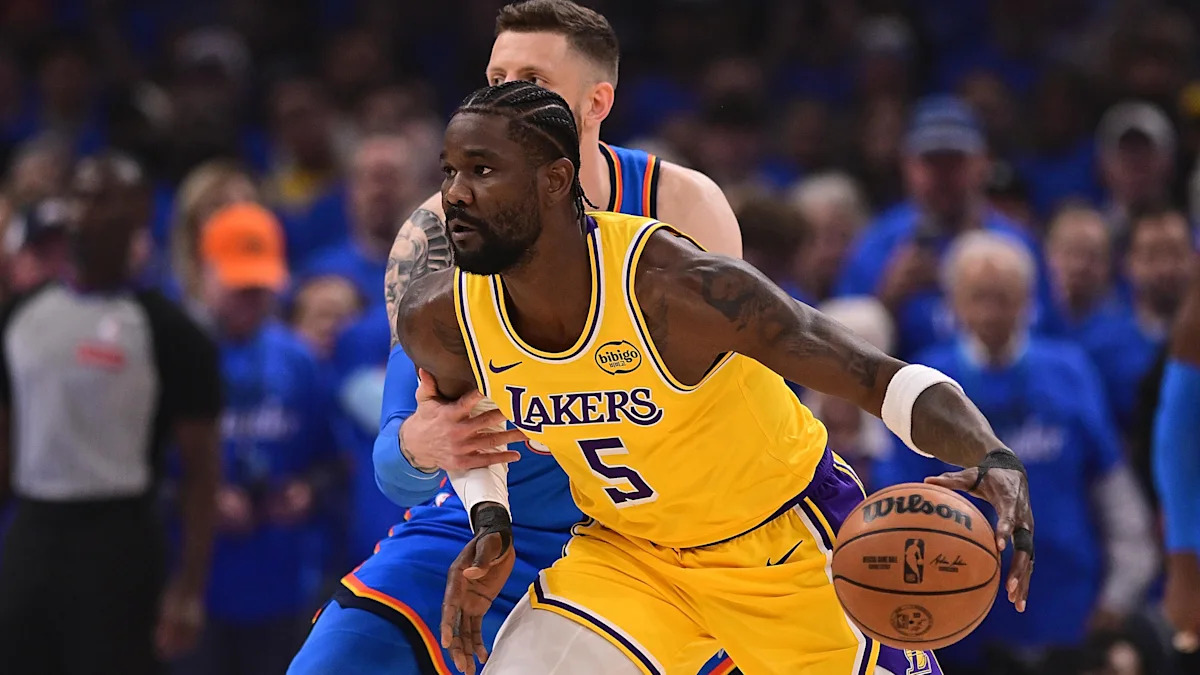
With training camp opening tomorrow, there’s time for one or two trips on The Statistical Doppelganger Machine. Next up: the guy who figures to be the team’s backup big man this season, DeAndre Ayton.
According to Basketball-Reference and other online sources, it only feels like Ayton has been in the NBA forever. Somehow, this will be only his ninth season. Somehow, he’s still just 28 years old.
Since going first overall in the 2018 NBA Draft — before players like Luka Doncic, Trae Young, Jaren Jackson Jr., Mikal Bridges, and Shai Gilgeous-Alexander — Ayton’s performance has been a frustrating mixture of good (at times) and puzzling. The puzzling part was often characterized by low motor and lack of awareness (especially on defense). His personality and attitude has been primarily frustrating, befuddling, and perhaps a bit delusional.
Coming off the bench for the first time in his career, DeAndre Ayton has a chance with the Washington Wizards to reset the direction of his career. | NBAE via Getty Images
Three teams have been happy to move on from him, including the Phoenix Suns, which he helped reach the NBA Finals and then back to the Western Conference semifinals the following two seasons. By the end, the Suns were dumping him — taking back Jusuf Nurkic, Grayson Allen, Keon Johnson, and Nassir Little — and getting no draft picks.
While Ayton’s individual production has been pretty good (his next below average PPA will be the first of his career), his impact on team metrics has been meh — modest positive on offense, about-the-same on defense.
The defense part is a bigger issue with a starting center, which Ayton has been throughout his career so far. He’s played 470 regular season games and not started seven times. All the non-starts came in his first two seasons. While he’s a legit seven-footer with better-than-adequate length, agility, and leaping ability, he’s not much of a shot blocker or rim protector. That loops back to the motor and awareness issues.
Even with effort, awareness, and attitude issues, Ayton’s still been a pretty good player. Certainly not what his teams have hoped he’d be, and not as good as his tools and talents would suggest he could be, but overall still an above-average NBA player.
Before running Ayton through the doppelganger machine, I kinda-sorta expected to see names like Joe Barry Carroll or Benoit Benjamin — talented 1980s-era bigs who had inconsistent motors, awareness, and attitudes. Ayton’s better than either, however. Ayton’s worst seasons (PPAs in the 130s) are about the level of Carroll’s and Benjamin’s best years.
This season could be a fascinating experiment for the Wizards and Ayton. Washington will be starting two centers, and one of them won’t be Ayton. The team should have plenty of minutes for Ayton — I figure Alex Sarr and Anthony Davis will consume 28-30 minutes each. Ayton could play another 28-30, and the team would still have 10-12 minutes a night at forward for someone else — perhaps Kyshawn George or AJ Dybantsa.
On the last year of an expiring contract, Ayton should be highly motivated to perform his very best. He could parlay a productive season into starting role with another team, or perhaps cement a spot in a Wizards big man triumvirate for the next few seasons. Of course, he could also low motor his way to a starting job with Olympiacos.
Let’s get to the doppelgangers. For new readers: this is the latest installment in a Bullets Forever annual Dog Days of Summer tradition, which involves me running players through my Statistical Doppelganger Machine. The Machine is a (not so) fancy-schmancy algorithm that compares the reference player season to every other NBA player season since 1977-78 and then tells me who was most similar. The Machine uses 14 statistical and biographical characteristics including minutes and age. While it doesn’t include position, players tend to get comps from their position group. The ones who don’t are usually interesting.
In this case, Ayton’s comps are not so interesting — at least positionally. Which is to say they’re all centers or 1990s/early 2000s power forward types.
Here are the player seasons with similar production at a similar age:
-
Richaun Holmes | 2020-21 | Sacramento Kings | Age: 27 — Worth mention that Holmes’ previous season ranked second most similar. While Ayton is physically bigger, their pace-adjusted production was remarkably similar across the 14 comparison points except for blocks (Holmes had more) and fouls (Holmes also had more). One other difference: Holmes was all effort all the time. If Ayton played with Holmes’ effort, he’d be first team All-NBA. Or perpetually injuried. These were Holmes’ two best seasons. Last season was something of a down year for Ayton.
-
Ivica Zubac | 2023-24 | Los Angeles Clippers | Age: 26 — Zubac’s career has been marked with year-to-year inconsistency. He posted a 184 at age 22, which he followed with a 121, 135, and 120. Remember, in PPA average is 100 and higher is better. In this comp season, he was on the way back up — 157, which he followed with a 183. Then he got hurt and his production dropped again. Interestingly, Zubac has faced criticism at different points of his career for his motor and alleged softness.
-
Derrick Favors | 2017-18 | Utah Jazz | Age: 26 — This was the first year of Favors’ short-but-high prime, which included a 200+ PPA at age 27. His last above average season was age 28, and he was out of the NBA after his age 30 season.
-
Loy Vaught | 1993-94 | Los Angeles Clippers | Age: 25 — Another guy whose career peak was around the level of Ayton’s “worst” seasons. This was the high point for Vaught (131 PPA). His production slid from there. After being a veritable Iron Man by playing in at least 73 games in each of his first seven seasons (80+ for the last three of those, including all 82 in 1996-97), the end of Vaught’s career was ruined by a serious back injury. His final NBA stop was in Washington — he arrived in the trade that sent Juwan Howard to the Dallas Mavericks.
-
Robin Lopez | 2015-16 | New York Knicks | Age: 27 — Known as Captain Hook during his year in Washington, this version of Lopez was still a good scorer on lower volume, offensive rebounding machine, and an all-82 iron man. Like Ayton, he was challenged on defense. He also generally seemed more interested in other stuff (like “feuding” with opposing team mascots) than basketball. That was often entertaining, like when he responded Hermione Granger. Which is both funny and wrong because Granger wasn’t a wizard at all — she was a witch. Also, the correct answer is Rincewind.
The honorable mentions are are most in that mid-tier big guy range who were pretty good at their best but either weren’t good enough to do better or weren’t always fully concerned with giving their best: Timofey Mozgov, Joe Smith, Jakob Poeltl, Tristan Thompson, and Randy Breuer.
Odds are that even if Ayton as a poor year by his standards, it’ll still be a significant improvement for Washington in the backup big man role. He’s a pretty good player who’s at something of a crossroads of his career.
Read the full article here


