

I’m here once again with a public service announcement to remind everyone not to believe everything they read on the internet. And to question motives behind some of the things you do see.
A couple of weeks ago, I warned about using LLMs and AI to do statistical data mining for you when it comes to basketball. Today, I’m warning you about prediction markets and their ability, and incentive, to manufacture a story out of almost nothing in an effort to get your attention, open your wallet, and put money into their systems.
We’re in the final dead stretch of the NBA offseason. Media days and training camps begin at the end of September, but until then, there simply isn’t much happening. Most transactions are complete. Rosters are largely set. Unless your team has suffered a major injury, which the Suns unfortunately have, there isn’t much real news to work with.
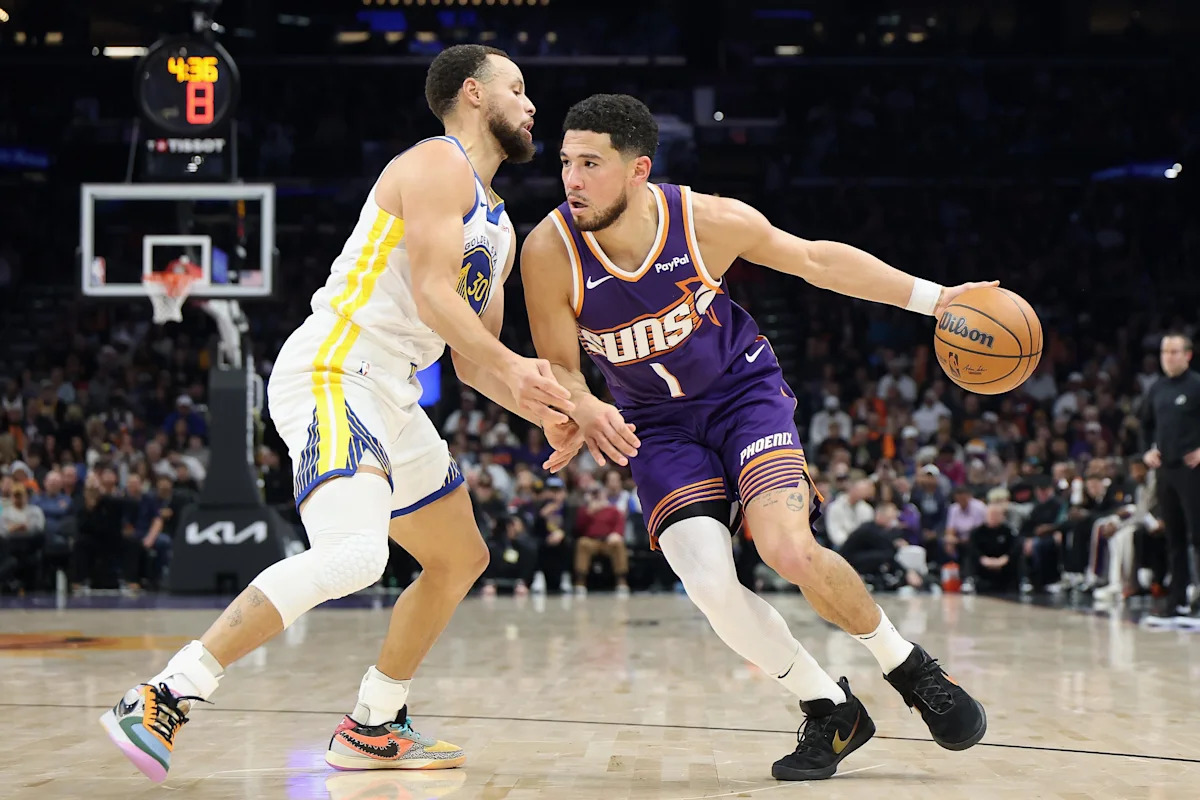
That isn’t going to stop prediction markets from trying to create some. Take what Kalshi NBA posted this weekend about Devin Booker and the supposed likelihood of him teaming up with Steph Curry, Steve Kerr, and the Golden State Warriors.
“I think the Warriors like [Booker] too much, if you ask me. Steve Kerr loves him,” Tim Kawakami recently stated on the Warriors Plus/Minus podcast. “Booker loved playing for Steve…I know the Warriors would be first in line saying, ‘We got three first-round picks we can give you’.”
To his credit, Kawakami is a respected journalist who covers the Golden State Warriors for The San Francisco Standard and has spent 35 years covering Bay Area sports. I’m sure he has sources within the organization who have told him the Warriors would have interest in Devin Booker. As someone who has a podcast himself, there are plenty of things I state that can be taken as speculative and/or out of context. But in the same breath, why wouldn’t the Warriors be interested? I might not have the same credibility, but I could go on my podcast tomorrow and say the Suns would have interest in Stephen Curry. Because of course they would.
That’s what makes this less about what Kawakami said on a podcast and more about what prediction markets did with it afterward. They took a relatively unsurprising piece of information and repackaged it in a way designed to generate engagement. That’s the part I find more concerning.
We’ve been living in the world of clickbait and engagement farming for nearly 2 decades now. The rise of the internet and the blogosphere fundamentally changed the way news is packaged and consumed, and prediction markets are simply another evolution of that same ecosystem.
There’s nothing new about shocking headlines. They sold newspapers long before the internet existed. The more eyeballs you attract, the more opportunities you create for advertising revenue, subscriptions, bets, or whatever product you’re trying to sell. And once money becomes attached to attention, the incentives become dangerous. A point of view can be exaggerated. Context can be stripped away. A relatively mundane fact can be repackaged as something far more sensational because sensationalism generates clicks, clicks generate action, and action generates money.
What really catches my attention, and concerns me, is that Kalshi NBA is the one pushing this information. And they aren’t alone. Polymarket picked it up too.
Both are federally regulated prediction markets where users can buy and sell yes or no contracts on everything from sports outcomes to politics, culture, climate, financial markets, and awards. Who wins the Nobel Peace Prize? What will the price of oil be? What team will Devin Booker play for next?
Yes, you can bet on Devin Booker’s next team.
And that’s where I start questioning the integrity of Kalshi NBA promoting something like this. Right now, their market has Booker staying with the Suns at 96%. The Warriors sit at 2%, with a payout around 31.2 times your wager.
So Kalshi can amplify a quote suggesting Golden State has interest in Booker, generate attention around that possibility, and then direct people toward a market where they can put money behind the very idea being promoted. That’s the part that bothers me. You’re no longer simply reporting or reacting to news. You have a financial incentive to make the possibility itself feel more legitimate, more urgent, or more likely than it actually is because every person convinced that maybe there’s something there becomes a potential customer.
I don’t have an issue with throwing a few bucks on sports here and there. For plenty of fans, it adds a little juice to a game they otherwise wouldn’t care about. What frustrates me is when prediction markets begin pushing highly unlikely stories while also providing the platform where people can wager on those stories becoming reality. Is a symptom of the potential problems created when the people or entities capable of influencing a market can move it with a single post, statement, or action. Strange times we live in.
Then you combine all of that with the accessibility of gambling and the growing concerns around problem gambling. According to AddictionHelp.com, 5.3% of people in North America gamble at a problem level compared with 1.9% worldwide, and betting through a phone app roughly triples the odds of experiencing problem gambling symptoms compared with other forms of betting. Profit off of pain, a tale as old as time.
When there is already a financial incentive to keep people wagering, manufacturing urgency around speculative information becomes even more troubling. And on the surface, we already know the answer here. There is no meaningful evidence suggesting Devin Booker is about to become a member of the Golden State Warriors.
There’s nothing wrong with exploring what a hypothetical trade might look like. That’s offseason fodder. It passes the time and can create interesting conversations about roster construction, salary flexibility, and the direction of different franchises. Those exercises aren’t really about predicting the future. They’re conversation starters.
The problem comes when a prediction market takes that speculation, amplifies it, and then stands ready to profit when people decide to bet on it. That’s when harmless offseason speculation starts to feel like something else entirely.
That’s the distinction worth remembering. Speculation is supposed to create conversation, not manufacture confidence. When the same entity amplifying the possibility also benefits financially when you believe it, skepticism shouldn’t be optional. Ask who is telling you the story. Ask what they gain from your attention. Ask whether there is actual reporting behind it. Because when someone is selling you the rumor and the bet at the same time, the safest wager is probably keeping your money in your pocket.
Read the full article here