







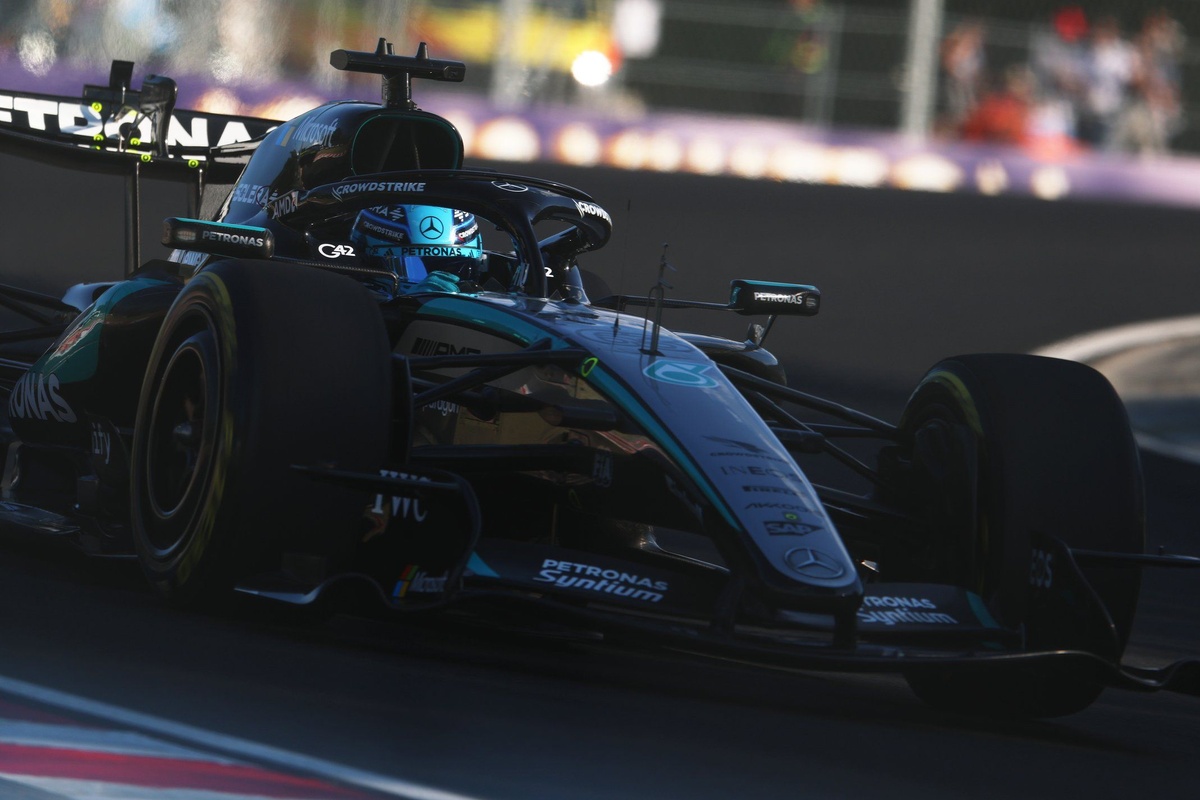
George Russell suffered a Mercedes Formula 1 engine software issue that put the revs out of control while on the Hungarian Grand Prix grid and triggered his slow start.
On Saturday, a water leak caused by hitting a kerb destroyed his engine, forcing Mercedes into an engine change ahead of the race. But on the grid an issue at the start triggered anti‑stall, costing him several positions and summed up his terrible run going into the summer break.
It was a far from smooth Hungarian GP weekend for Russell, who understandably admitted after the race that he needs a break to recharge following a first half of the season filled with more regrets than rewards.
Budapest was a perfect reflection of those frustrations. It wasn’t really about outright pace, and Russell himself admitted that even without the engine trouble a top three in qualifying would have been unrealistic. It was more about how a series of unlucky moments piled up and turned an already difficult weekend into something even harder to digest.
What went wrong for Russell at the start
The issue at the start that triggered the anti-stall is a clear example. But what actually happened? Over the radio, the team initially suggested it might have been a driver mistake, noting that Russell appeared to lift off the throttle during the launch procedure while the engine was revving high to build the necessary boost for the start.
Valtteri Bottas, Cadillac Racing
Photo by: Bryn Lennon / Formula 1 via Getty Images
However, while Russell did indeed lift his foot slightly, dropping from around 30% to below 10% throttle while the lights were still on, that was not the root cause but rather the consequence of another problem. As Toto Wolff explained after the race, there was a technical issue outside the driver’s control.
“It looks like that he gave about 10% throttle and the whole thing revved maximum, he went off the throttle and it popped down, so I’m really not happy about too many mistakes that happened. So that was the reason and then he drove very well,” explained Wolff, who later added to Sky Sports that the situation regarding reliability and technical issues in this first part of the season is simply unacceptable.
This reconstruction matches Russell’s words after the race. The British driver explained that at a certain point he noticed the engine revs climbing well beyond the threshold, which is why he tried to bring them back down by modulating the throttle. In short, his adjustment on the pedal was the consequence of the glitch, not the cause.
“I was on the throttle holding the revs, and then all of a sudden, about four seconds before the lights went out, the engine just started revving all over the place. And I was reacting with my throttle, and it wasn’t doing anything. So, the engine wasn’t reacting to the throttle,” explained Russell.
In fact, drivers must hold a precise throttle position to generate the required turbo boost. This is something drivers can also monitor directly on the steering wheel, since the launch procedure includes a display indicator showing whether the engine revs are too high or too low so they can adjust accordingly. Watching the onboard footage from the Mercedes, it is clear that the engine rev progression was far from linear while the five red lights were coming on, a detail fully confirmed by the telemetry.

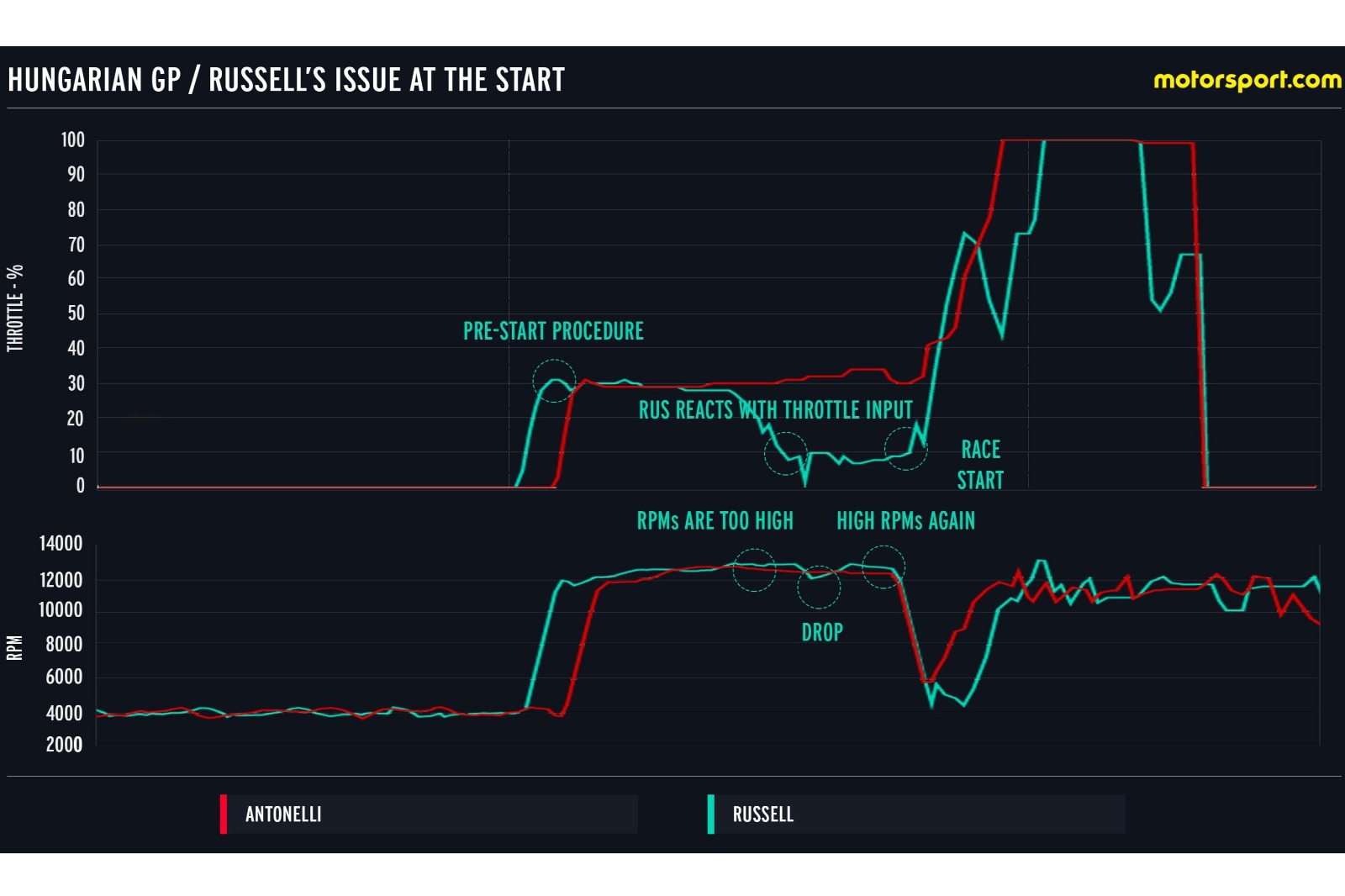
A comparison with his team-mate Kimi Antonelli highlights the issue clearly. At the start of the sequence, during the extra five second preparation period introduced this year, both drivers reached around 30% throttle as per standard procedure. However, while the Italian’s input and engine speed stayed perfectly stable at roughly 12300rpm, the situation for Russell was markedly different.
On Russell’s car, the engine began climbing past 12700rpm, briefly peaking as high as 12800rpm, which is an exceptionally high value. That is exactly why Russell, as he later explained, tried to modulate his throttle input by lifting his foot almost completely off the pedal. However, even that was not enough to stabilise the situation.
In fact, telemetry shows that for a brief moment the engine speed dropped well below 12000rpm, only to surge back up to around 12600rpm even though Russell was applying less than 10% throttle.
That is where the second part of the issue came from, as when Russell launched off the grid, he was holding the throttle at only 9% and could not push it any further, whereas Antonelli was at 30% to generate the usual launch momentum.
When Russell tried to get away from his grid box, the engine suddenly lost a significant amount of revs, likely also because he was starting with under 10% throttle. While Antonelli’s engine speed hovered around 5800rpm at the moment of clutch release, Russell’s dropped to 4500rpm. Without enough drive, the car triggered anti-stall.
It was a problem that compromised Russell’s entire race, and one that the team had actually already encountered during pre-season testing in Bahrain. “It was obviously a brand-new engine. I think it was something we had seen in pre-season at one point, but I have no idea,” Russell admitted.
We want to hear from you!
Let us know what you would like to see from us in the future.
Take our survey
– The Autosport.com Team
Read the full article here


