



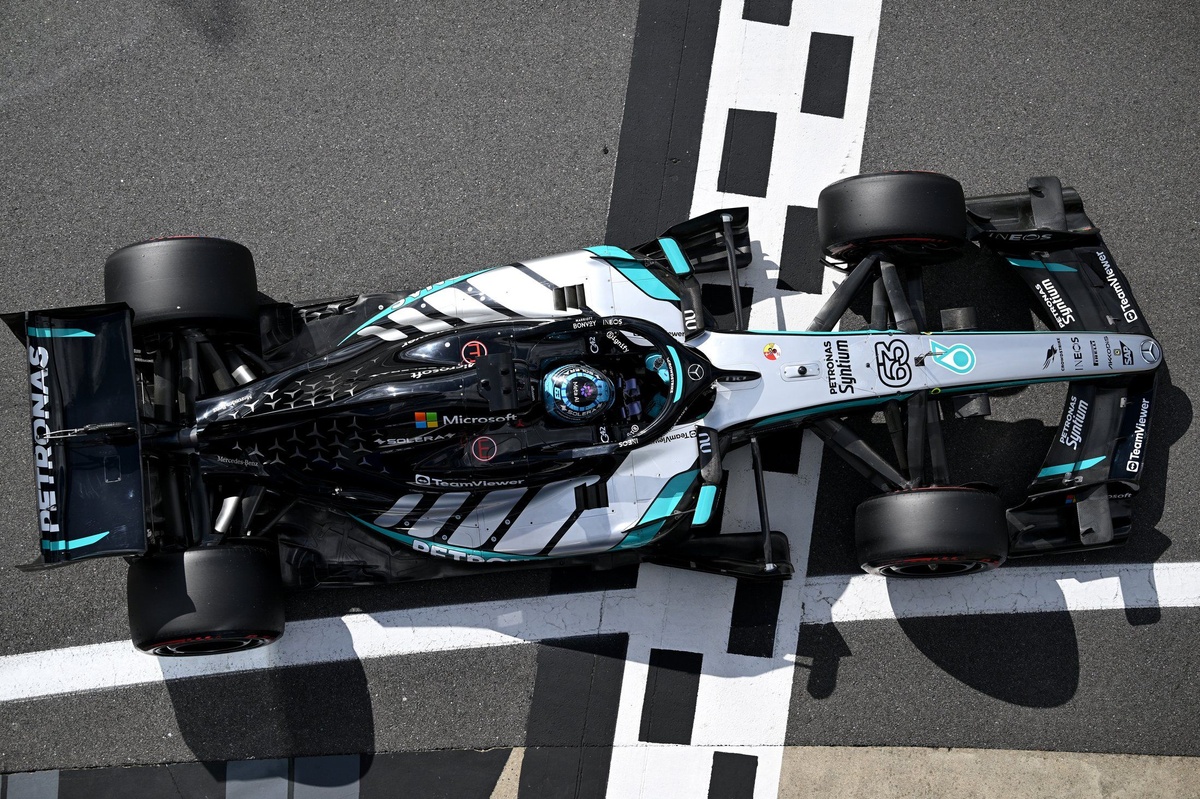
During qualifying for both races over the British Grand Prix weekend, one curious detail caught the eye: both Mercedes drivers completely lifted off the accelerator just a few metres before crossing the finish line. It’s unusual behaviour, because drivers normally try to cross the line with the throttle pinned to squeeze out every last hundredth of a second.
Paradoxical as it may seem, there are situations in which lifting off the throttle before the finish line can actually be an advantage by exploiting certain nuances of the regulations. After qualifying, Kimi Antonelli mused about the counter-intuitive nature of what he was having to do.
“It wasn’t easy,” he said.
“In Q3 I also had to lift off, and with these power units it’s always a bit complicated because sometimes you have to drive in a way that doesn’t feel completely natural. Sometimes you have to get back on the throttle later, so through the fast corners you carry more speed and only open the throttle afterwards.
“You might lose a little on corner exit, but then you make it back because by delaying the moment you get back on the throttle, you have more energy available further down the straight.
“That’s why the simulator work is so important – to make sure these things become automatic. At first, you even find yourself wondering why you should lift off at all.
“It’s complicated, but thanks to the preparation we did together with the team, it all became almost second nature.”.
Andrea Kimi Antonelli, Mercedes
Photo by: Sam Bagnall / Sutton Images via Getty Images
What Antonelli was describing is a principle that applies to every team. For example, as early as Friday Ferrari had instructed Lewis Hamilton to carry more speed into and through the Becketts complex so that he could delay getting back on the throttle before the Hangar Straight. Clearly, this means giving up a little performance on corner exit, but the key point is that it allows the MGU-K to remain deployed for longer on the straight, where the performance gain is greater.
Mercedes’ clever trick in this case, though, is based on a slightly different principle – and one that’s particularly interesting because it highlights just how intricate these regulations are. When the MGU-K is switched off, the FIA requires teams to follow a progressive power reduction ramp for safety reasons.

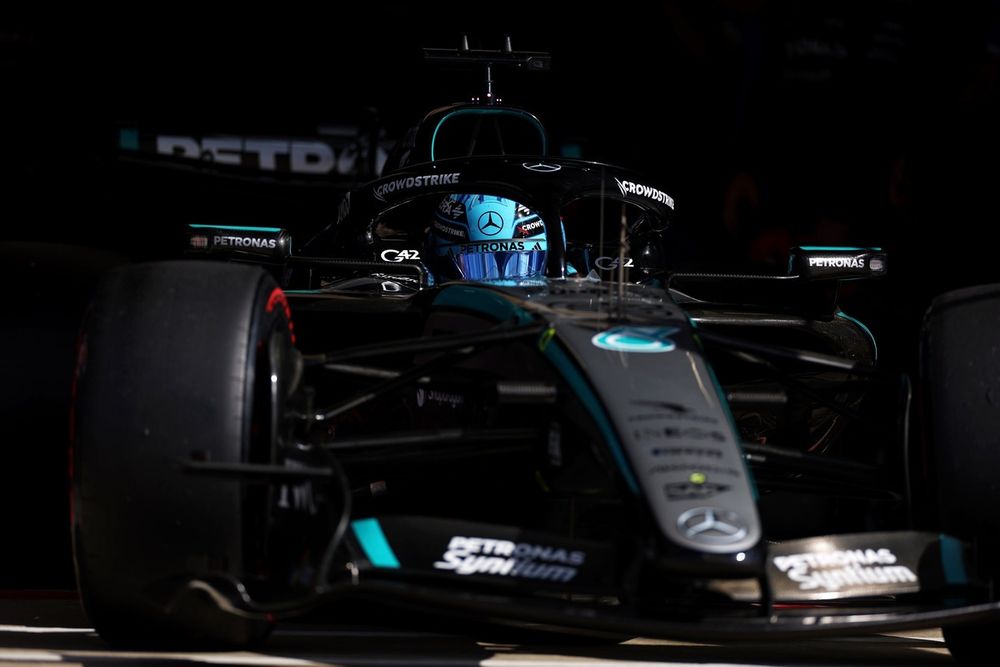
George Russell, Mercedes
Photo by: Alastair Staley / LAT Images via Getty Images
Why the power reduction ramp exists
Imagine a long straight. If a car were suddenly to switch off its electric motor, dropping instantly from 350 kilowatts (kW) to zero, it would create a safety issue because the driver would lose around 500 horsepower all at once. For that reason, on a fast circuit such as Silverstone, the regulations require the power reduction to occur in a linear fashion, limiting the rate of decrease to a maximum of 50 kW per second.
It’s a rule designed primarily for safety, especially during races, where a non-linear loss of power could create excessively large speed differentials between cars. In qualifying, though, the situation is different.
On a flying lap, teams want to extract every last joule of energy. Earlier this season some teams, including Mercedes and Red Bull, found a way around this rule by activating the emergency procedure that switched off the MGU-K.
Because this created the risk of dangerous situations – given that the MGU-K would remain disabled for around a minute – the FIA decided to ban the use of this tactic for performance purposes in qualifying.
Mercedes has now found an ingenious way to achieve the same effect through a careful (and entirely legal) interpretation of the regulations, allowing the MGU-K’s power to be cut much more quickly, even though some might argue that the rule was never intended to be used in this way.
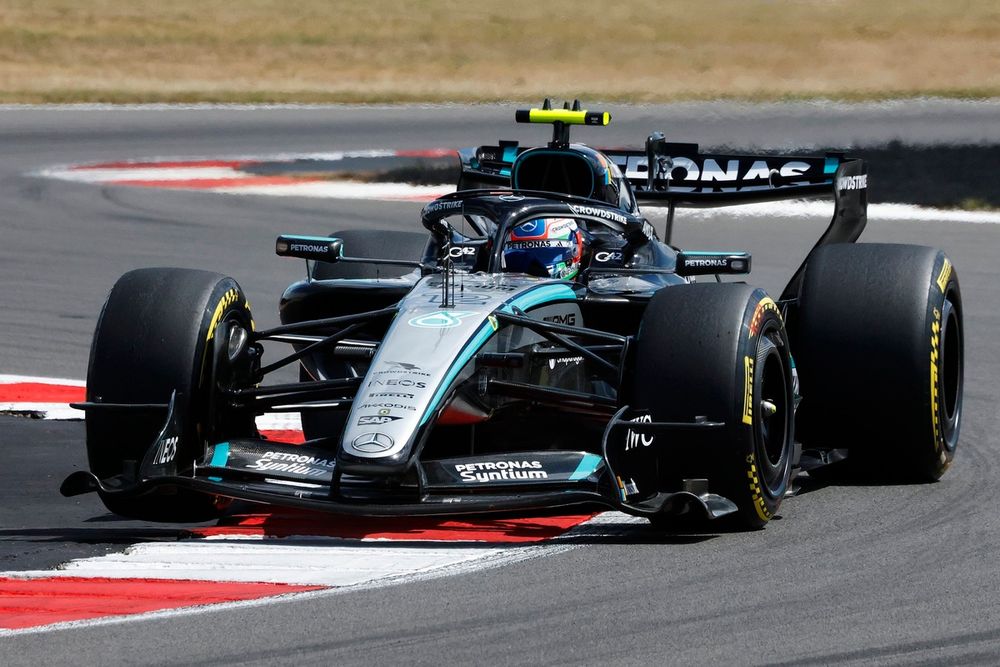
Andrea Kimi Antonelli, Mercedes
Photo by: Sam Bloxham / LAT Images via Getty Images
Lifting before the finish straight to cut power quickly
The key question Mercedes asked was: under what circumstances can the power reduction ramp be bypassed? The regulations specify several situations in which the MGU-K’s output may be reduced more rapidly. One of these occurs when the driver completely lifts off the throttle: the internal combustion engine no longer requires power – in fact, it begins to decelerate – and the MGU-K must respond accordingly.
If the electric motor continued to deliver power when the driver came completely off the throttle, the car would not decelerate as the driver intended. This is exactly the principle that Mercedes exploited so cleverly.
It has programmed the electronic control unit so that, using the car’s position on the circuit as determined by the distance travelled, it would not follow the normal power reduction ramp. Instead, it would keep the MGU-K delivering maximum power.
The drivers then simply had to lift off the throttle a few metres before the finish line. Before the battery energy was fully depleted, the MGU-K could shut off its power output instantaneously rather than following the gradual reduction ramp, while still remaining fully compliant with the regulations.
It’s an exceptionally clever solution, even if it feels completely counterintuitive from the driver’s perspective – hence the need to rehearse it extensively in simulation, and why other teams have yet to adopt it.
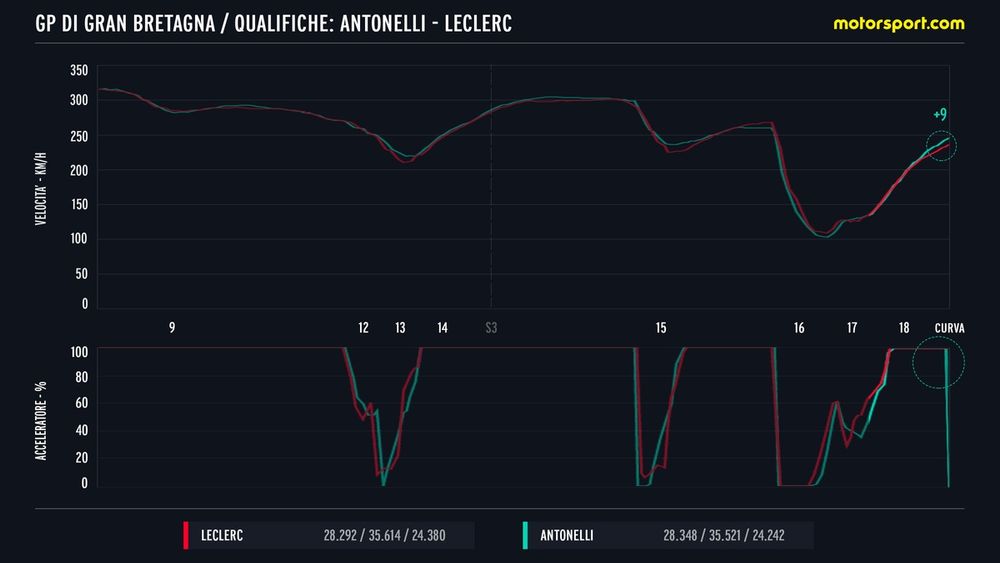
Mercedes strategy for MGU-K deployment
At Silverstone, this trick can be particularly effective for two reasons. First, the section from the final corner (Club) to the timing line is relatively short, making it easier for the driver to lift off just before crossing the line. Second, through both the final chicane itself (Vale) and its exit, the FIA regulations already provide several opportunities to reduce power quickly and conserve energy for the final burst down the straight.
Clearly, a system like this has to be programmed with great precision, both from the driver’s side and within the electronic control unit. The software must know not only when the battery is about to be depleted but also exactly where the car is on the circuit, so that it can instruct the MGU-K to continue deploying energy at maximum power instead of beginning the normal power reduction.
Speaking after Saturday’s qualifying session, McLaren team principal Andrea Stella said he had been surprised by what he saw.
“When we first noticed it yesterday in sprint qualifying, as Antonelli was doing it, it caught us a little by surprise because it’s not something we’d discussed,” he said.
“I’m not even sure it’s available to us, because it probably requires some additional elements, let’s say, in order to exploit the power unit in that way.
“As I’ve said before, there are certainly technical discussions ongoing with HPP to make sure we’re taking full advantage of everything this power unit has to offer, because it’s an extraordinary piece of engineering. There’s a lot of performance in it, and much of that comes down to the details of how it’s used.
“We’re now waiting to understand whether we can update to the latest specification and whether that might help in this area. It should only be a reliability update, so I don’t think that’s really the key issue.”
We want to hear from you!
Let us know what you would like to see from us in the future.
Take our survey
– The Autosport.com Team
Read the full article here


