A hypothetical: Joel Embiid plucks the board off the glass. What happens next?
He quickly turns and flings a pass ahead to LeBron James, who has already started bolting down the right flank on the break.
James may be 41, but he remains strong and powerful, so he glides past the first line of defense. But when help crashes in on him, James skips the ball across the floor to Tyrese Maxey.
Maxey pump fakes, but the defense closes in on him, too, so he waits for Embiid to catch up and settle at the top of the key. Maxey tosses Embiid the ball before slashing immediately to the paint on a give-and-go.
Embiid returns to Maxey, who is met at the basket by a rim protector, so Maxey contorts in mid-air, zipping a pass to Jaylen Brown near the right baseline for a corner 3.
1 / 23
Look back at LeBron James’ iconic Lakers moments
Los Angeles Lakers forward LeBron James (6) reacts after scoring a basket during the fourth quarter against the Houston Rockets at Toyota Center on Dec 28, 2021.
(Troy Taormina, Imagn Images)
1 / 23
Look back at LeBron James’ iconic Lakers moments
Los Angeles Lakers forward LeBron James (6) reacts after scoring a basket during the fourth quarter against the Houston Rockets at Toyota Center on Dec 28, 2021.
(Troy Taormina, Imagn Images)
2 / 23
Look back at LeBron James’ iconic Lakers moments
LeBron James answers a question during an interview session with reporters during the Los Angeles Lakers media day at the UCLA Health Training Center on Sept. 24, 2018 during his first season with the team.
(Robert Hanashiro, Imagn Images)
3 / 23
Look back at LeBron James’ iconic Lakers moments
Los Angeles Lakers forward LeBron James goes up for a dunk in the second half of the game against the Charlotte Hornets at Staples Center on Oct. 27, 2019.
(Jayne Kamin-Oncea, Imagn Images)
4 / 23
Look back at LeBron James’ iconic Lakers moments
Los Angeles Lakers forward LeBron James celebrates after a dunk by guard Danny Green during the second quarter against the Atlanta Hawks at Staples Center on Nov. 17, 2019.
(Kelvin Kuo, Imagn Images)
5 / 23
Look back at LeBron James’ iconic Lakers moments
Los Angeles Lakers forward LeBron James takes center court to speak to fans before the game against the Portland Trail Blazers at Staples Center on Jan. 31, 2020.
(Jayne Kamin-Oncea, Imagn Images)
6 / 23
Look back at LeBron James’ iconic Lakers moments
Los Angeles Lakers forward LeBron James gestures to a referee after a foul call during the first quarter against the Memphis Grizzlies at Staples Center on Feb. 21, 2020
(Robert Hanashiro, Imagn Images)
7 / 23
Look back at LeBron James’ iconic Lakers moments
LeBron James and Anthony Davis of the Los Angeles Lakers in a Black Lives Matter Shirt kneel with their teammates during the national anthem prior to the game against the LA Clippers at The Arena at ESPN Wide World Of Sports Complex on July 30, 2020 in Lake Buena Vista, Fla. on July 30, 2020.
(Pool photo by Mike Ehrmann via Imagn Images)
8 / 23
Look back at LeBron James’ iconic Lakers moments
Los Angeles Lakers forward LeBron James (23) holds up four fingers after winning his fourth NBA championship after game six of the 2020 NBA Finals at AdventHealth Arena on Oct. 11, 2020.
(Kim Klement, Imagn Images)
9 / 23
Look back at LeBron James’ iconic Lakers moments
Los Angeles Lakers forward LeBron James reacts after receiving 2020 NBA Championship ring before a game against the Los Angeles Clippers at Staples Center on Dec. 22, 2020.
(Kirby Lee, Imagn Images)
10 / 23
Look back at LeBron James’ iconic Lakers moments
Los Angeles Lakers forward LeBron James lands on fans sitting court side as he dives after a ball in the second half against the Los Angeles Clippers at Crypto.com Arena on Jan. 24, 2023
(Jayne Kamin-Oncea, Imagn Images)
11 / 23
Look back at LeBron James’ iconic Lakers moments
Former Los Angeles Lakers player Kareem Abdul-Jabbar hands the game ball to forward LeBron James (6) after James becomes the NBA all time scoring leader against the Oklahoma City Thunder during the second half at Crypto.com Arena on Feb. 7, 2023.
(Gary A. Vasquez, Imagn Images)
12 / 23
Look back at LeBron James’ iconic Lakers moments
Los Angeles Lakers forward LeBron James (6) with forward Anthony Davis (3) during a stoppage in play against the Minnesota Timberwolves in the second half at Crypto.com Arena on April 11, 2023.
(Gary A. Vasquez, Imagn Images)
13 / 23
Look back at LeBron James’ iconic Lakers moments
Los Angeles Lakers forward LeBron James dunks the ball against the Philadelphia 76ers during the second quarter at Wells Fargo Center on Nov. 27, 2023.
(Bill Streicher, Imagn Images)
14 / 23
Look back at LeBron James’ iconic Lakers moments
Los Angeles Lakers forward LeBron James shoots the ball against New Orleans Pelicans forward Zion Williamson (1) in the NBA In Season Tournament Semifinal at T-Mobile Arena on Dec. 7, 2023.
(Kyle Terada, Imagn Images)
15 / 23
Look back at LeBron James’ iconic Lakers moments
Los Angeles Lakers forward LeBron James (23) warms up on the court prior to he start of the game against the Atlanta Hawks at State Farm Arena on Jan. 30, 2024.
(Dale Zanine, Imagn Images)
16 / 23
Look back at LeBron James’ iconic Lakers moments
Los Angeles Lakers forward LeBron James prepares for the game against the Brooklyn Nets at Barclays Center on Mar. 31, 2024.
(Vincent Carchietta, Imagn Images)
17 / 23
Look back at LeBron James’ iconic Lakers moments
Los Angeles Lakers forward LeBron James (23) scores a basket against the Miami Heat as center Jaxson Hayes (11) reacts during the second half at Crypto.com Arena on Jan. 15, 2025.
(Gary A. Vasquez, Imagn Images)
18 / 23
Look back at LeBron James’ iconic Lakers moments
Los Angeles Lakers forward LeBron James dribbles the ball against the Dallas Mavericks during the first quarter at Crypto.com Arena on Feb. 25, 2025.
(Gary A. Vasquez, Imagn Images)
19 / 23
Look back at LeBron James’ iconic Lakers moments
Los Angeles Lakers forward LeBron James (23) shoots past Dallas Mavericks center Dereck Lively II (2) and Dallas Mavericks forward Anthony Davis (3) during the second half at American Airlines Center on April 9, 2025.
(Kevin Jairaj, Imagn Images)
20 / 23
Look back at LeBron James’ iconic Lakers moments
Los Angeles Lakers forward LeBron James (23) drives to the basket against the Orlando Magic in the first quarter at Kia Center on Mar. 21, 2026.
(Nathan Ray Seebeck, Imagn Images)
21 / 23
Look back at LeBron James’ iconic Lakers moments
Los Angeles Lakers forward LeBron James (23) reacts after dunking the ball against the Orlando Magic in the first quarter at Kia Center on Mar. 21, 2026.
(Nathan Ray Seebeck, Imagn Images)
22 / 23
Look back at LeBron James’ iconic Lakers moments
Los Angeles Lakers forward LeBron James (23) drives to the basket as Dallas Mavericks forward Cooper Flagg (32) defends during the first half at American Airlines Center on April 5, 2026.
(Kevin Jairaj, Imagn Images)
23 / 23
Look back at LeBron James’ iconic Lakers moments
Los Angeles Lakers forward LeBron James (23) shoots the ball against Houston Rockets forward Jabari Smith Jr. (10) and guard Amen Thompson (1) in the second half during game one of the first round of the 2026 NBA Playoffs at Crypto.com Arena on April 18, 2026.
(Kirby Lee, Imagn Images)
For these new Philadelphia 76ers, now with Brown and James in the fold, their offensive portfolio has just expanded significantly. After Philadelphia was swept in the conference semifinals by the eventual NBA champion Knicks, it became clear the roster needed aggressive reshaping to contend with the NBA’s best.
Now, with Embiid, Maxey, James, Brown and second-year guard VJ Edgecombe, the 76ers suddenly have a starting five that rises to the top tier of the Eastern Conference.
All that said, what will their offense actually look like? And who will handle the ball?
Realistically, the 76ers won’t need to have one primary ball-handler, given that each of Maxey, James, Brown and (to a lesser extent) Edgecombe can initiate offense. The reality is the Sixers should have a much more fluid offense with multiple ball-handlers, because when teams boast different players with the ability to create, it leads to tremendous offensive versatility.
Primary ball-handling duties, however, should fall to James and Maxey.
At this point in his career, soon to begin his record 24th season in the NBA, the thing James does best is distribute. In fact, some of the more awkward moments on the floor last season with the Lakers were when Los Angeles opted to have Luka Dončić dominate the ball.
James wields exceptional court vision and anticipation and has an encyclopedic archive of sets and offensive actions. It may take some time for him to assimilate, but his ball-handling should unlock easier offense for everyone. It’s the best natural fit for him.
Over the past couple of seasons, out of necessity, Maxey had been miscast somewhat as a shoot-first point guard. Philadelphia contended with several injuries, and substandard roster management left the team devoid of a true play-making distributor at point guard. Maxey filled in, and starred in the role, leading the team in assists the past three seasons.
Yet, while Maxey can handle and create, he’s most naturally a three-level scoring guard who excels off the ball, particularly on backdoor cuts and give-and-gos.
Now with James and Brown (though mostly James), there won’t be as much of a burden on Maxey to be the sole initiator on offense.
The other thing that’s safe to expect from these new-look Sixers: they’ll destabilize defenses in transition and will turn defense into offense.
Last season, the top three players in the NBA in converted transition field goals were Maxey (171), Brown (167) and James (164).
The league leaders in total fastbreak points were Maxey (382) and James (343); with 253, Brown ranked 10th.
Pairing all three together suddenly gives Philadelphia immense adaptability with how it attacks teams in transition.
And while flexibility and fluid shot creation should rule the day in coach Nick Nurse’s offense, players will still have to buy in and adapt their roles to make it work.
The player who’ll need to tweak his game most is Brown. Last season, Brown’s best in his career, he ranked third in the NBA in usage (35.1), which measures the rate of a team’s plays that a specific player completes when on the court.
Much of that was because Jayson Tatum was sidelined most of the year with his Achilles tendon recovery, though Brown has plenty of experience playing with another high-usage star.
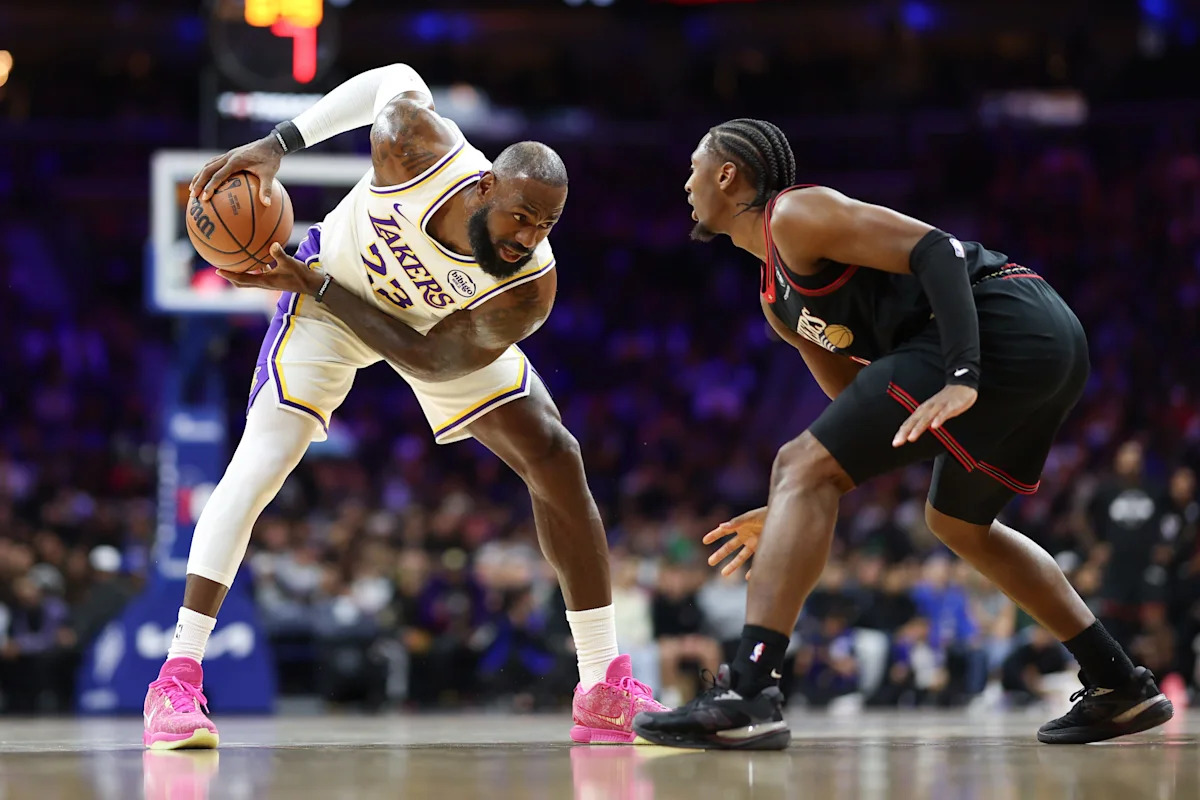
Los Angeles Lakers forward Lebron James (23) controls the ball against Philadelphia 76ers guard Tyrese Maxey during the first quarter at Xfinity Mobile Arena on Dec. 7, 2025.
Still, Embiid (33.6; sixth) and Maxey (28.6; 22nd) also were high-usage players last season. Brown will have to keep finding ways to move without the ball, cut to the basket and find soft gaps in defenses for perimeter shots. Where Brown struggled somewhat was turnovers (3.6 per game) and bouts of inefficiency. Playing alongside James and Maxey, however, Brown won’t need to create for himself anymore; he can let the ball find him.
This, to be sure, is a good problem to have. Teams can never have too many playmakers on the court, and Philadelphia now boasts a starting lineup that averaged a combined 27 assists per game.
Expect the ball to move around freely. Expect a dramatic improvement from last year’s offensive rating (114.3; 16th). Philadelphia’s defense, however, might need some work.
This article originally appeared on USA TODAY: The 76ers got LeBron James. What will their offense actually look like?