


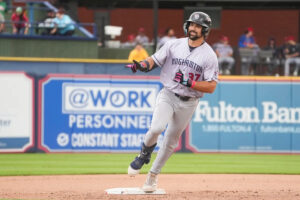


When the Jays dumped Trevor Richards on the Twins at the 2024 deadline, the return was an infielder who’d signed a way under slot deal in the sixth round of the previous year’s draft out of the decided non-baseball hotbed of Penn State University by the name of Jay Harry. Baseball America ranked him 426th among draft eligible prospects that year and promptly never wrote about him again. After the trade, Fangraphs’ rated him the 87th best prospect dealt at the deadline and described his likely peak as “a utility guy for a weak Double-A team.” Which is harsh, perhaps, but looked about right as his OPS last season, split between A+ and AA, started with a five.
I’m writing about him here, so you can guess that things have improved. And indeed they have, to the tune of a .327/.368/.591 line split between New Hampshire and Buffalo that makes Harry one of the best 40 or so hitters in the upper minors this season.
So what’s happened here? Harry was an ultra-contact-oriented hitter in college, with a swing geared just to try to poke line drives through the infield. You can see that approach carry over to his first taste of pro ball after the draft, where he struck out just 6.8% of the time in A ball but failed to generate much impact. His contact rate dropped, though, from 85% that season to 76% during his time with the Twins organization in 2024 and then 71% after his trade to the Blue Jays. At the same time he showed a little bit of game power, going from 1 home run in 129 PA in his draft season to 12 in 448 in ‘24. Last year he seems to have been caught in between, bringing his contact back to 77% but losing almost all of his impact. In 2026, his contact rate remains at 77%, but all of the power production has returned and then some. Normally with a left in New Hampshire, you can write some power jumps off as the product of park factors, but a) he was awful in the same park last season, and b) he’s hit even better since moving up to Buffalo.
On video, you can see his swing change a little over the course of the last three years, going from a very upright setup with almost no hand load and the bat starting upright in 2024 to a bit deeper of a load and more angle in 2025. His 2026 swing is back closer to 2024, very upright and with his hands starting out front to give him a super short path to the ball. These are all subtle differences, though, and I don’t see evidence that he’s reinvented his swing.
There are a couple of other changes to note. First, he’s just swinging a lot. He’s always been aggressive, but his 59.5% rate this season is among the highest in the league and would be in the top five in the majors. That’s resulted in a collapse in his walk rate, although without much change in his strikeouts.
He’s also pulling the ball a lot less often, 39% of the time down from an extreme 55-56% rate the previous two seasons. Normally you’d expect that to come with less power production, as hitters typically do their damage to the pull side. As we’ve seen, though, the effect for Harry has been the opposite. We don’t have comparative StatCast data, because A+ and AA don’t make that info public, but we can see that since the promotion to Buffalo he’s running a 90.0mph average exit velocity and a 41% hard hit rate, both of which are above average. His max exit velocity is 107.2, though, which is well below average. He might best that once he has more than 68 batted ball events in the register, but it seems like the scouting reports that noted a lack of raw power are still correct and that he’s doing this by just maximizing what he does have.
This is all a bit puzzling. Harry’s swing decisions appear worse, but he’s not making any less contact. He’s pulling the ball less, but producing more power. My best guess is that he’s just gone back to what’s comfortable. He’s ultra-aggressive on pitches inside, pulling the ball where he can but not forcing everything to the pull side. He’s using the swing that feels right to him, and trusting his strength to generate enough power.
Lacking a clear change that drive the breakout, I remain skeptical of how real it is. That said, you have to pay attention to the results, especially as players get close to the majors. Jay Harry isn’t likely to take the big leagues by storm, but his performance this year makes it easy to imagine him getting to the big leagues at all, which is a dramatic change in the course of three months. He can play all over (mostly short in the minors, but he’s not an everyday calibre glove there by big league standards), he gets the bat on the ball, and when he does there’s a chance he’ll do something with it. That’s not nothing. At the very least, I don’t think he’d have trouble cracking any AA lineup out there.
Read the full article here


