



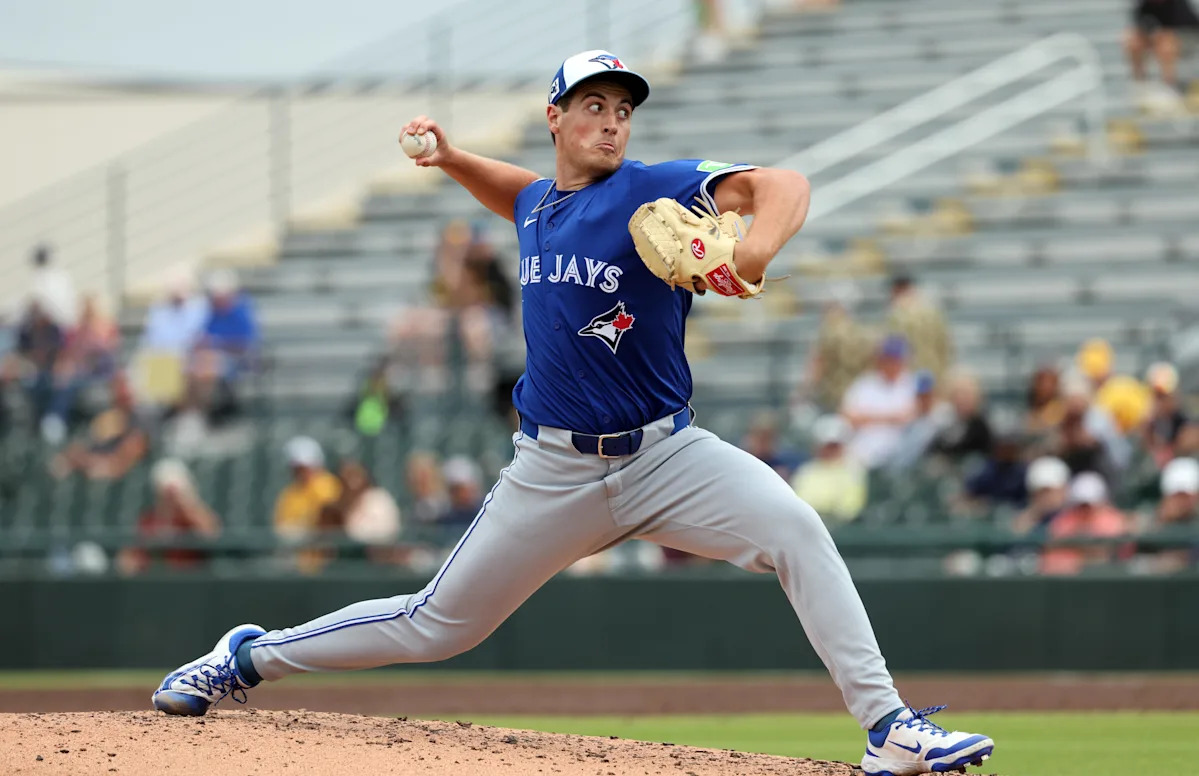
Today’s subject is in kind of an unusual spot as regards his prospect status. Bloss actually debuted two years ago, and as he turns 25 today (Happy Birthday, Jake) he’s on the fringes of what’s typically considered prospect eligibility. He’s also coming back from Tommy John surgery, which has eaten up the last 14 months for him when he would normally have been breaking into the MLB rotation. All that means the excitement about him is a little muted for a former top 100 prospect on the cusp of the majors. We ranked him as the system’s #6 prospect coming into the season, and he’s undoubtedly a key part of the organization’s medium term hopes, but right at this minute the buzz is lacking. He’s back at AAA as of last week, though, and given the state of the back of the Jays’ rotation he might become a factor of the big league club soon if he looks up to the challenge.
His rehab outing Statcast data offers some immediate intrigue. Last time we saw Bloss for a full season, in 2024, his four seamer sat 92-95 and touched 96. It’s a small sample size, with only 95 heaters tracked (we only have public StatCast data for his three appearances with A Dunedin and one with AAA Buffalo), but since coming back he’s sitting 95.8mph and regularly cresting 97. His hardest single pitch in 2024 was equivalent to his average in 2026, and he hasn’t thrown a pitch classified as a four seamer this season as slow as his average from the earlier year. There were hints before he went down with the elbow injury last year that he was taking a step forward with his velocity, but what we’re seeing right now is a big leap. The pitch was already considered to be above average in spite of middling velocity because Bloss gets great extension and generates a lot of backspin and vertical carry. That’s all preserved, so if he maintains most of the velocity gain as he gets fully stretched out his fastball has improved from solid to an easy plus pitch.
His sinker appears to have made the same gains, going from 93.3mph to 95.0. He’s spinning both fastballs harder by about 80rpm, which has preserved their total movement in spite of the velocity bump (slower pitches break more because they have more time to accelerate in whatever direction their spin is taking them before reaching the plate).
He also seems to have made changes to his secondaries. His changeup has gotten harder, but by only 1.3mph (87.2 up to 88.5mph), and he’s actually gotten better at killing the spin on the pitch, reducing the rotation by 100rpm. The result is that it has more drop and a bigger velocity gap off the fastball. The slider, like the fastballs, has picked up about 2mph and about 100rpm, breaking harder to cover the same distance in less time. His curveball, interestingly, hasn’t seen the same gains in spin rate but is now almost 2.5mph harder, leading to less glove side break and a slightly more up and down shape.
There have been the hiccoughs with command that you’d expect from a guy coming back from surgery, and he’s still only partially stretched out. Bloss probably won’t be ready for the majors for a few weeks yet. The leap his stuff has taken during his rehab creates reason to be excited for him when he arrives, though.
Read the full article here


