







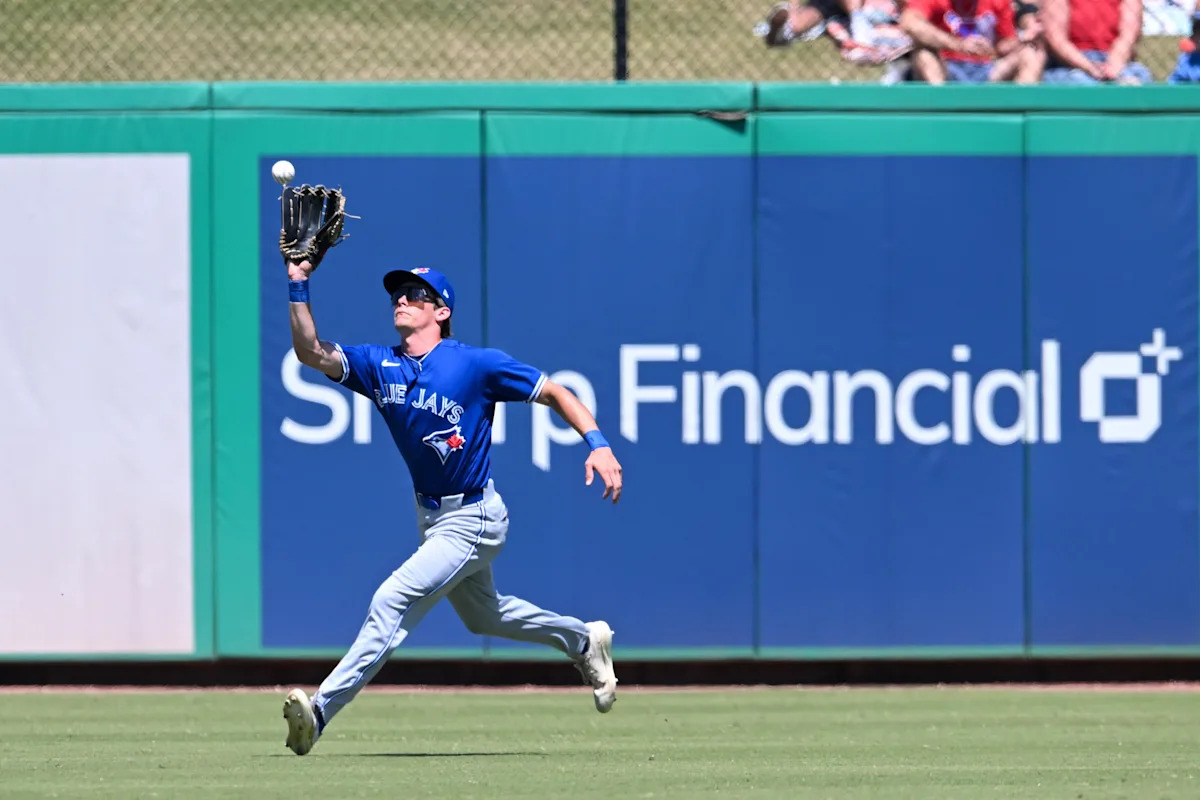
After an unexpected couple of weeks’ hiatus, I wanted to get back to looking at one promising Blue Jays prospect each week. Today, the Blue Jays’ intriguing 12th round selection in last year’s draft, who’s nearly matching the performance of his much more highly touted teammate, first rounder Jojo Parker.
Blaine Bullard was considered a top 3-5 round talent in the 2025 draft class, ranked #151 by Baseball America. His commitment to Texas A&M was regarded as pretty firm, though, and teams weren’t willing to risk taking him with a top 10 round pick and losing a valuable slot bonus. As a result, he slid out of the top 10 rounds entirely and the Jays were able to tab him 352nd overall. They scraped together $1.7m from money saved on Parker’s bonus and from a couple of later picks plus the allowed 5% bonus pool overage, roughly equivalent to the slot value for the 55th overall pick, and dared him to turn it down.
So far, they have to be happy that he couldn’t. Bullard is an elite athlete with easy plus speed. He’s been able to deploy that to steal 18 bags in 19 tries, one of the best success rates among all high volume runners in A ball. He’s also drawn strong reviews for his routes in centre field, and looks like he’ll ultimately be an above average to plus defender there.
The questions in his profile have all been about his future at the plate. He’s a switch hitter, but naturally left handed, and he’s far more advanced from that side of the plate. The scouting consensus was that he had the potential to be an average or somewhat better pure hitter, although he was seen as raw. He also faced questions about his ultimate power potential, with a lanky build and whippy swing that’s geared to spray grounders and line drives more than elevate for power.
So far, things have looked a little different than expected. Bullard has already launched five home runs in 167 PAs, using his wheels to add in eight doubles and a pair of triples. His .184 isolated slugging is well above the Florida State League average and third best among the 10 teenagers who have gotten regular run there. He’s also struck out a fair bit (30% of the time), though, and hasn’t produced many walks (8%, in a league where the median is 12%). It’s an effective overall package, as his .265/.337/.449 line has been 12% better than league average and in the 68th percentile among teenagers in full season ball, but it’s not quite the shape we expected.
Digging in a little, it appears that part of the difference is due to his switch hitting. All but two of his extra base hits have come from the left side, and his 27% and 9% walk and strikeout rates look a little more like it. He’s a more aggressive than average swinger, but his 68.7% in-zone swing rate and 27.4% chase rate suggest decent underlying plate discipline. He’s making contact inside the zone just 78% of the time, which is less than ideal, but not disastrous by any stretch and not necessarily a surprise for such a young player seeing professional pitching for the first time. When he does hit the ball, he’s delivering the low line drives expected, with a 5.5 degree launch angle, but he actually makes his best contact a little higher, with a 13.7 degree angle on hard hit balls. His 85mph average exit velocity and 27% hard hit rate from that side would both be near the bottom of the scale in MLB but they’re not bad for a teenager and suggest that with a little maturation he could get to the 40-grade raw power many scouts projected for him, with enough hard contact pulled for line drives or fly balls to get to all of it in games.
Things are less promising from the right. He’s struck out 11 times in just 24 PA without a walk, and has just 6 hits, two of them doubles. His 80.6mph average exit velocity is pretty dismal, as is his -4.5 degree launch angle. He’s more aggressive from that side, swinging 54% of the time, and he’s whiffing far too much both inside the zone (67.7% contact rate) and outside it (25%). It’s a small sample because Dunedin hasn’t happened to face that much left handed pitching yet, but it’s at least a yellow flag on his ability to switch hit longer term.
The overall picture is of a very talented player experiencing mixed success with an aggressive assignment to start his pro career. Many high schoolers, including for example last year’s 9th overall pick Steele Hall and Bullard’s draft-classmate Tim Piasentin, would start their first full pro season at the complex. Bullard was sent straight to a real league where he’s more than two years younger than his average competition, and has produced. His speed and defence look to be everything advertised, and his power production has exceeded expectations. He also has clear work to do on refining his approach and contact ability, though. That goes for both sides of the plate, and the gap on the right side is big enough to question whether he might ultimately wind up focusing on his natural left handed stroke full time. He remains one of the higher upside players in the system, with the potential to develop into a Lorenzo Cain or Coco Crisp type table setting centre fielder if everything comes together.
Read the full article here


