






With the bulk of the 2026 NBA offseason now concluded, and with the calendar now flipped to September, it’s time to start looking ahead to what’s coming next in the NBA, both this season and afterward.
In that spirit, and in the interest of killing some time in the dying days of summer, let’s take a look at the five* most interesting veterans — to me! — who are eligible for extensions of their current contracts.
(We’ve previously considered my five most interesting potential free agents in the class of 2027, my five most interesting comeback players for next season and my five most interesting rising sophomores in the NBA.)
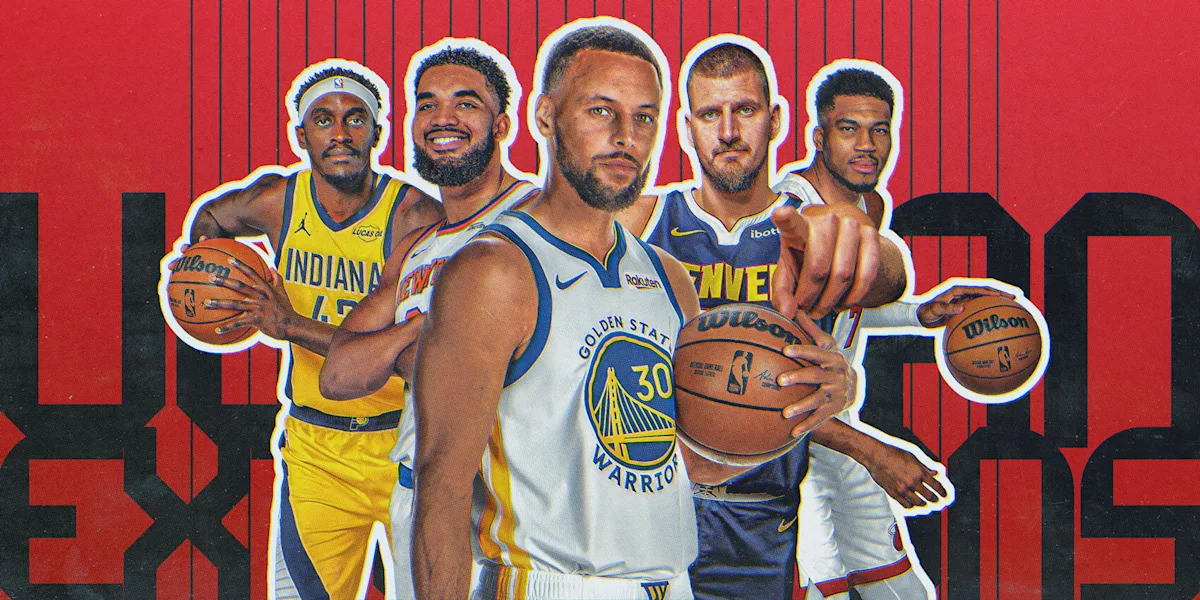
We begin with two of the 14 players in NBA history to win consecutive Most Valuable Player trophies:
(Taylor Wilhelm/Yahoo Sports Illustration)
On one hand, I take both Curry and Jokić at their word when they say they plan to sign extensions with the only franchises they’ve ever known, and intend to remain in the respective cities where they’re revered as gods until such time as they finally decide to hang up their high tops. Until they actually put pen to paper, though? Well, you’ve got to keep an eye on things.
I wrote about the state of play for Curry in Golden State in late July, after they missed out on LeBron James and found themselves seemingly stuck — a roster long on aging veterans, light on notable young talent, projected to remain mired in the play-in picture in the Western Conference. That somewhat grim near-future outlook led some to wonder whether Curry might consider seeking greener pastures in a bid for a fifth championship as he walks the back-nine of his legendary career. But Golden State brass has projected confidence that he wants to stay the course, as well as a willingness to effectively let him choose his preferred deal structure to do so. For his part, Curry — a “realist” who understands the franchise’s predicament — has continually maintained a desire to remain with the only franchise he’s ever known.
“There’s no question I want to be here the rest of my career,” Curry recently told Dalton Johnson of NBC Sports Bay Area. “And I’m pretty sure that’s going to happen.”
Similarly, Jokić said last September that his “plan is to be a Nugget forever.” The three-time MVP reiterated that desire after an up-and-down season that saw Denver hit the 50-win mark for the fourth straight year, then bow out in the first round of the playoffs for the first time since 2022 … but he also said he wouldn’t be executing that plan right now.
“My idea and my wish is to stay in Denver,” Jokić told reporters after a FIBA World Cup qualifying game back in July. “I will most probably sign next summer. The decision is strictly business oriented.”
Jokić’s rationale for slow-playing the extension is simple. If he extends now, with two more seasons left on his deal — $59 million this season, plus a $62.8 million player option for 2027-28 — the largest contract he can ink would pay an estimated $278 million over four years, according to ESPN’s Bobby Marks. If he waits until next summer, though, he can sign a five-year deal that would pay him an estimated $359.5 million, and that would stand as the largest contract in NBA history. When it comes to reasons for waiting to do something, “I get an extra $81.5 million for waiting” is about as good as it gets. (Certainly a hell of a lot better than my go-to: “Aw, c’mon, man, I don’t wanna.”)
The Nuggets “repeatedly stressed” to Bennett Durando of the Denver Post this summer that the big fella’s delay is strictly about the dollars, and “have remained bullish […] that Jokić isn’t going anywhere.” There is, at the moment, no reason to believe otherwise. But after underwhelming summers that still likely leave Denver and Golden State behind the likes of the Spurs and Thunder (at minimum) in the Western pecking order, you’d forgive Nuggets and Warriors fans for feeling ill at ease at the prospect of spending the next year wading through uncertainty — and keeping their fingers crossed that deteriorating on-court conditions wouldn’t convince their franchise icon to consider changing those plans.
Similarly, there’s no real reason to assume that either Antetokounmpo, who left Milwaukee for Biscayne Bay back in June, or Leonard, who hasn’t quite officially rejoined the Raptors yet for, um, reasons, won’t sign an extension as soon as they’re eligible to do so.
Giannis won’t be able to do that until Jan. 6 — six months from the date his trade became official, in accordance with the collective bargaining agreement’s rules on extension eligibility. On that date, he can tack as much as four years and $275 million onto the end of his existing deal, which is slated to pay him $58.5 million this season with a $62.8 million player option for 2027-28. If all goes well in what promises to be a fascinating two-way partnership with incumbent star center Bam Adebayo, and if Pat Riley and Co.’s work to augment Miami’s 3-point shooting on the perimeter — hello there, Tim Hardaway Jr. and Klay Thompson — bears fruit in what should be a dramatically improved offense under head coach Erik Spoelstra, then it seems all but certain that both parties will agree to lock in their new agreement in short order.
“The Heat acquired Giannis and Giannis embraced the Heat because both sides knew an extension would be forthcoming,” longtime Heat chronicler Ira Winderman of the South Florida Sun-Sentinel wrote last month. “For that matter, if NBA rules allowed, the Heat likely would extend Giannis now if they could […] rest assured, it will be a massive agreement, one that very well could carry Giannis to the close of his career.”
Technically, Kawhi and his new agent are already able to negotiate an extension, which can pay up to $123.7 million over three years. Practically, though, it’ll depend on when, or if, he finally makes his way back to Toronto … which itself depends on when the teams actually present the paused deal to the league office. For whatever it’s worth, Leonard’s reportedly already joining the Raptors’ pre-training camp workouts, and it sure sounds like the extension’s still very much on track — barring, of course, the next shoe to drop in the ongoing s***show surrounding the Clippers investigation that now includes the U.S. Department of Justice.
Between the two situations, Leonard’s is the more volatile. (Duh.) In terms of title contention equity, it’s also potentially the more notable. This depends on whether you think Miami adding Antetokounmpo, the greatest rim attacker of his generation, to an offense that has struggled to consistently pound the paint represents a more significant strengthening of a weakness than the addition of Leonard to a team that needed half-court shot creation, pull-up 3-point shooting and late-game execution. It also depends on whether you prefer Adebayo, Andrew Wiggins and the rest of Miami’s shuffled-up rotation over the returning pieces from a Raptors squad that just won 46 games with a near-top-five defense. Reasonable people can differ!
Wherever you fall on which player’s arrival and subsequent new deal would be the bigger deal, I think we can agree that “two perennial All-NBA players and perennial injury risks on the wrong side of 30 going to new teams with only one guaranteed year left on their contracts, with nine-figure, multi-year re-ups hanging in the balance” is inherently interesting. Maybe everything proceeds as projected, with Antetokounmpo and Leonard landing in their respective new spots, elevating their new teams up the Eastern pecking order, and signing those lucrative new deals at their earliest opportunity. Until it does, though, it all bears watching.
Hey, speaking of “the Eastern pecking order” …
In a vacuum, it’s difficult to envision a better time for Towns to find himself eligible for a lucrative new deal than right after playing the best basketball of his career — as a high-post facilitator, as an interior defender, as a driver, rebounder and tough-shot-maker — to help propel the Knicks to their first NBA championship in 53 years.

Consider the context, though, and what seems like it should be a fairly straightforward affair becomes a bit trickier.
You see, James Dolan’s fear of the second apron, below which the Knicks sit just $3.3 million right now, already led New York to bid farewell to backup center Mitchell Robinson this offseason. (The Knicks brought in veteran big Andre Drummond, and tried unsuccessfully to snipe Dallas Mavericks youngster Moussa Cissé, to replace Robinson. They’ll enter camp still in need of a third big.) And that fear doesn’t figure to dissipate any time soon for a Knicks team that will also face a number of other financial questions in the not-too-distant future, with Josh Hart and Miles “Deuce” McBride currently eligible for extensions, and both Finals MVP Jalen Brunson and Game 4 folk hero OG Anunoby becoming extension-eligible next offseason.
Towns holds a $62.8 million player option for 2027-28. If he exercises it, he can sign a three-year, $208 million extension; if he declines it, he can tack on up to $272 million over four years. He certainly proved his worth this postseason, validating Leon Rose’s big swing to import him by showcasing his ability to stand tall on both ends of the floor on the grandest stage possible.
He also turns 31 in November, though. It seems reasonable to assume the Knicks, with all that contractual business still coming down the pike, would be leery about paying a big man north of $70 million a year as he enters his mid-30s — historically past the prime years of most NBA players, and particularly 7-footers, and particularly 7-footers in an era of basketball that demands so much mobility and flexibility on the defensive end for players to be able to continue to contribute at a contention-caliber level. (It’s worth noting that Towns’ deadeye 3-point shooting, and its attendant gravitational pull on opposing defenses, makes his game a good bet to age pretty gracefully; Dirk Nowitzki remained a net-positive contributor until his final season, even while moving around like a mummy as he approached age 40.)
This prompts a pair of questions: What would the Knicks be comfortable paying a 7-footer through his mid-30s? And just how comfortable would Towns be accepting what’s tantamount to a significant pay cut coming off an All-Star/All-NBA-caliber regular season and All-World postseason to deliver the biggest prize in the last half-century of Knicks basketball?
James L. Edwards III of The Athletic and Ian Begley of SNY have both indicated that they don’t see the Knicks offering Towns a full-boat max. Stefan Bondy of the New York Post projected a potential deal at four years and $180 million — an average annual value at $45 million per year. (Begley, too, offered the $45-million-per number as a benchmark.)
On one hand, that would represent a noteworthy trim from the supermax salary that Towns has been making since the Timberwolves offered it to him in the summer of 2022. It would also make Towns somewhere around the 30th-highest-paid player in the league in two years — a number that feels a little low, given the level of play Towns has provided during his two years in New York.
On the other, the Knicks’ last three big contracts — Anunoby’s 2024 re-up, Brunson’s 2024 extension and Mikal Bridges’ 2025 extension — all included at least some level of sacrifice below their top possible dollar in service of attempting to build a championship-caliber roster; perhaps, having seen that sacrifice rewarded with a ring, Towns is willing to follow in their footsteps. (That said: Expect Brunson to be looking to be made whole when his number comes up.) A $45 million average annual value would also still be top-five center money in a few years’ time — potentially an attractive level of long-term security for a player with 11 NBA seasons and nearly 27,000 minutes on his odometer.
Factor in the chance to continue playing for the team he grew up loving, and to continue reaping the benefits that come with remaining a newly minted New York legend, and maybe that’s a deal Towns is willing to accept to keep the good times rolling as summer turns to fall. If the two sides can’t come to an agreement, though, it’ll be interesting to see if the uncertainty threatens to harsh the Knicks’ hard-earned immaculate vibes.
Siakam’s situation in Indianapolis is somewhat similar to Towns’ in New York. Since arriving midway through the 2023-24 season, all the Cameroonian forward has done is prove to be precisely the hand-in-glove fit that the Pacers had hoped for, averaging 21.7 points, 7.0 rebounds and 3.6 assists per game while shooting 51.2% from the field and 37.6% from 3-point range. He was the Most Valuable Player of the 2025 Eastern Conference finals during the Pacers’ remarkable run to the NBA Finals two seasons ago. He was the team’s leading scorer, lone All-Star and competitive standard-bearer last season, as the Pacers suffered through a year without the injured Tyrese Haliburton.
“I hope we go into the summer, everyone just really, really mad about the situation,” Siakam said in April, according to Dustin Dopirak of the Indianapolis Star. “This was really, really frustrating. I hope we bring that rage into the summer, everyone getting better individually, find some time together, stay together, work together as a team. When we come back, we understand what it takes.”
Every team in the NBA would love to have a player who maintains that kind of professionalism and production amid a lost season; every team in the NBA would love to have a versatile and skilled two-way forward who can contribute at a championship level on both ends of the floor. Siakam’s ability to plug gaps all over the court — partnering with Haliburton in the two-man game, working as a ball-handler in the pick-and-roll, punishing mismatches in isolation, making tough shots in the midrange, attacking in transition and on the offensive glass, matching up with opposing big wings, shrinking the floor and knifing into passing lanes, etc. — makes him absolutely central to getting the Pacers back in the running for the top spot in the East, to unlocking the best version of Rick Carlisle’s roster, and to maximizing the championship window of a team whose core pieces are all under contract for the next two seasons.
But every team in the NBA also has to consider life beyond the next two seasons. With Siakam, new center Ivica Zubac, stalwart guard Andrew Nembhard and reserve big man Obi Toppin all currently ticketed for unrestricted free agency in the summer of 2028, with Haliburton set to make his return and eligible for an extension himself, and with starting swingman Aaron Nesmith up for an extension next summer, the Pacers have a ton of decisions to make, in pretty short order. Of those players, Siakam — who can add up to three years and $207 million to his existing contract — is the only one on the wrong side of 30; in fact, he turns 33 in April.
Will a Pacers franchise that’s been loath to pay the luxury tax over the years blanch at the prospect of paying Siakam well over $50 million a year through his mid-30s, especially with so many other deals to hash out? Or, having seen the heights this roster can reach when healthy and sprinting at full speed, will they decide to damn the torpedoes and bet that they’ll continue to get bang for their buck from Siakam, the connective strand that ties it all together?
To be clear, this isn’t a blinking-red-lights situation right now; Diabaté isn’t even eligible to extend until Feb. 8, 2027, the two-year anniversary of when the Hornets converted his two-way deal into a standard contract. And given how the French pivot produced last season — 7.9 points on 63% shooting, 8.7 rebounds, 1.9 assists and 1.8 steals-plus-blocks in 26 minutes per game — you’d imagine that Charlotte would be eager to hold on to a player whose elevation into the starting lineup was a significant contributing factor in last season’s second-half surge.
It does seem worth noting, though, that the Hornets just traded for a veteran power forward/center in ex-Wolf Naz Reid. And that 2025 second-round pick Ryan Kalkbrenner performed well in rotation minutes as a rookie and is under team control through 2029. And that Charlotte used the No. 14 pick in the 2026 NBA Draft on Washington big man Hannes Steinbach. And that, if the 24-year-old Diabaté doesn’t come to an agreement with the Hornets on a new deal, he’ll hit unrestricted free agency next summer.
Diabaté will be able to sign an extension starting at 140% of the league’s estimated average player salary. An EAPS of just under $15.2 million means that the former second-round pick would be eligible for a starting salary of more than $21.2 million; a deal building off that, with an 8% raise after the first season, would top out at nearly $69 million over three years, and at more than $95 million over four. That’d be pretty heady territory for a guy who’s on the books for less than $2.5 million next season. (Just because you can make a certain amount doesn’t mean you’re going to, of course; a better benchmark for an eventual Diabaté deal might be something more like the four-year, $56 million extension that the Celtics gave Neemias Queta this summer.)
The fact that the Hornets’ frontcourt mix looks a bit more crowded — vets Royce O’Neale and Grant Williams are around, too — doesn’t necessarily mean that Diabaté will wind up being the odd man out. But if the two sides are far apart in their expectations for what a new deal should look like, or if Charlotte decides it’d rather bet on bigger options than on the 6-foot-10, 210-pound Diabaté in the middle for the long term, it might be worth keeping an eye on what sort of trade market the Hornets might be able to work up for a player who’s currently one of the biggest bargains in the sport … and who you’d assume would very much like to stop being one of those in the near future.
Other persons of interest: Hart, on whom the Knicks don’t have to make any decisions right now — he has a $22.4 million team option for 2027-28 — but who’s obviously a vital piece for the defending champs, and who could justifiably ask for at least as much as Dillon Brooks just got; the aforementioned McBride, whose play merits a significant pay bump over the bargain deal he signed back in 2023 that might not fit into the Knicks’ salary structure (which could lead to him being on the move before the trade deadline); the also-aforementioned Haliburton, Nembhard and Zubac, whom the Pacers could let ride but on whom they could also try to jump the market; Anthony Davis, who’s gonna wait and see how this whole “playing for the Wizards” thing plays out, thanks; Oso Ighodaro, a productive playmaking big in Phoenix who could stand to be a major beneficiary of Mark Williams’ untimely shoulder injury; Payton Pritchard, Onyeka Okongwu and Devin Vassell, all key pieces of playoff teams who become extension-eligible on Oct. 1; Rudy Gobert, Michael Porter Jr. and RJ Barrett, all of whom I covered as potential 2027 free agents of note — if, that is, they don’t re-up sooner.
Read the full article here


