



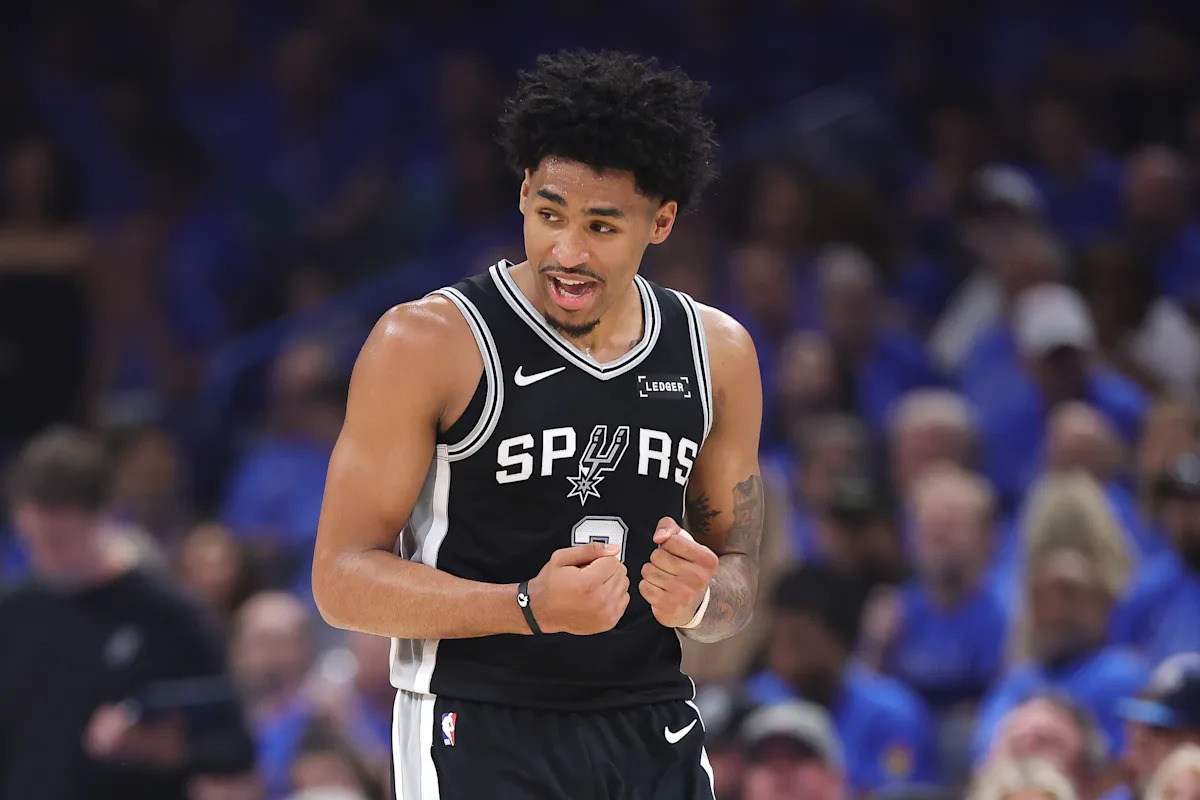
If you’ve been watching the San Antonio Spurs, you know exactly what Dylan Harper has brought to the table all year long. If you haven’t, his performance in Game 1 of the Western Conference finals against the Oklahoma City Thunder certainly clued you in on what has been building.
It’s one thing for a rookie to provide consistent and steady impact for a playoff team. It’s another to do it for a 62-win team. To then step into the starting lineup with De’Aaron Fox sidelined and produce 24 pts, 11 rebounds, 6 assists and 7 steals should not fly under the radar. Since 1973-74, only two other players have recorded 20+ points, 10+ rebounds, 5+ assists and 5+ steals in the conference finals. That’s Larry Bird and Julius Erving.
Not a bad list for a 20 year old.
With Game 2 on Wednesday (8:30 p.m. ET, NBC), let’s break down how the young point guard is shining for the Spurs on both ends.
Attacking on offense
The offensive impact from Harper comes from his ability to stay aggressive within what the Spurs want to do. He can initiate a play or find a crease when a play breaks down. He can run pick-and-roll or find ways to drive gaps when spaced. There is a consistent command Harper plays with offensively. Head fakes, jab steps, shoulder to chest.
The drives deliver a level of pace but splice in a change of pace. There’s a rhythm to the footwork, an urgency to find and initiate contact, a delight in getting into the paint. It’s easy at times to forget the size he has as a guard at 6-foot-5, but the film shows you he can hit first, take the contact in return and still work to finish. When he gets downhill, everything opens up.
There are many highlights you could take from Harper’s Game 1 performance against OKC. There is one that stood out to me.
Tie game, fourth quarter and Harper has the ball in his hands. He drives, works to get in the paint, and the defense converges. He loses the ball, but fights to get it back. When the ball swings back to him, he looks to attack again, loses his balance and the ball, but fights to get it back again and manages to get fouled on a shot attempt. A misshapen possession leads to an opportunity to get free throws.
I highlight that because that’s the hidden part of Harper’s mindset. There’s a level of aggression and force he plays with. And that can open things up against Oklahoma City, which has perimeter defenders and the ability to protect the paint to take things away.
San Antonio really worked to get to double pick-and-roll in Game 1, trying to attack matchups especially when the Thunder were working to stick with Victor Wembanyama as the screener. Harper’s ability to see the space, turn the corner and finish should not be ignored.
Harper is also dangerous in transition. The Spurs’ defense has been their base for a large majority of the season. The ability to consistently get stops allows them to attack in the open court and flow offensively. Harper has continued to grow in those scenarios, finding a knack for attacking defenses before they are completely set. It can be somewhat of a luxury for a young guard to be able to change speeds.
For Harper, space is the setup for him to find the right angle. It becomes less about overall speed and more about containing the quick bursts he uses to attack. He finds an angle to get you off balance, initiates contact and then finishes.
Creating chaos on defense
Harper’s effort on the defensive end fits right into what the Spurs want to do, too. A (deservedly) large chunk of the credit for the Spurs’ defensive efforts goes to Wembanyama, but if the Spurs guards work to contain penetration and consistently rotate around him, that becomes even more important when Wembanyama is off the court.
Harper’s ability to contain penetration helps. And the ability to get back into help position and attack when someone else drives is key.
There is a necessary mindset that is required on the defensive end. That’s where Harper can tend to surprise people. If you decide to put Wembanyama in action on one side and he switches, that can bog your offense down. The idea would be to swing to the second side of the action, and that’s where Harper’s effort stands out.
Getting into Jalen Williams’ body, fighting over the screen and staying attached on the drive are huge plays. That’s not just funneling a drive to Wemby, that’s being an active part of the chaos. That effort closes gaps and forces turnovers.
The playoffs are about superstars, but that shines a brighter light on the others who contribute to a team’s identity. For Harper, this playoff run feels like a stamp for how he ties into it.
Some rookies may have had bigger moments during the regular season, but Harper is a reminder that putting in the work can pay off in the long run. Understanding the assignment, knowing what your team needs from you and doing it on a nightly basis encourages growth.
Harper knows he’s in the best spot for him as a player, and he’s a large reason the Spurs are beating the drum toward the NBA Finals.
Read the full article here


