



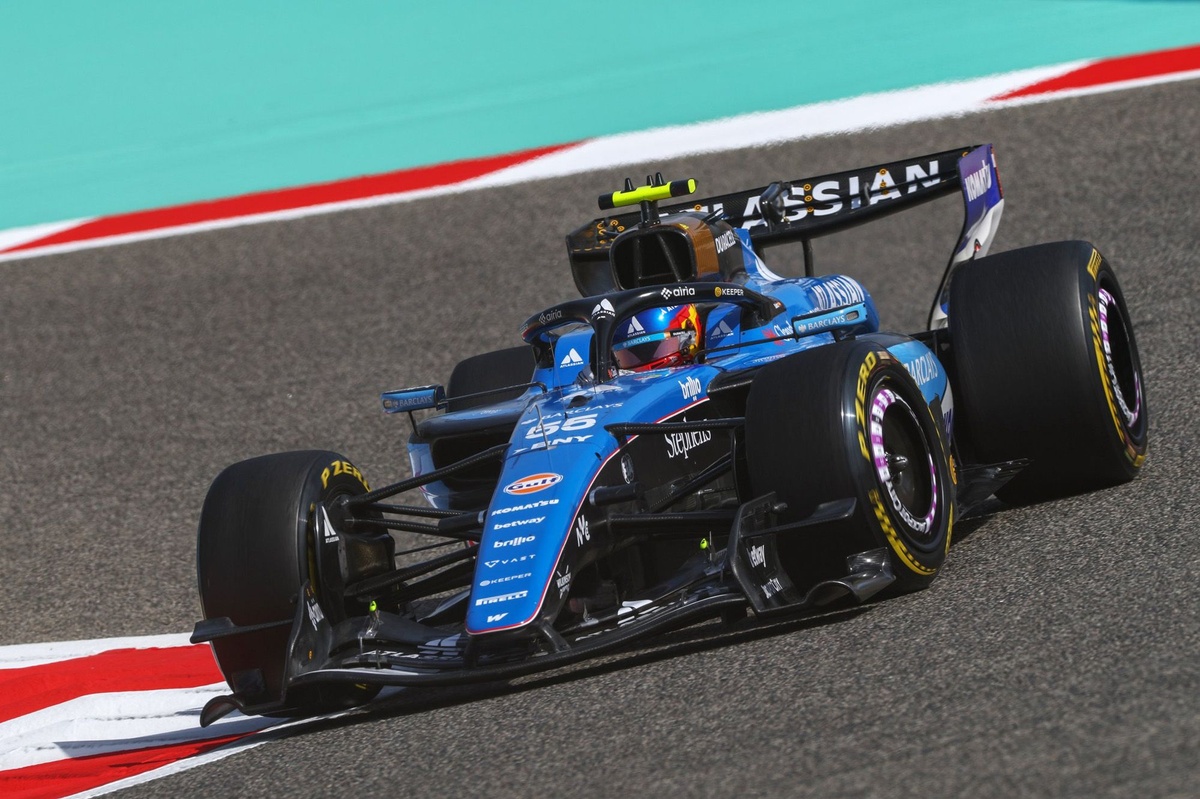
Williams driver Carlos Sainz says Red Bull Ford’s power units have looked “a step ahead”, backing similar comments by Mercedes, as he offered fresh insight into how to get the best of out the 2026 generation of cars.
On Wednesday, Mercedes chief Toto Wolff said Red Bull Ford’s power units are currently the benchmark in Bahrain winter testing, singling out the new manufacturer’s outstanding energy deployment from the electric motor.
Sainz, who drives for Mercedes customer Williams, now agrees that Red Bull appears to be a step ahead of the field.
“It’s still extremely early days, but if I would have to judge by the GPS data of yesterday, right now it is true that whatever Red Bull Ford Powertrains were doing yesterday was a clear step ahead of anyone else,” he said. “Not only a small step, but a clear step and it was mighty impressive.
“If they manage to turn up to race one with a completely new set of regulations, with a completely new engine, new people, and turn up to be the fastest and most reliable engine, you will have to take your hat off to them and say what they’ve come up with, because at least what they were showing yesterday was very impressive.”
Max Verstappen, Red Bull Racing
Photo by: Sam Bagnall / Sutton Images via Getty Images
GPS data do suggest there is merit to the Mercedes camp’s praise, as on his longer runs Verstappen was able to recharge his battery to such an extent that he could deploy plenty of the 350kW on tap on the straights, routinely achieving higher top speeds than the competition lap after lap.
But as Sainz points out, there are the usual caveats about diverging run plans and subterfuge that cloud winter testing’s observations, and teams still have five days of testing to nail down their optimal power unit strategy, which has become a focal point of the 2026 regulations.
The amount of energy generated from the electric motor has tripled compared to the previous generation, up to half the total power output. However, the battery capacity has remained at the same level, meaning drivers could easily deplete their total energy storage several times per lap. As a result, Bahrain testing saw drivers go down to lower gears in slow corners to keep the revs up and harvest as much energy as possible wherever they could. Some of that is down to driving technique, while power unit software is programmed to learn from previous laps to help optimise harvesting and deployment behaviour.
According to Sainz, optimising those energy harvesting techniques without sacrificing cornering will be crucial to unlocking overall performance. “The key to these regulations is not going to be separating both, but integrating both of them together,” the Spaniard explained. “From what I could see yesterday, it seems like Red Bull has done exactly that, without having to give the driver a compromise.
“When the car is telling you to downshift a certain way, you just do what the car is asking you to do. That’s why all drivers, after we will end up doing maybe 300, 400 laps in Bahrain, we try to sort every kind of technique to try and help the driveability and the performance of the car.
“That’s why I’m insisting that the integration of power unit versus gearbox versus driver preferences, it all has to be a closed circle. The moment one of the two or three things are not exactly how you want is where you start facing issues, so everyone’s going to need to adapt and find the right way.”
We want to hear from you!
Let us know what you would like to see from us in the future.
Take our survey
– The Autosport.com Team
Read the full article here


