




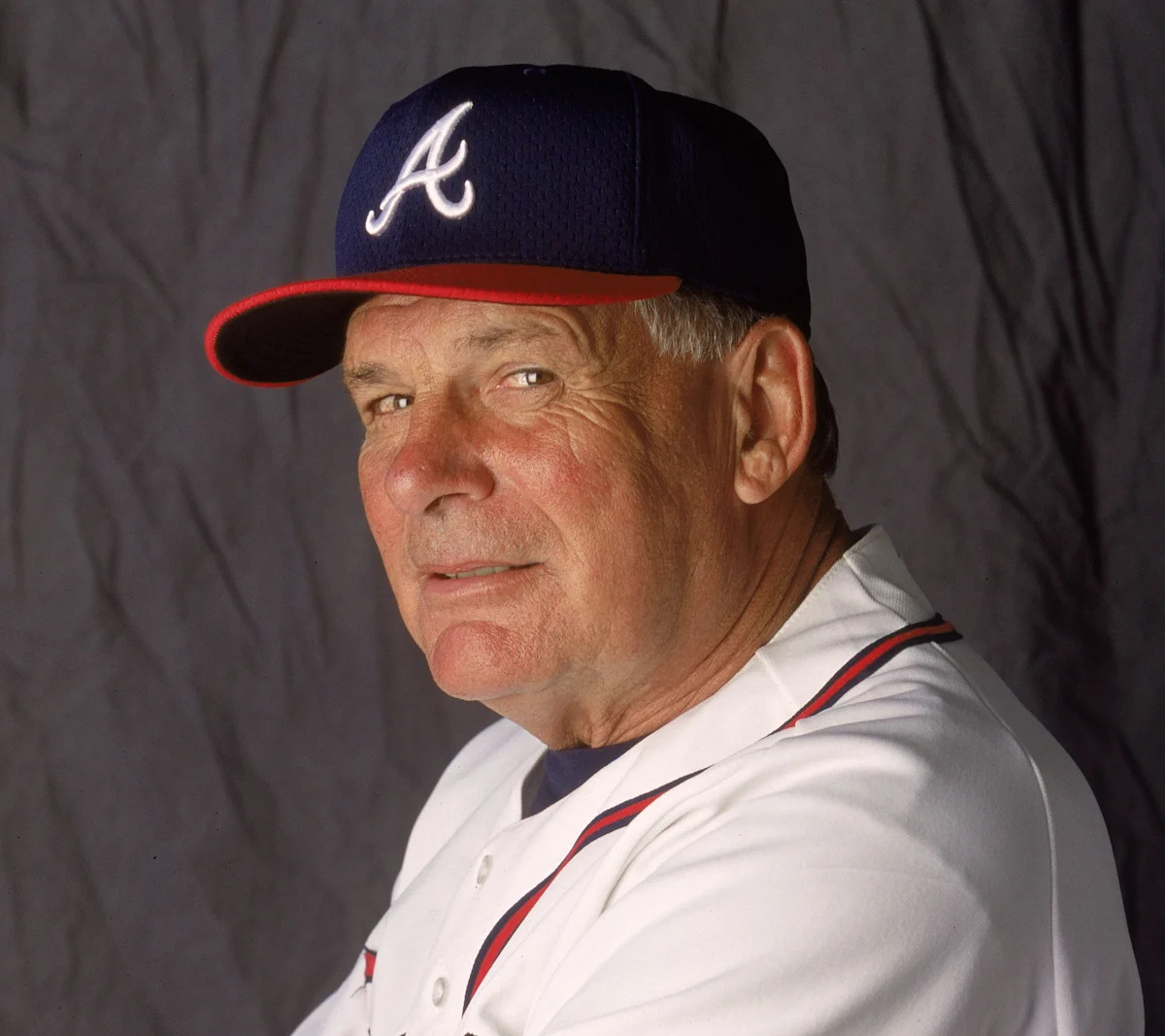
Earlier this afternoon, the Atlanta Braves announced the passing of Hall of Fame manager Bobby Cox. He was 84.
In six decades in the organization, Cox spent two separate stints as Braves manager; served as the team’s general manager; and was a player with the organization’s minor leagues prior to the beginning of his coaching career.
Cox’s death comes the same week as the passing of former Braves owner Ted Turner, who twice hired Cox to leadership roles in the organization.
Cox was born in Oklahoma in 1941 and moved with his family to California three years later. He began his playing career in 1960 after signing with the Dodgers organization out of high school.
After making it to Double-A with the Dodgers, he spent the 1965 season in Triple-A with the Cubs organization and split 1966 between the Cubs and Braves Triple-A ranks, playing for Austin in the Braves organization. In 1967, the Braves affiliate moved to Richmond, and he had a productive season with a .849 OPS.
The New York Yankees gave Cox an opportunity at the MLB-level in 1968 and he spent that and the 1969 season in the big leagues before his playing career wrapped up with parts of two seasons in the minors in 1971. Primarily a third baseman, Cox ended his big league career with 220 games played with nine home runs.
When his playing career concluded, it was only a few years until the beginning of what would become an iconic managerial career.
After several seasons of managing and coaching in the minor leagues and in winter ball, Cox became the first base coach for the Yankees in 1977 under manager Billy Martin. When the Braves moved on from manager Dave Bristol, they tabbed Cox as the team’s manager for the 1978 season.
Cox spent four seasons at the helm of a rebuilding Braves team that had a young Dale Murphy and added third baseman Bob Horner with the first overall pick in the 1978 draft. Unfortunately for Cox and the Braves, the team finish as high as fourth in the National League West only once – a 81-80 season in 1980.
The Braves weren’t able to build on the success of the 1980 season, finishing just below .500 in the first and second half of the strike-impacted 1981 campaign. Turner opted to replace Cox as manager, but when asked about the type managerial candidate that would be ideal to lead the Braves, it was Cox who Turner named.
Joe Torre, the former Braves All-Star player, would be hired to replace Cox and the two would both go on to have Hall of Fame careers.
The Toronto Blue Jays wasted no time hiring Cox as manager in 1982. Cox lead the Jays to back-to-back 89-win seasons in 1984 and 1985 and then took the squad to the American League Championship Series after a 99-win season in 1985. It was the first American League East title in franchise history.
Despite coming off of the best season of his managerial career, when Turner and the Braves came calling with an offer to become Atlanta’s general manager, Cox opted to return to the Braves.
As general manager, Cox oversaw a rebuild of the team’s minor league system with a focus on pitching. It was a painful era of Braves baseball at the big league level with the team losing 97-or-more games in three consecutive season, including the 106-loss 1988 season. But, by shifting from aging veterans to young, developing talent, Cox was setting a coarse for what would be a historic run for Atlanta.
During the 1990 season, Cox was faced with firing manager Russ Nixon after a 25-40 start. In doing so, he took over as skipper of the team. The team’s on-field record didn’t improve, but when John Schuerholtz was brought in from the Kansas City Royals as general manager, it was Cox he wanted to continue leading the team as manager.
The 1991 worst-to-first season for the Atlanta Braves changed everything for the Braves, the city of Atlanta and all of Braves country. The excitement, electricity and magnitude of that season is difficult to encapsulate 35 years later, but that season – and the run of 14-consecutive division-winning seasons (1994 notwithstanding) – has yet to be bested in MLB.
With the fiery Cox as skipper, the Braves won more than 100 games six times, and of course won the 1995 World Series. On the field and in the clubhouse, Cox was revered by players – many of whom he called by homespun nicknames that ended with -y – and respected by opponents as he was viciously loyal to his guys, a notion that was underscored by his MLB-record 162 ejections as manager.
Off-the-field, Cox dealt with a domestic abuse issue during that 1995 campaign, although charges were dropped and Cox did not miss any time during the season.
Cox led the Braves to the playoffs in every season there was a post-season from 1991 through 2005. Atlanta missed the playoffs in 2006, finishing below .500 for the first time since 1990, but returned to the post-season in 2010 – Cox’s final season as manager – when the team finished second in the NL East but claimed the Wild Card.
Cox’s post-season success was marginal, he ended his career with a below .500 record with the Braves and Blue Jays, and his sole World Series Championship was often sighted as a blight on an otherwise historic 15 years of dominance by the Braves.
He retired with 2,504 career victories, fourth most all-time, and led his teams to the post-season 16 times – 15 of those coming with the Braves. He won 15 division titles, five pennants and managed five All-Star games, including the 2000 contest in Atlanta. His 67 career post-season wins are fourth-most all-time. He also led the Braves to the 1995 World Series Championship.
Cox was inducted into the Braves Hall of Fame in 2011.
A four-time manager of the year winner, Cox was inducted into the the Baseball Hall of Fame in 2014 – a class that included Torre and fellow manager Tony La Russa as well as two of his former starting pitchers, Tom Glavine and Greg Maddux.
Cox suffered a stroke in 2019, the day after appearing at Trust Park for Opening Day, and made limited public appearances in the years that followed. His last appearance with the Braves was in 2025, on August 22, when the 1995 team was honored.
Cox, who was teammates with Mickey Mantle in New York, led teams in Atlanta that included future Hall of Fame players Fred McGriff, Tom Glavine, Greg Maddux, Chipper Jones, Andruw Jones and John Smoltz. As general manager, he drafted Chipper Jones and traded for Smoltz. He notoriously almost pulled off a trade for Barry Bonds in 1987 – five years before the Braves attempted to do a deal for Bond with Pittsburgh for a second time.
Cox’s 2,149 regular season wins are the most in Braves franchise history – with more than an 1,100 win gap between him and fellow Hall of Fame manager Frank Selee who has the second-most wins if franchise history. Cox is also third all-time in wins in Blue Jays history.
Each of the three managers who followed Cox in the position have ties to him with Fredi Gonzalez and Brian Snitker both serving as coaches on his staff while current manager Walt Weiss played under Cox from 1998 to 2000. Snitker (3) and Gonzalez (6) are both in the top six in wins in franchise history.
After a decade of being marketing as “American’s Team” on TBS by Turner, the Cox-led Braves became one of the powerhouse teams of the 1990s, transiting Atlanta from an also-ran franchise to one of the top brands in the sport.
The outpouring of messages from his former players in the hours following the new of his passing showed the reverence they held for him. Andruw Jones called him a “second Father” and outfielder Ender Inciarte labeled him, “a wonderful person, a great human being” while numerous others called him the greatest manager for whom they played.
To honor Cox during his final season, the Braves had a game-day give away that was a poster of Cox comprised of photos of every player he had managed, a fitting honor for a manager who still wore spikes like he did when he a player.
The image of Cox hobbling out of the dugout to argue a call, kicking dirt and get ejected for defending his players and his team, is one that resonates across many Braves fans who are mourning the loss of their skipper this afternoon.
The Atlanta Braves and their fans lost the person responsible for building the foundation for the success the Braves franchise has had for the past 35 years.
Baseball lost an icon of the sport today.
Read the full article here


