







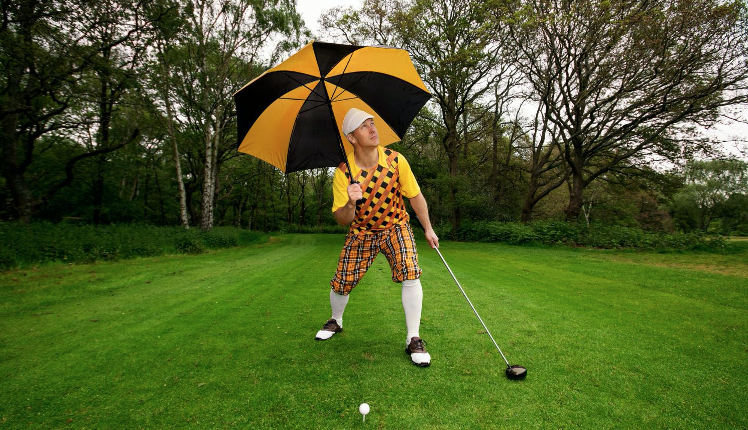
Every golfer knows the feeling. You have been looking forward to the round all week. The bag is packed, the tee time is booked, the group is assembled and ready. Then the sky turns that particular shade of grey that every British golfer recognises immediately, the rain starts, and the course marshal appears with news that nobody wanted to hear.
Rain stopped play. Two of the most deflating words in the club golfer’s vocabulary.
What happens next says a lot about a golfer’s character, and their creativity. The hours that open up when a round is cancelled or suspended are genuinely unstructured in a way that most of adult life is not. No agenda, no obligations, and usually a clubhouse nearby. What you do with that time is entirely up to you.
Here is an honest look at how UK golfers actually spend those unexpected hours when the weather takes the decision out of their hands.
The Clubhouse Is Where It Starts
The immediate destination for most golfers when play is suspended is, naturally, the clubhouse. What begins as a temporary shelter while the group watches the radar app and debates whether the weather will clear tends to evolve into something more settled once the drinks are poured and the chairs are occupied.
The clubhouse in a rain delay operates differently from its normal function. It fills quickly, the atmosphere is oddly social, and the usual rhythm of people arriving and leaving between rounds gives way to a more static, communal feel. Groups that would ordinarily cross paths briefly end up sitting together for an hour or two, which produces conversations and connections that a standard club day rarely allows.
The bar does reasonable business during a rain delay. This is not a controversial observation.
The Great Debate: Wait It Out or Call It
One of the defining rituals of the rain delay is the group weather forecast analysis. Someone has the BBC Weather app open. Someone else swears by a different one. A third person is checking the Met Office radar and interpreting the colour bands with the confidence of someone who studied meteorology rather than simply installing an app six months ago.
The debate that follows, wait it out versus abandon the round, is conducted with a seriousness that is roughly proportional to how much money is riding on the round and inversely proportional to how much anyone actually knows about reading a radar image. The conclusions reached are often wrong, but the process of reaching them is thoroughly enjoyed.
The Met Office, which has been providing UK weather forecasts since 1854, publishes radar data and short-range forecasts that are genuinely among the most accurate available for British conditions. Knowing how to read the hourly breakdown rather than the daily summary is the closest thing to a competitive advantage a golfer can have in the wait-it-out debate, and it is a skill that pays dividends across an entire season of UK golf.
Cards, Games, and the 19th Hole Tradition
The social tradition of games in the clubhouse is older than most golfers appreciate. Long before smartphones and streaming, golfers have been filling rain delays and post-round hours with cards, dice games, and any other portable entertainment that could be played around a table with a drink to hand.
Card games in particular have always had a natural home in the golf clubhouse. They are competitive without requiring physical space. They generate the kind of low-level banter that golfers excel at. And they scale well to whatever size group happens to be sitting together when the rain arrives.
The practical challenge, as with any mixed group, is that not everyone knows the same games. A standard pack of cards is in most clubhouse drawers somewhere, but the rules of Rummy, Cribbage, or even a well-played game of Snap can be surprisingly contested when the group includes players of different backgrounds. Having a reliable reference to hand, whether on a phone or printed out, settles disputes before they derail the afternoon.
Mobile Entertainment for the Modern Rain Delay
The smartphone has changed what a rain delay looks like more than any other development of the past two decades. Where golfers once had to rely entirely on whatever was physically present in the clubhouse, they now carry a connected device capable of accessing virtually any form of entertainment while the weather does its worst.
Streaming is the obvious first option. A podcast that has been sitting in the queue for weeks, a documentary about a major tournament, a highlights package from the weekend’s tour events, all of these are perfectly calibrated to the length and mood of a rain delay.
Online gaming has become a significant part of how UK adults pass casual downtime, and golfers are no exception. The rise of mobile-first platforms has made it straightforward to play a quick session of something genuinely entertaining without any of the friction that used to make online gaming feel like a commitment. Bingo on mrQ is a good example of how well this format fits the rain delay context: MrQ is a UK Gambling Commission licensed platform offering 30-ball and 90-ball bingo games running around the clock, with rooms like Pinch a Penny starting at 1p per ticket and games that wrap up in roughly ten minutes. It is accessible, social, and precisely the right length for a break that might end the moment the sun reappears. The platform is built mobile-first with no unnecessary complexity, which means getting into a game takes about as long as deciding to.
The Equipment Conversation
Every golfer has one. Or several. The rain delay is prime territory for the equipment conversation, which in the right company can fill hours without anyone noticing the time passing.
The latest driver release. Whether anyone actually needs a new wedge. What the tour professionals are using and whether that has any bearing whatsoever on what a 14-handicapper should be putting in their bag. The second-hand market and whether that set of irons on eBay is worth investigating.
These conversations are genuinely enjoyable and completely inconclusive, which is part of their appeal. No rain delay equipment conversation has ever ended with consensus. That is not the point. The point is the conversation itself.
Pro shop browsing is the physical extension of this. If the club has a well-stocked pro shop, a rain delay provides the rare combination of time and motivation to actually look at things properly rather than rushing through on the way to the first tee. Golf retailers understand this dynamic well, which is why pro shops tend to be thoughtfully positioned between the car park and the clubhouse.
Practice Makes Acceptable
The golfers who use a rain delay productively, by which we mean something related to actual golf rather than conversation and card games, tend to head for the indoor facilities if the club has them. A putting mat, a swing analysis bay, or even an outdoor short-game area that is sheltered enough to use in light rain all offer an alternative to sitting and waiting.
Short game practice in particular fits the rain delay well. It does not require a full round of conditions, it can be picked up and put down easily if the weather clears, and it addresses the part of the game that statistically makes the most difference to scores for the majority of club golfers. The putting green, if it is covered or sheltered, is the most used practice facility during any rain delay at a well-equipped club.
When the Rain Wins Completely
Sometimes the weather is not going to clear. The radar tells you, the groundskeeper tells you, and eventually the darkening sky confirms it. The round is done, the day has been handed over to the clouds, and the group has to decide how to salvage the afternoon.
For some, this means heading home. For others, and this is the more interesting group, it becomes an occasion in its own right. A lunch that runs longer than planned. A second round of drinks that turns into a third. A conversation that covers ground that a round of golf, for all its social virtues, rarely creates space for.
The rain delay that becomes an afternoon has produced more than a few lasting friendships among golfers who started the day as occasional playing partners. There is something about the shared experience of the weather defeating your plans that creates a particular kind of camaraderie. You are all in the same boat, the boat is not going anywhere, and you might as well make the most of it.
British golfers are, by necessity, a resilient and adaptable group. A country that produces this much rain has also produced a golfing culture that has learned to find the enjoyment wherever the day happens to lead. If that is eighteen holes in sunshine, excellent. If it is six holes, a rain delay, three card games, and an unexpectedly good afternoon in the clubhouse, that is a story worth telling at the next round.
The weather wins sometimes. The golfer’s job is to make sure the day does not lose.
Read the full article here


