






The MotoGP grid remains divided over the impact of banning front holeshot devices, with riders warning that first-corner incidents will not be eliminated.
Ahead of this weekend’s Dutch GP, the championship announced that it is outlawing front ride-height devices at the start of races with immediate effect, although riders will still be allowed to deploy the rear device.
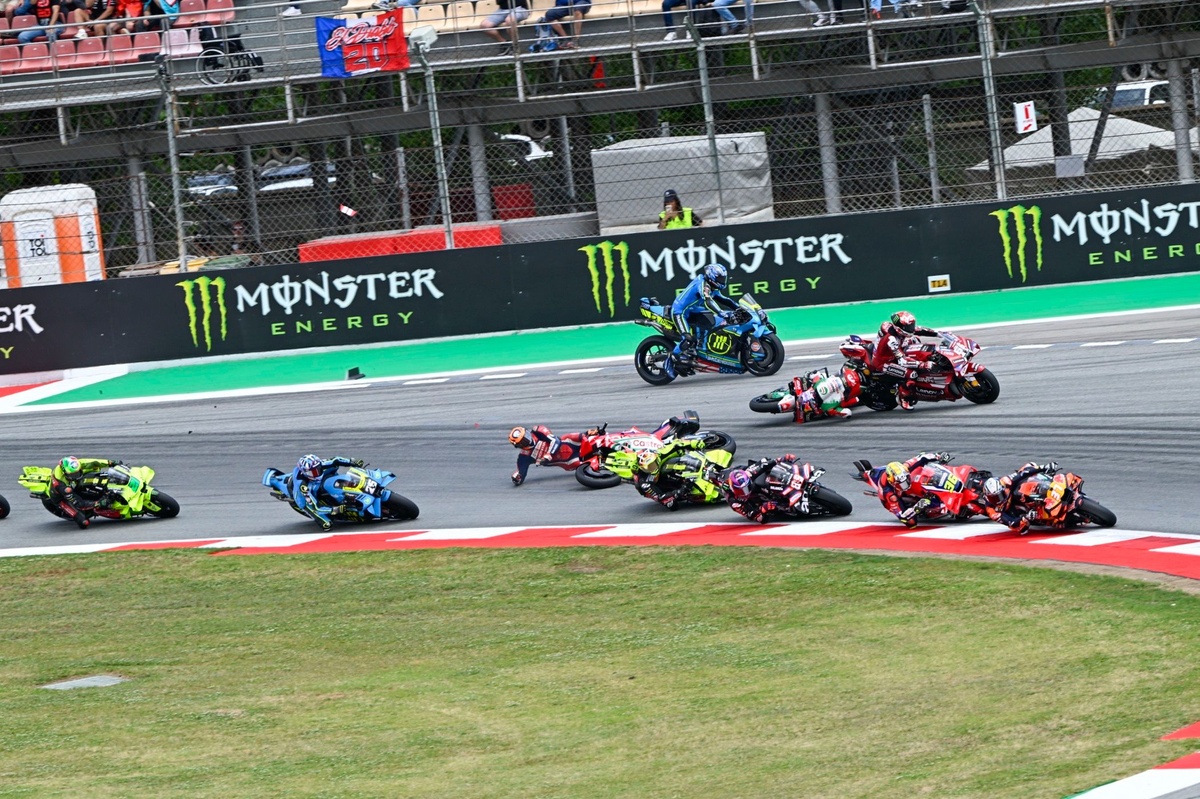
This is the first measure MotoGP has adopted in the wake of a crash-filled Catalan GP in which both Alex Marquez and Johann Zarco suffered injuries, with the latter breaking his knee at the restart at Barcelona’s notorious Turn 1.
Riders were already given a chance to practice starts without the ride-height adjustment device at Brno, with not all riders agreeing that races would necessarily be safer without it.
Speaking at Brno on Thursday, Honda’s Luca Marini welcomed the move by MotoGP, but stressed that riders would continue to take undue risks at the start, with a combination of excessive aerodynamic and tyre pressure rules making overtaking harder than ever before.
“It is perfect,” he said. “For me, it is nice, because we have one thing less to think about when we are arriving at Turn 1 at the start.
“For some manufacturers, maybe the rear device cannot come up fully extended, but this is not a big problem, because if you make the corner with a little bit more stroke in the rear from the rear device, it is not as dangerous as blocking the front device. So, it is a good change in the correct direction.
Race start.
Photo by: Gold and Goose Photography / LAT Images / via Getty Images
“But the crashes in Turn 1 will not disappear completely. So maybe we reduce the possibility a little bit, but it will be there, because the start and the first corner is the only moment that you can overtake three-four-five riders risking a little bit. It is impossible to overtake more than two usually, unless you are [Ai] Ogura.”
Trackhouse’s Raul Fernandez highlighted a possible downside to the ban, citing the long lap penalty Izan Guevara received for an unsafe change of direction during the Moto2 race at Balaton Park.
“In Brno, we started to make some stuff with no front device. It was quite strange because we will arrive with less speed in the first corner,” he said.
“But I think it’s not 100% safe because if you see what happened with Izan in Hungary with the wheelie on the straight, for which he received a penalty, you will see too many penalties [in MotoGP].
“With no device in the front part of the bike, the wheelie is easier. So you will see that in the first two-three races that we will not use this one, we will have too many wheelies and you will see too many changes of direction. Maybe it is even worse.”
Yamaha’s Fabio Quartararo said racing without the front ride device will be more nuanced, and could actually make racing safer where it matters the most.
“I think it’s not bad, It’s good for the safety,” he said. “Of course, it’s more tricky with the wheelie and everything. It’s somehow more dangerous in the straights, but it’s more safe in the braking point.

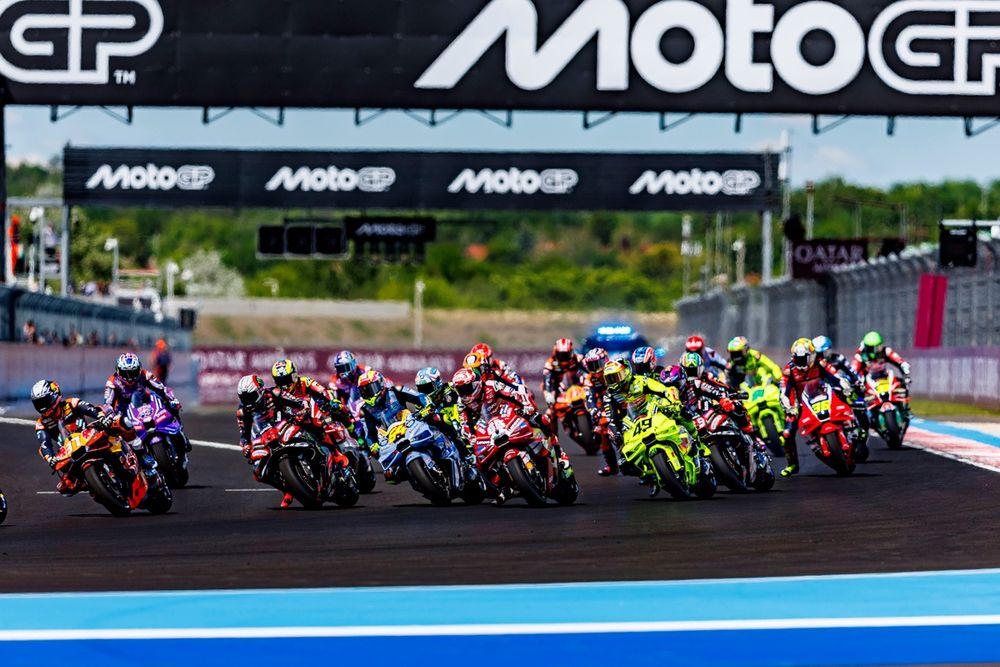
Race start
Photo by: Stephen Blackberry/NurPhoto via Getty Images
“You just need to get used to it because the bike has a lot of wheelie but you don’t have the same problem as in Le Mans where the bike is jumping everywhere. At Phillip Island, Silverstone, there are some tricky places where it’s really dangerous [to use the holeshot device] but you have to use it because everyone is using it.”
Quartararo’s team-mate Alex Rins echoed his opinion, saying: “It brings me to the past, when I started MotoGP with no devices and anything. So, in our case, it’s going to be a little bit more secure.
“In our case, the way that we need to unlock the front device is we need to hit the brake really hard and release, and then brake again. So, for sure, in terms of security, I think it’s an improvement.”
While championship leader Marco Bezzecchi suggested that there could be a better solution, he took satisfaction from the fact that MotoGP was taking steps to improve safety.
“It is a decision that we must accept. It’s different, and in terms of safety, it can be better. I’m also one of the guys that think that it’s not the only solution,” said the Aprilia rider.
“But it’s good that they took a strong decision to try to improve these kinds of things. And I accept it, I respect it and I agree.
“It will be tough to change everything. They gave us two sessions in Brno and they will give us two sessions here in terms of practice starts. So, they are also helping us to try to adapt quickly.”
We want to hear from you!
Let us know what you would like to see from us in the future.
Take our survey
– The Autosport.com Team
Read the full article here


