





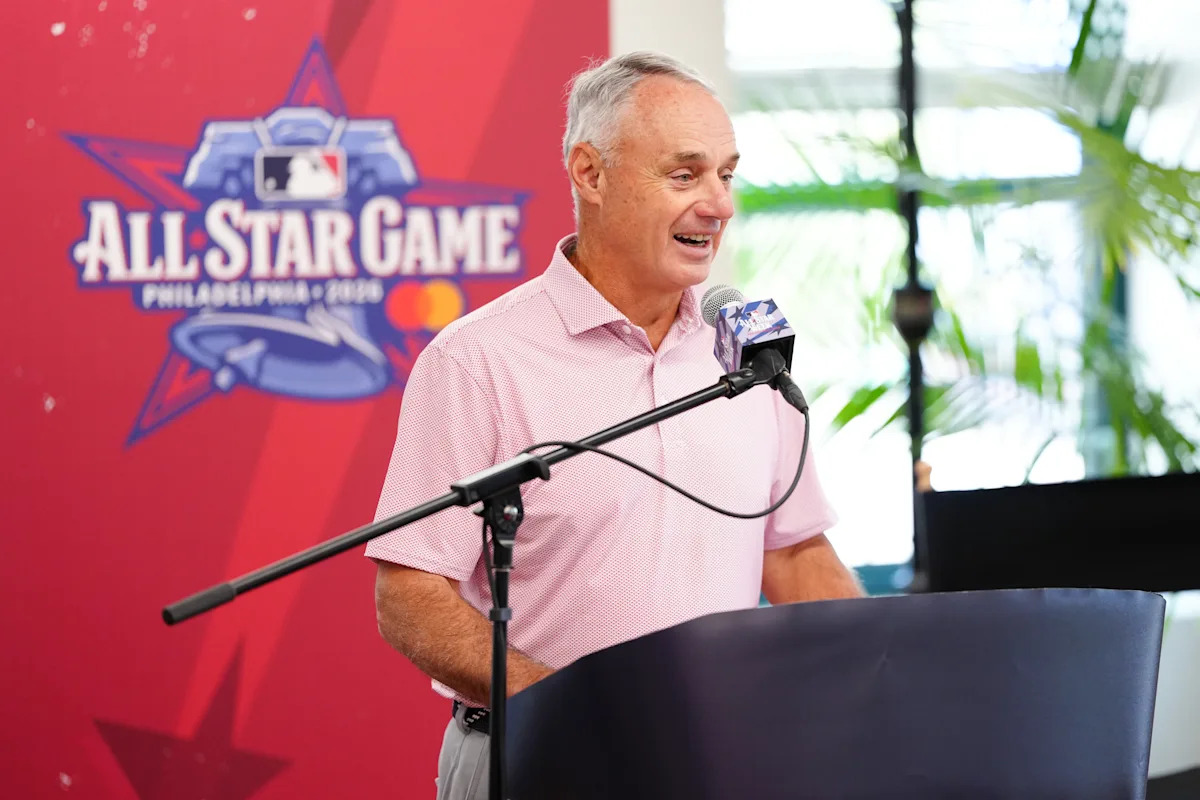
PHILADELPHIA — On Tuesday morning in a hotel ballroom, the two men primed to shape the future of baseball provided a valuable glimpse into the sport’s upcoming labor fight.
MLB commissioner Rob Manfred and MLBPA interim executive director Bruce Meyer held separate question-and-answer sessions with assembled members of the Baseball Writers Association of America. Unsurprisingly, Manfred and Meyer offered diametrically opposed perspectives on the state of the sport.
With the current collective bargaining agreement set to expire on Dec. 1, the entire industry is preparing for an extended work stoppage. A lockout feels like a foregone conclusion. Missing games in 2027 is a real possibility. That reality is, in large part, a product of the league’s insistence on implementing a salary-cap system, something the union has fundamentally opposed for its entire existence. The storm clouds are rumbling, the sky is getting darker.
While no shocking revelations were made Tuesday, the dual media conferences functioned as a drawing of battle lines. How Manfred and Meyer spoke about the sport illustrated how the league and union plan to handle their messaging moving forward.
Meyer, who assumed the union’s top job in February following the scandalous resignation of former boss Tony Clark, led off the proceedings. He began by heralding the health of the sport. It was a theme he would return to multiple times.
“We have a great game. Our game is in a great place overall,” he declared. “We have record attendance, record ratings, worldwide interest, youth demographic coming back. We had a great season last year — great playoffs, great World Series, great WBC.”
He then criticized the league for attempting to redirect that momentum into frustration.
“The league, these supposed stewards of the game, have spent an inordinate amount of time trying to convince those same fans that they don’t have hope, or they shouldn’t have hope, or that the product that they’re paying to consume in record numbers is somehow broken.”
That’s a reasonable line of messaging for the players’ association to take, even if the staid, subdued Meyer is an odd fit as a spokesperson for that enthusiasm-forward approach. Effectively, the union is arguing that if things are good, the status quo is working well and baseball is in a strong place, why the need to fundamentally reshape things by adding a cap?
The commissioner was then asked that exact question and offered a big-picture reply.
“Momentum in the game is a great thing,” Manfred said. “We got that momentum by listening to our fans and making changes that, you know, candidly, that the MLBPA was not interested in. Those changes have paid off in terms of creating that momentum, and the best way to lose momentum is to stay still.”
Over the course of his remarks, Manfred repeatedly employed some version of the phrase “listening to the fans.” Expect a whole lot more of that in the months to come. The league intends to position itself as an altruistic actor, one whose willingness to adopt rule changes has propelled the sport into this era of massive growth. The majority of fans, according to Manfred and the league, want a capped system. That desire, in Manfred’s opinion, is driven by a yearning for more competitive balance.
“I think that we need a system where fans, particularly in smaller markets, can have some hope that the players that are signed and developed by the organizations can actually stay there through free agency,” he said.
Although he spoke before Manfred, Meyer offered a direct rebuke of that argument when asked about that dynamic in regard to Pittsburgh Pirates ace Paul Skenes and the fan base’s lack of optimism regarding a long-term extension.
“I hear that, and then I think, what about Bobby Witt? What about Julio Rodriguez? What about JJ Wetherholt, who just signed? Konnor Griffin, Kevin McGonigle, Samuel Basallo, Corbin Carroll. … So you have this notion that they can’t keep their players. It’s just not true. It’s not true. They are keeping their players, and they can.”
CBA negotiations and the prospect of a salary cap weren’t the only topics covered during the two sessions. Both were asked about baseball’s role in the 2028 Olympics, as well as the ongoing eruption of gambling and prediction markets and their effect on the sport. Manfred was pressed on a wider scope of topics, including the potential involvement of President Donald Trump in a lockout and the decades-long decrease of Black big leaguers. That last question provided the day’s most bizarre moment, when Manfred stumbled through a tangent about the semantics of what exactly classifies a player as Black.
“The numbers from 40 years ago, there’s a lot of debate about who was counting what there in terms of who was being counted as a Black athlete, as a Black player, so I think you gotta be a little careful with that comparison,” he said before arguing that the league is making progress on that front with its efforts on the amateur side, pointing toward the recent MLB draft as an example.
Side quests aside, the morning was understandably dominated by posturing for the upcoming labor battle, one that could lead to the longest MLB work stoppage since the disastrous 1994 strike. Neither Manfred nor Meyer gave an inch to the other side. Nothing about the proceedings seemed friendly. It was, unfortunately, a sobering reminder of just how far apart the two sides are at this moment in time. Thus far, there has been far more public postering and bickering between the league and union than in previous bargaining seasons. Tuesday gave that contentiousness a much more tangible feel.
And things are going to get a whole lot uglier before they get rosier.
Read the full article here


