




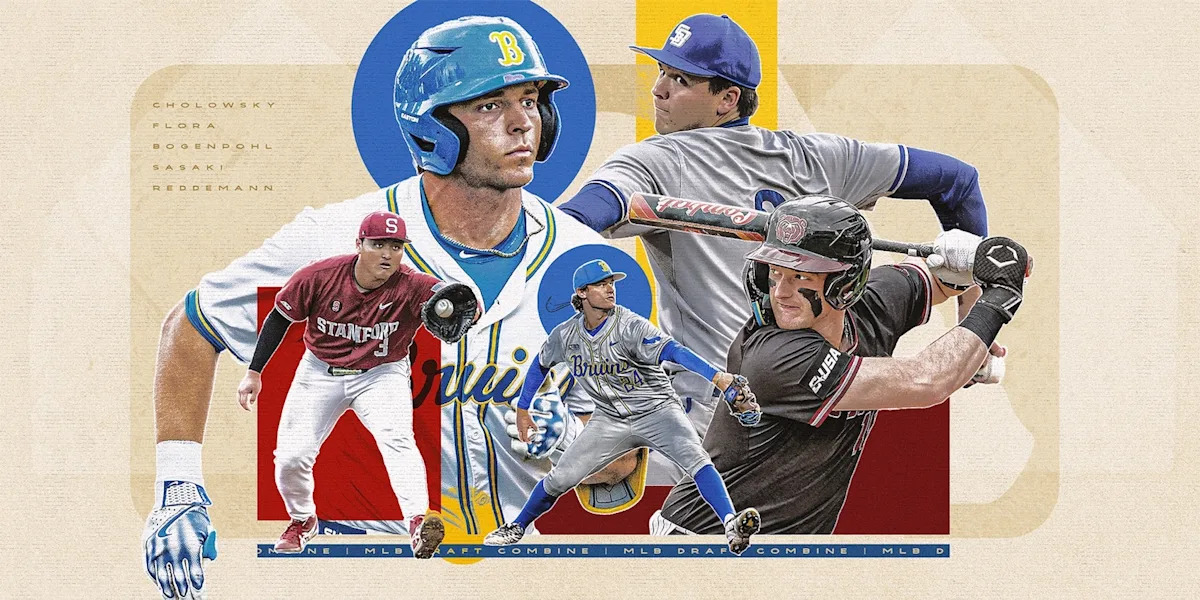
PHOENIX — The sixth annual MLB Draft Combine took place this week in Arizona, with more than 300 amateur prospects from high school and college programs all over North America descending upon Chase Field to participate in on-field workouts and interviews with major-league ballcubs.
A rigorous cycle of evaluation that began in earnest a year ago led up to the combine, the final official opportunity for players to raise their stock in advance of the 20-round draft that begins July 11 as part of All-Star weekend in Philadelphia.
Here’s a closer look at eight players whose attendance and participation stood out at this week’s combine.
SS Roch Cholowsky, UCLA
Few players in draft history have sustained their status as the undisputed top prospect in the class for the entirety of a cycle — from the prior summer all the way until draft day — but the Bruins’ shortstop has a chance to achieve that rare feat if he is ultimately selected first overall by the White Sox next month. But two other elite players — Georgia Tech catcher Vahn Lackey and Texas high school shortstop Grady Emerson — have joined Cholowsky in what is widely considered the first tier atop this class, clouding the likelihood that Cholowsky will be the first to hear his name called. While Lackey wasn’t in attendance at the combine, Cholowsky and Emerson were both in Phoenix to meet with teams and speak to the media.
“Everyone wants to be the first overall pick,” Cholowsky said. “I’ve done everything that I can to put myself in the best position. It’s out of my hands where I end up, but whoever takes me, I’m just excited to be there.”
Of note, Cholowsky revealed that he had only three team meetings scheduled: the White Sox (picking No. 1), the Rays (No. 2) and the Giants (No. 4). Whether that indicates a lack of interest in Cholowsky from the Twins (No. 3) or a lack of interest in Minnesota from the shortstop is unclear. It also might not be worth reading into, as many other factors will have a lot more to do with whether the Twins would draft Cholowky. Regardless of the significance there, any nugget involving a prospect of Cholowsky’s caliber and status leading up to draft day is compelling — and this one raises the level of intrigue should he still be on the board at pick No. 3.
RHP Logan Reddemann, UCLA
While Cholowsky bounced among numerous media obligations and his select trio of team meetings, his teammate Reddemann had a much different combine experience. Early in the spring, the right-hander was trending toward the first round — an 18-strikeout gem against Rutgers on April 10 certainly grabbed headlines — but he didn’t pitch for the Bruins after April 17 due to what was described as right arm fatigue. With the draft approaching, that ended his season on an uncertain note. But Reddemann had reportedly been ramping back up behind the scenes in recent weeks, in hopes of showing at the combine that he’s healthy and restoring confidence that he’s worth an early selection in July.
Reddemann was the first to throw in the second round of bullpen sessions Wednesday, and he flashed a toned-town version of his deep arsenal, climbing to 94 mph with his fastball. While this didn’t exactly resemble the peak version of Reddemann, who was dialing his heater up to 98 mph and shuffling through multiple excellent secondary offerings, it was still refreshing to see the righty take the mound and demonstrate his smooth mechanics and five-pitch mix, even without the high-end velocity.
Even after losing Reddemann for the stretch run, Cholowsky spoke glowingly of his teammate’s impact on the team after he transferred from the University of San Diego last summer:
“He was the ideal guy that we wanted to pick up the portal,” Cholowsky said. “Coach [John] Savage is very particular with who he picks up. He’s a big makeup guy, personality guy — he’s very specific on who he thinks will fit in the program, and Logan came in and did an unbelievable job not just fitting in but also pitching for us. I felt like it was a free win on Friday if he was on the bump. We had a lot of confidence in him, and he just really developed into a good Bruin pitcher.”
With an eventful collegiate career behind him, Reddemann remains one of the true wild cards in next month’s draft. A team unconcerned about his injury could pluck him in the middle of the first round, but it’s also possible the missed time and modest bullpen display at the combine push him farther down the board.
RHP Ethan Wachsmann, Grandview High School (Colorado)
Two years ago, a big right-hander from a Colorado high school turned some heads at the combine by touching triple-digits with his fastball. That was Trey-Gregory Alford, who went on to be selected in the 11th round by the Los Angeles Angels but received a signing bonus of nearly $2 million, one of the largest given to a high school pitcher in the 2024 class.
Could history repeat itself in 2026? Wachsmann also represented the Centennial State with some elite heat this week, showcasing the best velocity of any pitcher who threw an official bullpen session, college arms included. Not only did he max out at 100 mph with his fastball, but Wachsmann also exhibited spin rates in excess of 2,900 on both a low-80s curveball and an 85-mph slider.
A Wake Forest commit from the same high school program that produced Kevin Gausman, Wachsmann arrived at the combine in the third-round mix. But in a year without any clear-cut first-round high school righties, perhaps Wachsmann flashed enough in Phoenix to be considered earlier come draft day. There’s a UCLA connection here, too: Ethan’s older brother, Isaac, an outfielder who has put up some big numbers at Xavier and Creighton, recently announced his commitment to the Bruins in the transfer portal.
Will Roch Cholowsky go No. 1? How high will Jackson Flora hear his name called? These are some of the big questions as the MLB Draft nears.
(Mallory Bielecki/Yahoo Sports)
RHP Jackson Flora, UC-Santa Barbara
One pitcher who did not need to throw at the combine to validate or raise his draft stock was Flora, the consensus top arm in this year’s class after another sparkling campaign piling up strikeouts with the Gauchos. But Flora made the rounds in Phoenix anyway, exhibiting a relaxed yet excited demeanor as he prepares to start his professional career and expressing his appreciation for his rise from relatively unheralded high school arm to premium prospect. Several of the college stars were at their second combine this week after being invited as top high school prospects two or three years ago, but Flora was in attendance for the first time.
“I had some draft meetings out of high school, but I think they were just doing their due diligence because I could throw pretty hard,” he said. “But I think once I got to college and started having a little bit of success, I didn’t want to put a ceiling on myself. I felt like I could put in the work and get to the spot that I’m at today.”
Flora finds himself in a similar position to his former teammate Tyler Bremner, who also blossomed at UCSB en route to being selected second overall by the Angels last summer.
“It was awesome to be around him while he was going through this experience,” Flora said, “just because I feel like it made me a better player, too, just watching him kind of go through the whole draft year and all that stuff. Since we were pretty close, I could talk to him about it, ask him what’s going through his mind, what he’s thinking, and I think it helped me a lot in my success this year.”
Considering the position-player talent at the very top of the class, Flora is unlikely to usurp his pal in terms of draft position. But he said he had combine meetings with all seven teams picking Nos. 2-8 (Rays, Twins, Giants, Pirates, Royals, Orioles, Athletics), meaning he shouldn’t have to wait long to hear his name called on draft day.
1B Rintaro Sasaki, Stanford
After a legendary career at Hanamaki Higashi High School — the same program that produced Shohei Ohtani — Sasaki made the unprecedented decision to leave Japan and prove his skills stateside in college, rather than beginning his professional career in NPB. Because of his age, Sasaki was slated to be draft-eligible as a sophomore in 2026, giving him two seasons to perform against top-tier collegiate competition and establish himself as a viable MLB draft pick. He underwhelmed as a freshman with the Cardinal in 2025, lessening the hype around his unique presence in Division I baseball and lowering his chances of being an early-round pick. But Sasaki’s production took a leap in Year 2 — his OPS climbed from .790 to .952 — and his decision to attend this week’s combine reaffirmed his intent to pursue his MLB dreams.
Known for his prodigious, left-handed power dating to childhood, Sasaki did not disappoint in his batting practice performance Tuesday, when he sent several balls soaring well beyond the right-field fence. His best blast came off the bat at 115.4 mph, and he hit another mammoth shot that traveled 458 feet. Sasaki also took ground balls at third base, but he looked markedly more comfortable at first during infield drills.
Even with his improved performance as a sophomore, Sasaki — with limited defensive value and more good than great offensive metrics — is not considered an early-round candidate by major-league clubs. The most optimistic evaluations peg him as more of a fifth-to-eighth-round prospect who could warrant a signing bonus in the low six figures. It’s also important to note that Sasaki was selected by the Fukuoka Softbank Hawks in October’s NPB amateur draft, meaning the Hawks have the rights to negotiate with Sasaki about a return to Japan should he be unsatisfied with his MLB selection next month.
While his collegiate tenure might not have made the impact many hoped for when he arrived, Sasaki’s choice to chart his own course should not go underappreciated, regardless of what happens next. He embraced the challenge at every turn, learning English at an astonishing rate and becoming a beloved figure in both the Stanford baseball program and the college baseball world at large. As things stand, the most likely next chapter of his journey involves a return to Japan, but Sasaki has surprised everyone before, so perhaps he’ll find a way to continue chasing his big-league dreams, even if that means a later draft selection.
OF Caden Bogenpohl, Missouri State
Another standout performer in batting practice was Bogenpohl, who registered five of the eight highest exit velocities on Tuesday, including a jaw-dropping, 119.4-mph laser beam down the right-field line for a home run.
Bogenpohl, a 6-foot-6, 230-pound center fielder who also participated in outfield drills, burst on the scene in 2024, when he launched 20 homers in 56 games as a freshman for the Bears. That breakout propelled him into the inner circle of collegiate position-player prospects in his class, but his power production evaporated over the next two seasons, as Bogenpohl’s home run total fell to 13 as a sophomore in 2025 and just six as a junior this spring. But dig deeper into his profile — and watch him demolish baseballs in a big-league ballpark, like he did Tuesday — and it’s clear this odd trend was the product not of any sort of physical decline but of a shift in approach that didn’t lead to optimal results.
“This season, I tried to be the most complete player I could be on both sides of the ball, and a big factor in that was making more contact,” Bogenpohl explained. “And obviously, cutting down the whiff rate in the zone meant having to level out the swing a little bit and the path, which you know led to more ground balls, which isn’t going to help your slug out whatsoever.”
Indeed, while Bogenpohl’s power numbers suffered, he slashed his strikeout rate from 28% as a freshman to 18% as a junior while maintaining excellent plate discipline and continuing to draw walks at roughly a 20% clip (which he did in all three seasons at Missouri State). That he was able to make that dramatic of an adjustment over the course of his college career is admirable, but he might have taken it too far. His groundball rate skyrocketed from 32% as a freshman to 53% as a junior, resulting in the sharp decrease in long balls — an untimely development in his draft year.
“I gave some slug up for less whiff,” Bogenpohl summarized. “Ultimately, I don’t know if that’s who I’m gonna be one day playing pro ball, but at least I kind of showed myself I could do it if I wanted to.”
Bogenpohl’s loud showing in BP on Tuesday was a reminder that he still has exceptional slugging potential that could be accessed with the right tweaks at the next level. We’ll find out next month which team wants to take on that challenge.
1B/OF Dominic Santarelli, St. Joseph High School (Wisconsin)
One valuable element of the combine is the opportunity to see an enormous range of players on the same field at the same time, allowing for a more direct visual comparison of prospects’ frames and statures relative to one another beyond their listed heights and weights, which can sometimes be misleading. With batting practice sessions and defensive drills mixing high school and college players together, this dynamic often ends up highlighting the prep prospects whose physicality stands out not only among their same-aged peers but even compared to those who have developed in high-end college programs for several years.
Enter Santarelli, a hulking first baseman from Wisconsin whose thunderous, left-handed swing produced some of the more eye-popping batted balls of the week.
Santarelli was a staple on the showcase circuit last summer, so his outlier raw power has been well known in scouting circles for a while. If anything, Tuesday’s loud BP showing was just another day at the office, rather than any sort of unexpected introduction to his ability. He also wasn’t the only prep bat to stand out in BP: outfielders Martin Shelar (Georgia, committed to Mississippi State), Genson Veras (Florida, Florida State) and Blake Bowen (California, Oregon State) as well as shortstop Jack Beck (Tennessee, Georgia Southern) were all pummeling balls with authority.
Santarelli’s commitment to LSU as one of the Tigers’ top position-player recruits makes his next step especially intriguing, as it feels like a coin flip whether he gets paid handsomely in the draft or heads to Baton Rouge as one of the more hyped freshmen in the country.
SS Rocco Maniscalco, Oxford High School (Alabama)
Maniscalco is one of several high-profile high school prospects in recent years to reclassify in an effort to take advantage of teams’ prioritization of age in the draft as a vital indicator for future development. His reclassification stood out as especially extreme, as Maniscalco didn’t just class up to ensure he wasn’t old for his class (as many have done to avoid being 19 years old on draft day); he did so to become one of the youngest prospects in draft history. Maniscalco does not turn 18 until May 1 of next year. This made the switch-hitting shortstop a high-priority scouting target this spring, but he struggled for much of his senior season — to the point that his status as a pick in the first two rounds was wavering, regardless of his youth.
But scouts say Maniscalco finished the year strong enough to resurface as a viable early selection, and the combine offered him one final opportunity to assert himself as one of the top prep infielders in the class. He showed well in Tuesday’s workout, exhibiting smooth actions with a strong arm in infield drills and some surprising pop in BP, including a max exit velocity of 108.8 mph from the left side.
Significant questions about Maniscalco’s hit tool remain for some teams, so it’s no guarantee that he’ll be drafted early enough to forgo his commitment to Mississippi State. But his age and physical traits are rare enough that it wouldn’t be a surprise if Maniscalco starts his professional career this summer after being selected in the first couple of rounds. Like Santarelli, this is another toss-up prep prospect to monitor.
Read the full article here


