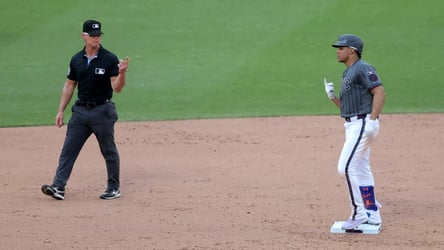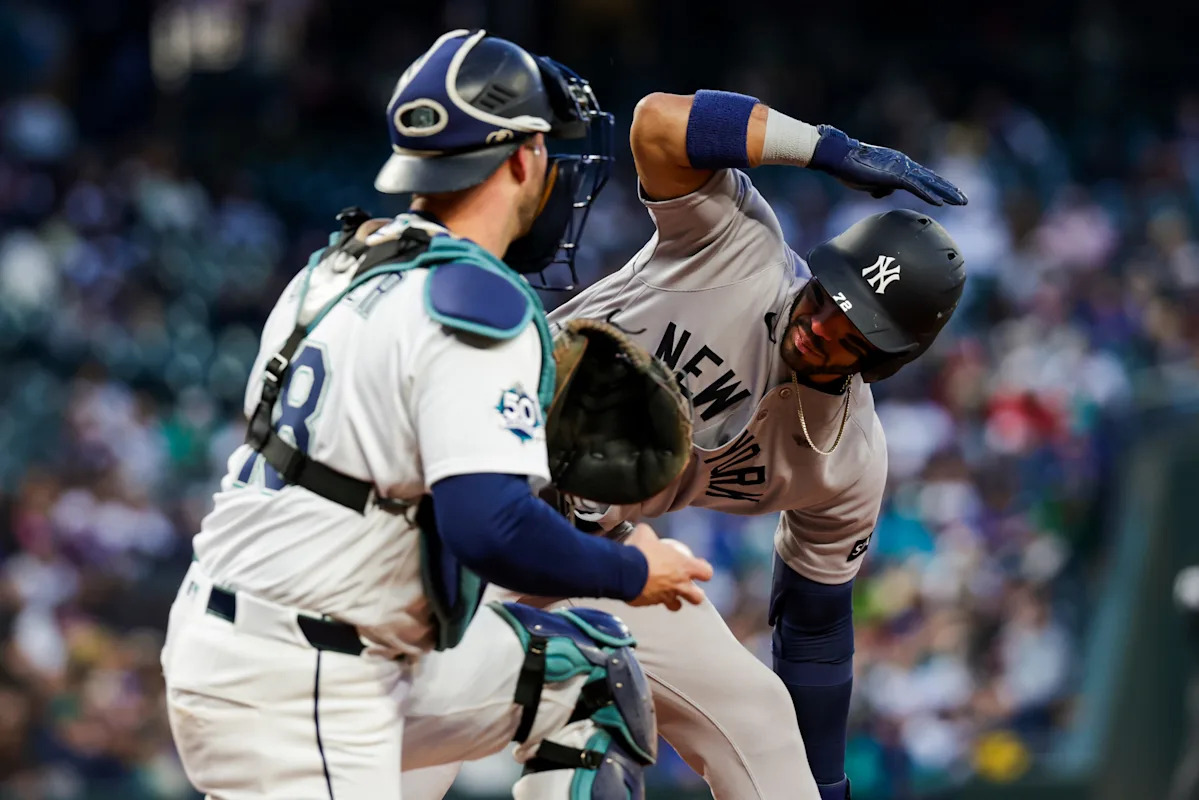
Ten percent of the season is in the books. Does Major League Baseball play any differently after three weeks of the automatic ball-strike challenge system?
Perhaps. Certainly, it is a nascent and evolving niche within the game, filled with trial and error, hot hands and teachable moments all in the name of trying to gain an edge – 0.1% of an edge, even – on the corners of the strike zone.
While things will certainly change, and something resembling normalization will occur over the rest of the season, there are a few hard and fast maxims about ABS that we feel comfortable rolling with. A look at six truths the so-called “robot umps” have yielded so far:
Games are longer
It’s true: The average nine-inning game is averaging 2 hours, 42 minutes, longest in the four years of the pitch-clock era. (The first three seasons produced nine-inning averages of 2:39, 2:36 and 2:38).
Certainly, there are plenty of factors that contribute to game time beyond the 30 or so seconds every ABS challenge takes. Teams are using 4.34 pitchers per game, the highest mark since 2021 and possibly a function of the early-season glut of off days enabling managers to more liberally deploy relievers.
Pitchers are also issuing 3.8 walks per game, the highest mark since 2000 and perhaps one that will normalize as the year proceeds and time is shaved off of games. So is it all the challenge system spiking game times?
Nope. But it’s certainly a contributing factor.
Catchers are king
As one might have anticipated.
Nobody has the vantage point of a catcher, able to see exactly where a ball crossed the plate and, like machine learning, eventually figure out, most importantly, what the Hawk-Eye tracking system believes is a strike.
Accordingly, catchers are successfully challenging at a rate of 62% entering games of Tuesday, April 14. They account for 501 of the 522 attempts by fielders, though pitchers, emotional beings that they are, aren’t faring too poorly – they’re 10-for-21 so far.
As for hitters?
Consider them the foolishly aggrieved party. Helmet-tappers are successfully challenging at a rate of just 47%, with Ronald Acuña Jr. (2 for 6), Nolan Schanuel and Hunter Goodman (each 1 for 5) the most erratic.
Dillon Dingler is the ABS whisperer
So, who’s the best at this thing?
We’ll give an early nod to the Detroit Tigers’ Dillon Dingler. He’s currently 9-for-10 in getting balls overturned for his pitcher, the best rate for a catcher with more than five challenges. Victor Caratini (8-for-10) is right on his tail, while veteran J.T. Realmuto is perfect in five challenges so far.
Managers are working harder to get thrown out
Yep, arguing balls and strikes – traditionally the surest ticket to an early shower – is much harder to do with a pair of replay challenges in a manager’s back pocket.
Yet are skippers still getting tossed? You bet.
Eight managers have been ejected so far, and the intent hasn’t changed much in the ABS era: Six of the eight got the heave-ho when their teams were trailing and, maybe, the manager saw fit to light a fire under the lads. Alas, none of the six clubs came back to win after their manager was ejected, though perhaps the histrionics proved whatever point the manager hoped.
One ejection did occur in an ABS situation: Derek Shelton, tossed with one out in the top of the ninth inning after an overturned ball, just as the Minnesota Twins were about to lose to the Baltimore Orioles. Runner’s interference resulted in two ejections, while a balk call, a disputed quick-pitch, a pair of check swings and an overturned out call at first accounted for the others.

The Twins are winning both sides of the ball
OK, so we won’t correlate ABS challenge success with on-field record just yet. Still, it’s hard to ignore that the Twins – consensus picks to finish last in the AL Central – are 10-7 and tied with Cleveland for the AL’s best record.
And they’ve won more batter’s challenges – 14 – than any team in the majors and lead the AL with 19 successful defensive challenges.
Sure, maybe the games have simply played out that the Twins have had a ton of chances to air a grievance. Either way, they’ve clearly chosen a path of aggression, as they lead in batter challenges (29) and are second to the Marlins with 28 defensive challenges.
Their percentages aren’t elite – they rank 15th among batters with a 48% success rate and 10th defensively at 68%.
But shooters shoot, as they say, and nobody’s gotten more calls overturned.
Umpires have gotten … worse?
So this is a tricky one.
There’s plenty of ways now to measure umpire aptitude, and we tend to lean on the very means-tested Umpire Scorecards as our metric of choice. Within that, we can look at correct ball-strike percentage or other methods of accuracy.
For this exercise, we’ve chosen to highlight how many umpires rank in the positive for what they call “accuracy above expected,” or the difference between actual accuracy and expected accuracy given the web site’s “machine learning approach to estimating an umpire’s performance relative to their peers.”
Fair enough.
For what it’s worth, 76 of 91 umpires – or 83.5% – finished above 0 in accuracy above expected in 2025. This year? Just 54 of 83 – or 65% – rank in the positive.
Keep in mind: This is an extremely small sample size. A vast majority of umpires have had three or fewer plate assignments so far. Perhaps the accurate calls heat up with the weather, etc.
And maybe the umps’ confidence will level up when they realize ABS confirms that they were right a lot of times, too.
Perhaps that’s the ultimate truism: That humans can go toe-to-toe with robots just fine.
This article originally appeared on USA TODAY: MLB ABS system stats: Challenge results, 2026 robo ump takeaways
Read the full article here