

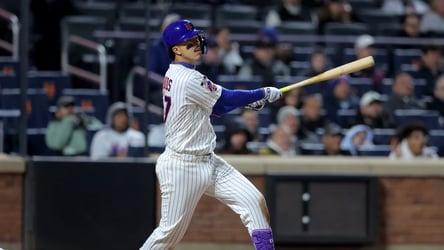
Mark Vientos saw the stop sign. He admitted as much later, though, to hear him discuss the sixth-inning play on which he was thrown out at home by several feet in a tie game, the fact that he saw third base coach Tim Leiper hold his hands up did not strike Vientos as an admission at all.
“I was just following my instincts. Once I saw [Marcus Semien’s double] was hit off the wall, I was like, I’m gonna go score on that,” Vientos said. “Leip gave me the stop sign, but I followed my instincts and went home.”
As it happened, Vientos’ instincts did not doom the Mets, in large part because with runners on first and second and two out in the eighth, he wrestled an inside pitch into short right field to score Brett Baty with the eventual winning run.
“I’m glad he got that hit and redeemed himself,” Mets manager Carlos Mendoza said with a chuckle that felt appropriately nervous, given that Vientos made clear he would probably make the same choice again.
“Obviously, depending on the situation, we want to make the right play. But I’m always going to be aggressive. I’m not going to play passive on the baseball field,” Vientos said. “I’d rather make a mistake aggressive than passive.”
In some ways, the 2026 New York Mets are an example of that same philosophy: If the 2025 team sputtered out with the same old names, David Stearns was determined not to replicate last year’s failures this year. What the Mets must discern – now that their shoulders are free of that unfathomable losing streak — is what parts of their current roster might eventually look like aggressive mistakes.
Wednesday night’s win did not happen because the Mets made drastic changes. Juan Soto’s return certainly helped, though it was quickly undermined by the departure of Francisco Lindor, who appeared to suffer nearly the same injury that sidelined Soto while scoring in the fourth.
It happened because the Mets, led by their manager, emphasized the need to trust track records as the present spiraled.
“You feel like you’re doing the right things. You evaluate things. You look around. People are doing what you should be doing,” Clay Holmes said after throwing seven strong innings. “You kind of really want to reach for something to do, but you’re already doing those things. Sometimes, that can be a little harder. You have to double down on the belief in yourself.”
Holmes, for example, tripled down on his sinker Wednesday, using it 73 percent of the time – almost as he might have in his days as a reliever. The righty is pitching to a 2.10 ERA in five starts this season.
But no one has been more stubborn than the Mets lineup, which has changed in terms of personnel even as it has committed to being aggressive through its slump. Mendoza said Wednesday that even though his lineup compiled the lowest on-base percentage in baseball, he was not clamoring for patience.
“It’s hard to get behind in counts here,” Mendoza said. “You have to be able to stay on the attack with good pitches in the strike zone.”
Quite obviously, little has changed because the Mets won Wednesday’s game 3-2. They still have the worst on-base percentage in baseball. Only two teams are swinging more frequently than they are. Only three are swinging at a higher percentage of pitches out of the zone. But last year’s team was baseball’s fifth-most patient and look where that got them. This year’s team will not make the same mistake.
Exactly what mistakes it will make now, after the baseball gods finally permitted them a win, remains to be seen. If Lindor is out for a significant period – and it is important to remember that Soto received what was considered a best-case diagnosis for a calf-related injury and still missed nearly three weeks – the Mets will have to wait even longer to see what the intended version of their lineup can produce.
But in the meantime, they will cross their fingers that Bichette can swing his way into a hot streak, that Vientos can turn a bloop into an offensive blaze, that two walks from Baty on Wednesday mean he is seeing the ball better…that everyone keeps doing what they would normally be doing in the hopes that better results must somehow follow.
“You have to stay positive. You can’t come to the ballpark expecting the worst, even if you’re going through a very rough stretch,” Mendoza said. “You come to the ballpark expecting good things to happen. And yes, it doesn’t matter how hard it is and how things are unfolding. Your mindset has to be expect something good to happen for us.”
No one should expect anything less than good things from the Mets, in whom Steve Cohen invested roughly $380 million this year. But when he chatted with reporters this week, he was careful to describe himself as “calm but concerned” in the only on-the-record comments he would offer, wary not to seem too worried nor too relaxed.
His roster is set. This team is in place. If a 12-game losing streak in April would be interpreted by some as a stop sign for championship dreams, the Mets seem resigned to ignore it. They are trusting their instincts, and those instincts are telling veteran members of their clubhouse that they are better than they have shown — or at least, that if they are not as good as some believed, their best chance is to run past the red flags anyway.
Read the full article here