

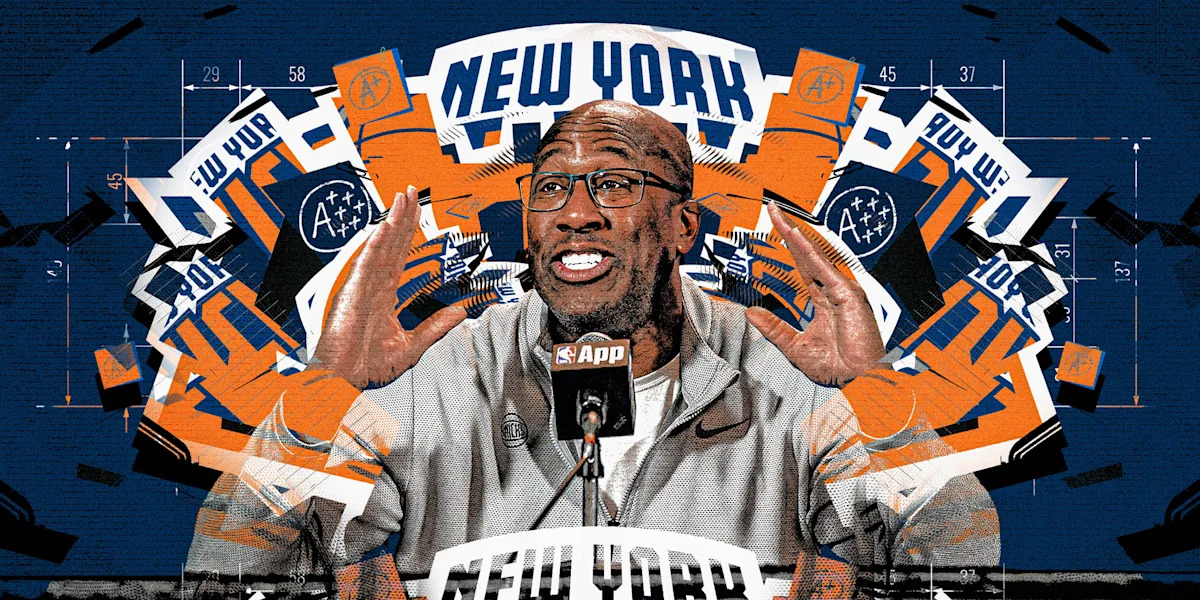
CLEVELAND — It stood out because, like so much about this unbelievable New York Knicks run through the 2026 NBA playoffs, it was just a little bit different.
After yet another commanding win in Game 3 of the 2026 Eastern Conference finals to put the Cleveland Cavaliers on the brink of elimination and draw the Knicks 48 minutes closer to an NBA Finals return more than a quarter-century in the making, Brown praised his players for remaining desperate despite their success. It’s a message the coach has delivered repeatedly this postseason.
“They’ve been fantastic,” Brown said. “We’ve thrown a lot of adjustments, offensively and defensively, at them throughout the course of these playoffs. And to still see them locked in, and trying to be focused on the details at hand, again, that just speaks volumes of my coaching staff and the way that they’re presenting and changing and all that stuff.”
And then, Brown said something new.
“But [it’s] more so about these players,” Brown said. “And their want to go try to get a ring.”
To that point in his maiden postseason voyage as the head coach of the New York Knicks, Brown had yet to reach for that rhetorical brass ring.
Now, after a 130-93 Game 4 victory on Monday — another blowout in a closeout — Brown is the first Knicks head coach since Jeff Van Gundy in 1999 who will have a chance to compete for the real thing.
(Joseph Raines/Yahoo Sports Illustration)
It’s the high point (thus far, at least) in what’s been a remarkable return to head coaching for Brown, who hadn’t made the championship round from the first seat on the bench since 2007 — the longest gap for any coach in NBA history — and whose future seemed uncertain after he’d been fired amid a slow start to his third season in Sacramento during the 2024-25 season.
“If an opportunity came up, great; if it didn’t, you know, shoot, I felt lucky, blessed, fortunate,” Brown said. “I had a good run, you know? And I felt that at some point, I’d get another opportunity, whether it was a head coach or an assistant coaching position. So I just kind of rolled with it. Didn’t think much about it.
“And, you know, obviously, this opportunity came up. You know, from afar, I just felt that this team was ready.”
The incredible events of the past month — 11 consecutive wins, two straight series sweeps, blowing opponents’ doors off by nearly 22 points per 100 non-garbage-time possessions, a margin twice as large as either Western Conference finalist — have proved that the Knicks were ready. The path to get here, though, proved that Brown was also ready — for another chance at the top job, for the pressure that came with Finals-or-bust expectations, and for the challenge of synthesizing all that he’s learned in three decades on NBA benches into an approach capable of getting championship-level results out of this New York roster.
And while everybody watches the two titans out West slug it out for the right to host the Knicks in the 2026 NBA Finals, Brown can think about what being the first Knicks coach to hoist the Larry O’Brien Championship Trophy since Red Holzman in 1973 would mean.
He can think about it. He probably won’t, though. Not yet.
“When I took the job, I thought about it,” Brown said during a Zoom conference call with reporters on Sunday. “But going through this process, one of the things that I’m trying really hard to do — and trying really hard to make sure our team does from the top down — is to stay present. And what I mean by that is, we don’t wanna get ahead of ourselves, because as soon as we start getting ahead of ourselves, that’s when disaster always occurs, it seems. And so for us, starting with me, making sure everybody in the organization understands it’s about the next game — and, really, it’s about the next possession.”
That kind of relentless focus on the next task — on winning the next possession, and the one after that, and the one after that — sounds awfully similar to the approach famously espoused by Brown’s predecessor.
‘He had big shoes to fill’
Tom Thibodeau preached process, persistence, a maniacal attention to detail. You can’t skip steps; the magic is in the work. And Thibodeau did help perform a magic trick — the total transformation of what had been a moribund franchise for the better part of two decades into a respected, relevant and consistently competitive NBA team.
The Knicks won 21 games the season before team president Leon Rose arrived and hired Thibodeau. In his first season, they finished over .500 and made the playoffs for the first time in eight years. After a step back in his second year, and the signing of franchise fortune-changer Jalen Brunson: 47 wins, and New York’s first playoff series victory since 2013.
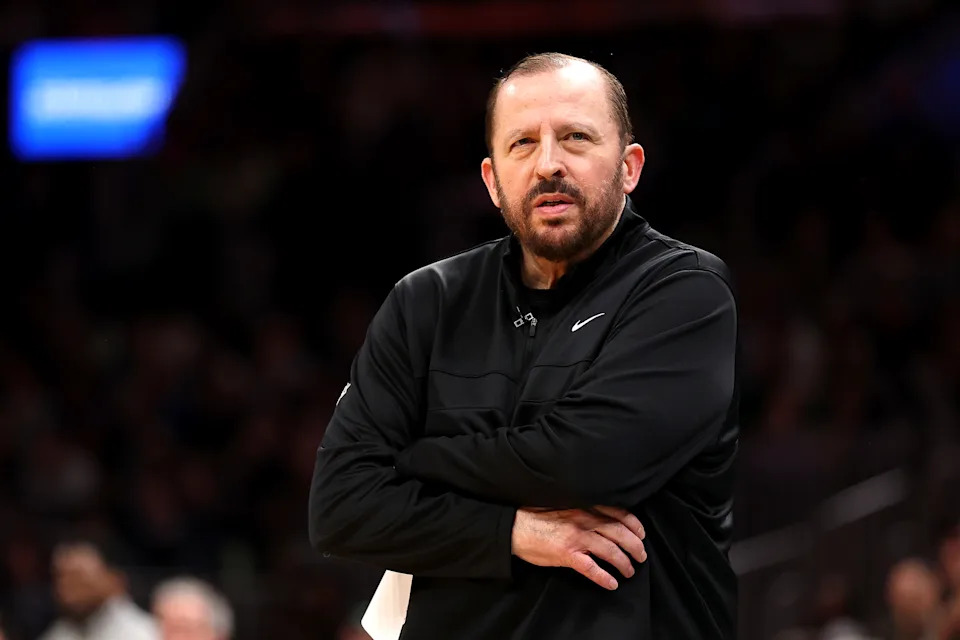
Tom Thibodeau helped build these Knicks, but was fired last season after they lost in the conference finals. (Photo by Maddie Meyer/Getty Images)
(Maddie Meyer via Getty Images)
Next: 50 wins, another series win, and a trip to Game 7 of the conference semis before a critical mass of injuries and incredible Indiana shooting ended things. Then: 51 wins, a stunning win over the heavily favored Celtics in Round 2, and New York’s first trip to the conference finals in 25 years.
Jettisoning a coach responsible for such a sea change seemed, in the eyes of many observers, psychotic. But New York’s brass didn’t hesitate, showing Thibs the door just three days after the Pacers once again ended the Knicks’ season. It was a clear statement that Rose and owner James L. Dolan believed a different coach would be “best for [an] organization” that had, after checking the boxes of regular-season success and consistent playoff qualification, now become “singularly focused on winning a championship.”
“The team is really built on Tom Thibodeau. He built that core,” Dolan said in a January radio interview. “We went as far as we did last year, so you really have to take your hat off to Tom. But we did come to the conclusion on how we wanted to organize the team, and that meant we needed to evolve beyond the old, traditional coaching formulas.”
They wanted a coach willing to operate differently than Thibodeau: to be more collaborative with other stakeholders in the organization, including front-office executives, assistant coaches and the players themselves; to introduce more variety into an offense that had too often devolved into Brunson isolations; to make a more concerted effort to play his reserves rather than routinely leaning on his starters for the heaviest minutes in the league; and to be willing to explore different strategic and tactical approaches during the regular season, with an aim toward having more tools in their toolbox come the postseason.
After a search that famously included New York being denied the opportunity to interview a handful of sitting head coaches and meeting with several other candidates, the Knicks landed on the 55-year-old Brown — a candidate who might have looked like a retread through one lens, but who checked an awful lot of boxes.
Brown offered decades of experience, cutting his teeth with Gregg Popovich’s Spurs and Rick Carlisle’s Pacers in the early aughts. He’d coached superstars, taking the early-days LeBron Cavs to the Finals in 2007 and steering the late-model Kobe-Pau Lakers from 2011 through 2013. He had a championship pedigree, winning one NBA title as an assistant under Pop in San Antonio and two more with Steve Kerr in Golden State. And when he got the wheel in Sacramento, he’d performed one hell of a magic trick of his own: returning the Kings to the playoffs, ending the longest postseason drought in major American professional sports.
Brown took the job knowing he faced elevated expectations — a point that Dolan would explicitly underline during that infamous radio interview.
“He had big shoes to fill, because Thibs did an amazing job and gave us the experience and the education and the opportunity to show the world what we could do as a team,” All-Star center Karl-Anthony Towns said after Game 3 against Cleveland. “When Mike came in, making the Eastern Conference finals was going to be the bar — minimum.”
Brown made it clear from the start that he understood that, and welcomed it.
“Shoot, I don’t know if anybody has any higher expectations than me,” Brown said at the Knicks’ media day session all the way back in September. “I love being in a position where you feel expectations. To me, that means there’s something of importance that you’re doing.”
How Brown made adjustments in New York
Brown started tinkering right away. New York’s opening-night win — over the Cavs, funnily enough — offered an indication of how things would be different on his watch: more getting Brunson off the ball, more multi-guard lineups, more experimentation with small-ball, a religious adherence to proper spacing and pushing the tempo whenever possible.
He used the regular season as a laboratory where he could experiment with different actions, schemes and rotations. When incumbent starter Josh Hart returned from a preseason injury, Brown brought him off the bench, so he could get a closer look at how the starting lineup might function with either another big (Mitchell Robinson) or a better shooter (Miles McBride, Landry Shamet) in the fold. When it became clear that the unit benefited from the unique and multifaceted contributions that Hart brings to the table, Brown reinserted him.
Brown found more minutes for reserves McBride and Shamet, both of whom offered a dose of point-of-attack defense and 3-point shot-making that could help keep New York humming when starters sat. He implemented a load management plan for the oft-injured Robinson. He got Jordan Clarkson to completely change his game, trading in quick-trigger 3-point launches for corner crashes to the offensive glass, aggressive 94-foot pressure defense, and short stints of all-out two-way effort. And he gave young guys like second-year guard Tyler Kolek and rookie Mohamed Diawara opportunities to get on the floor with the starters and in moments of consequence — just in case.
“You know, Steve Kerr, Gregg Popovich — they were guys that went deep into their bench, and they both always used to say, ‘It’s not about now, it’s about the postseason,’” Brown said after Game 3. “You know, you keep guys engaged by doing that, and you do develop not just the bench, but the team as well, because guys get used to playing with other guys, just in case someone goes down.”
When the Knicks’ defense wasn’t working quite as intended midseason, Brown and his staff switched things up, changing New York’s pick-and-roll scheme and helping kickstart a run that’s seen the Knicks lead the NBA in defensive efficiency since mid-January. When Towns was struggling to figure out where he fit into an offensive scheme that sought to push him outside his comfort zone, Brown and his staff found ways to get the big man a steadier diet of some of the looks he prefers — all the while keeping the dream of a more motion-heavy, read-and-react offense alive.
Brown has made it clear that he’s not particularly interested in making sure the game plan the Knicks go with is his idea so long as it’s the best idea. Throughout a playoff run that’s been characterized by the Knicks identifying the right buttons to press and mashing them immediately — hunting Joel Embiid, James Harden or Donovan Mitchell in the pick-and-roll, throwing relentless traps at Tyrese Maxey, pushing the pedal to the metal on the fast break against a Cavaliers defense that already struggled with transition defense and was absolutely out of gas — Brown has frequently lavished praise on his assistants, chiefly offensive coordinators Chris Jent and TJ Saint and defensive coordinators Brendan O’Connor and Darren Erman.
“Those guys, they watch more film than anybody that I know […] everything is collaborative,” Brown said before Game 1 against Philly. “You know, I’m a firm believer in giving your guys ownership, and if they have an idea or suggestion, they can speak up.”
That goes for his players, too.
‘He is getting the best from us’
It wasn’t New York’s first rough patch of the season; that would be the much-discussed 2-9 stretch after their NBA Cup victory, during which Brown’s club largely flailed on both ends of the floor. But when the Knicks fell down 2-1 to the Hawks in the opening round, struggling to score against an Atlanta side that had dogged point-of-attack defender Dyson Daniels to make life difficult on Brunson, and to slow down CJ McCollum as he attacked in the pick-and-roll, everybody went back to the drawing board — and the players took advantage of Brown’s open-door policy.
Hart, who’d spent the early part of the series frustrating and stifling All-NBA forward Jalen Johnson, went to Brown and reportedly demanded the defensive assignment on McCollum. And after “conversations among Brown, his staff and the players,” the Knicks also came out for Game 4 with a new offensive game plan: reorient the offense through Towns, running possessions through him as a hub at the elbows and out of the post, with Brunson more frequently operating off the ball, setting more off-ball screens and creating more havoc in the half-court by becoming a moving target rather than a stationary scorer.
The dividends were immediate. Hart promptly shut off McCollum’s water, taking point in holding the veteran scorer to just 11.3 points per game on 39.5% shooting more than twice as many turnovers (10) as assists (four) over the final three games of the series. And Towns flourished as a high-post quarterback, putting up playmaking numbers he’d never before touched in his career.
New York’s assist rate started to skyrocket. Its offensive efficiency has gone through the roof. A starting five that hadn’t produced at a level commensurate with its talent for much of the last two seasons is smacking opponents around by more than 16 points per 100 possessions.
The result has been a string of blowouts and one of the longest postseason winning streaks in NBA history — all because, when the going got tough, Brown had built up enough equity with his players and staff that they felt comfortable coming to him in a collective search for answers, and that they would buy into the resultant plan of attack. He’d earned their trust.
“He was put in a tough situation with a lot of expectations, but he’s handled that unbelievably,” said Hart. “He’s coaching us in his way, his style. He’s taking input from everybody. His ability to lead us to adapt to things has been great. That’s just the kind of person he is.”
Brown had also shown his players that they had his trust. When Mikal Bridges looked like he’d lost touch with his game, Brown stuck with him, and was rewarded by the swingman’s best play as a Knick. When Hart couldn’t get his jumper online against cross-matching defense, and was compromising New York’s half-court offense against Cleveland, Brown went away from him when he needed to late in Game 1 … and then went right back to him in Game 2, and was rewarded with perhaps the best playoff game of Hart’s career.
“With Mike, he had to learn us and adjust to us,” Towns said. “On the flip side, we had to do the same as well. Now, we are at a point where we are both working seamlessly. We understand each other’s language. He is getting the best from us, and we are getting the best from him.”
Better results beget greater belief, which begets even firmer commitment to the process, which begets better results.
“I think when you get to those benchmarks and those milestones as a team, you start believing it a little bit more and a little bit more,” Hart said before Game 4 against Cleveland. “And it’s kind of like a snowball effect.”
That virtuous cycle has fueled the best month in the last half-century of Knicks basketball — if not longer.
“This is the greatest playoff run in Knicks history,” Van Gundy told Ian O’Connor of The Athletic earlier this week. “They still have to win it, but there’s never been a Knicks team this dominant. They are just waylaying people.”
The Finals frontier
The seeds of this undefeated, unforgettable month, as Brown sees it, were planted long before — during that 2-9 stretch that dissipated all the positive vibes from the victory in Vegas; during an up-and-down March that featured both a seven-game winning streak and a half-dozen tough losses to playoff teams, including a pair to Oklahoma City; during those two fateful mid-April nights when they couldn’t get a handle on McCollum.
“We hit adversity during the regular season, which was fantastic,” Brown said. “I embraced it. I wanted it to happen. We hit it numerous times. And our guys were tested then, and they stayed connected. And to see the ups and down, especially early in these playoffs against Atlanta and to see them stay connected while trying to sacrifice and believe, it’s fantastic. You don’t know if there’s gonna be carry-over with those things in the postseason until you go through it. And going through it with these guys, these coaches, and seeing it — it gives you hope for a lot of things.”
This last month has represented that hope and Knicks fans’ wildest dreams realized, live and in thrilling technicolor. The basketball has been beautiful. The vibes appear to be immaculate: Brunson describes it as “a pleasure working with these guys,” while Shamet says the connection is “like, spiritual with this group,” all of which seems like the downstream effect of a collective commitment to the standard that Brown said he imported from the Finals teams he’s coached.
“They all sacrificed for one another,” Brown said. “They all had a competitive spirit. They were all connected, and they all believed in each other, and in the process, while holding each other accountable. That’s our standard here.”
That Brown has remained unwavering in upholding that standard might be more important than any schematic adjustment or substitution pattern he’s made.
“I think he’s really, really good at not letting any of us — he talks about human nature a lot. He’s very upfront about it,” Shamet said. “When you win games in a row, respectfully, getting questions like this from you guys, he talks about it, and it’s human nature to kind of get comfortable sometimes. So he’s always checking us, curbing us on that, reminding us of kind of fighting that off. It’s a lot of the intangible stuff like that that I think he’s spectacular at, keeping us in our right headspace. […] This is a great coach. We trust him. You follow his lead.”
A great coach, and, it’s clear now, the right coach for where these Knicks were after last season, and for what they needed if they were to hit a new level.
They’ve reached the bar. Now, all that’s left is to clear it.
“I don’t want to consider us peaking at this moment,” Brunson said Sunday. “I still think we have a lot of work to do.”
Brown will be there at the practice facility in Tarrytown, N.Y., locking in on the details, doing whatever he can to keep his group desperate in pursuit of the brass ring he’s long been confident they could reach.
“I did have that belief from Day 1,” Brown said after finishing off the Cavs. “I didn’t know how it was going to turn out. But we’re here.”
Read the full article here