

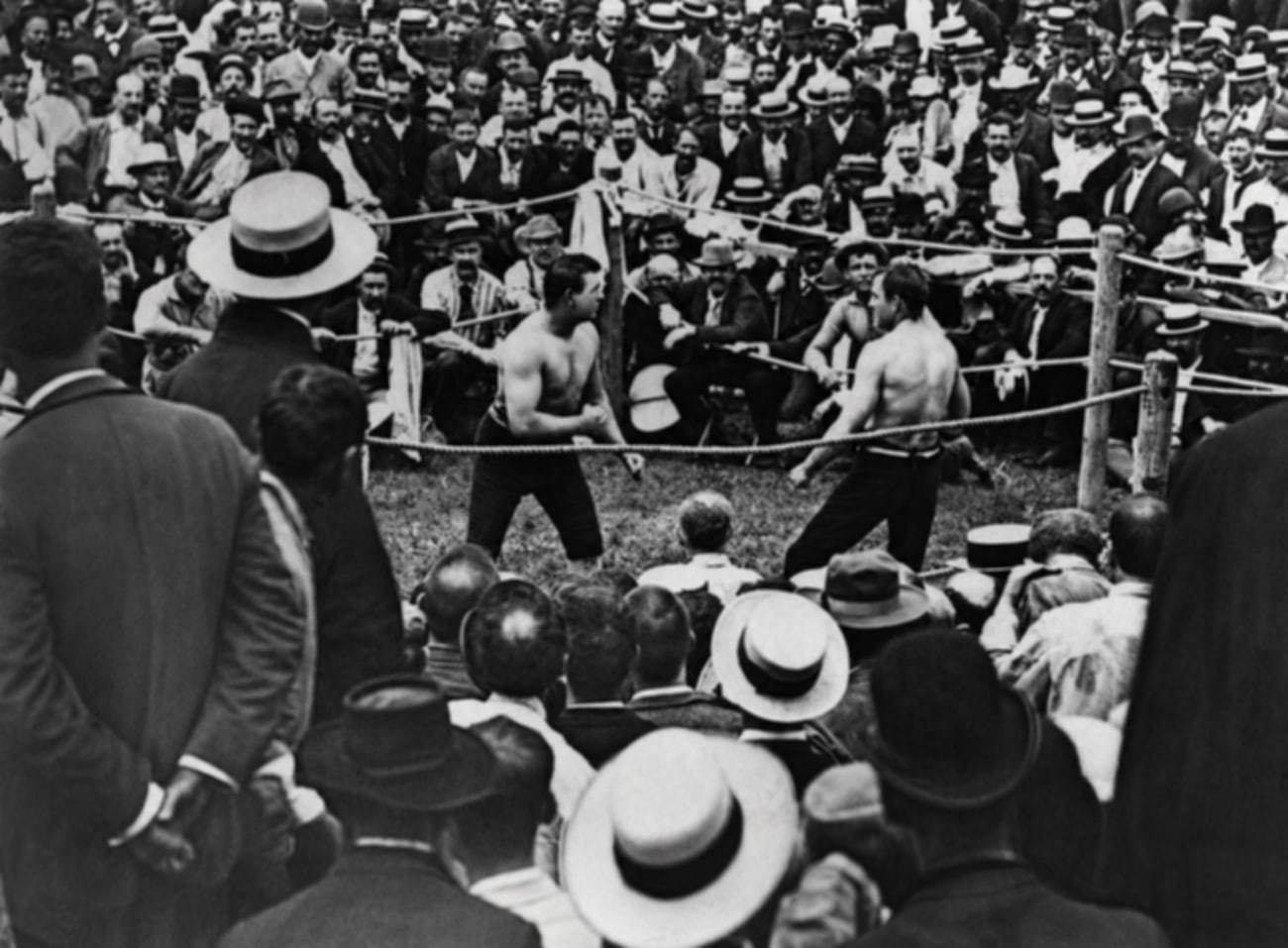

The stakes were enormous. Sullivan defended his claim as heavyweight champion in a winner-take-all contest built around a $20,000 side bet, a staggering sum in 1889, along with possession of a diamond-studded championship belt.
Sullivan and Kilrain entered the contest as two of the best-known heavyweight prizefighters of their generation. Their championship meeting attracted widespread attention and brought thousands of spectators to Richburg.
The contest was fought under the London Prize Ring Rules, which differed significantly from modern boxing. There were no fixed three-minute rounds. Instead, a round ended when a fighter went down or was thrown. Competitors then had 30 seconds to recover before returning to the scratch line to begin the next round. The championship was scheduled for as many as 80 rounds.
The fight unfolded under suffocating conditions, with temperatures reportedly climbing above 100 degrees Fahrenheit on a grass ring exposed to the Mississippi sun.
Kilrain made an immediate impression by taking the opening fall with a quick throw after landing a left hand. Throughout the early rounds, he frustrated Sullivan by relying on sharp jabs, clinches, and wrestling trips rather than exchanging punches in the center of the ring. In the seventh round, Kilrain drew the first blood by tearing Sullivan’s ear with a hook.
Sullivan gradually imposed his physical strength. Beginning in the eighth round, he found success with crushing rights to the body and heavy blows to the jaw that repeatedly knocked Kilrain off his feet. As the fight wore on, Sullivan relentlessly attacked the ribs while Kilrain’s face became increasingly battered. By the mid-30s rounds, Kilrain was fighting with a broken nose, split lips, and one eye swollen completely shut.
The contest nearly took an unexpected turn during the middle rounds when Sullivan became violently ill. Suffering from the extreme heat and reportedly affected by the heavy meals and alcohol he had consumed before and during the fight, the champion vomited repeatedly near the 44th round. Sensing an opportunity, Kilrain suggested the fight be declared a draw.
Rather than accepting a draw, Sullivan recovered, floored Kilrain with another punishing body attack and steadily wore down the challenger over the remaining rounds.
One of the defining moments came in the 68th round, when Sullivan landed a thunderous right uppercut that reportedly lifted Kilrain off his feet. From that point forward, Kilrain was fighting almost entirely on courage. He continued answering the scratch despite absorbing tremendous punishment, often going down quickly simply to gain precious seconds of rest before the next round.
After 75 rounds and approximately 2 hours and 16 minutes of fighting, Kilrain had little left. Covered in blood and barely able to continue, he was examined by a doctor, who warned his corner that allowing him to fight on could prove fatal. Before the start of the 76th round, Kilrain’s second, Mike Donovan, threw in the sponge, giving Sullivan the victory.
Both fighters left the ring battered. Sullivan suffered a swollen ear and black eye but escaped comparatively well, while much of the blood covering him belonged to Kilrain. Authorities soon arrested both camps for participating in the illegal prizefight.
The Sullivan-Kilrain fight closed the chapter on world heavyweight championship contests fought under the London Prize Ring Rules. Sullivan defended his title successfully, but three years later he was defeated by “Gentleman Jim” Corbett under the Marquess of Queensberry Rules, reflecting boxing’s shift from bare-knuckle prizefighting to gloved competition.
Sullivan and Kilrain eventually put their rivalry behind them. When Sullivan died in 1918, Kilrain served as one of the pallbearers at his funeral. More than a century later, their 75-round battle remains one of the most enduring stories of boxing’s bare-knuckle era and a landmark in the sport’s history.
Read the full article here