







The former champion remained among boxing’s most feared punchers. Baer had knocked out Max Schmeling and battered Carnera to capture the title. His earlier bout with Frankie Campbell ended with Campbell’s death, giving Baer a frightening reputation that extended beyond his record.
Louis had never faced a puncher carrying that combination of power and menace. His discipline and technical precision were admired, but no one knew how he would respond after taking a clean right hand from a seasoned former champion.
Baer’s supporters never received their answer because Louis gave him almost no opportunity to land one.
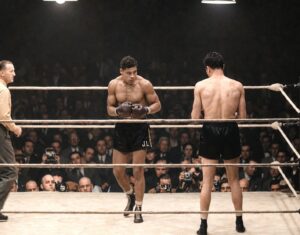
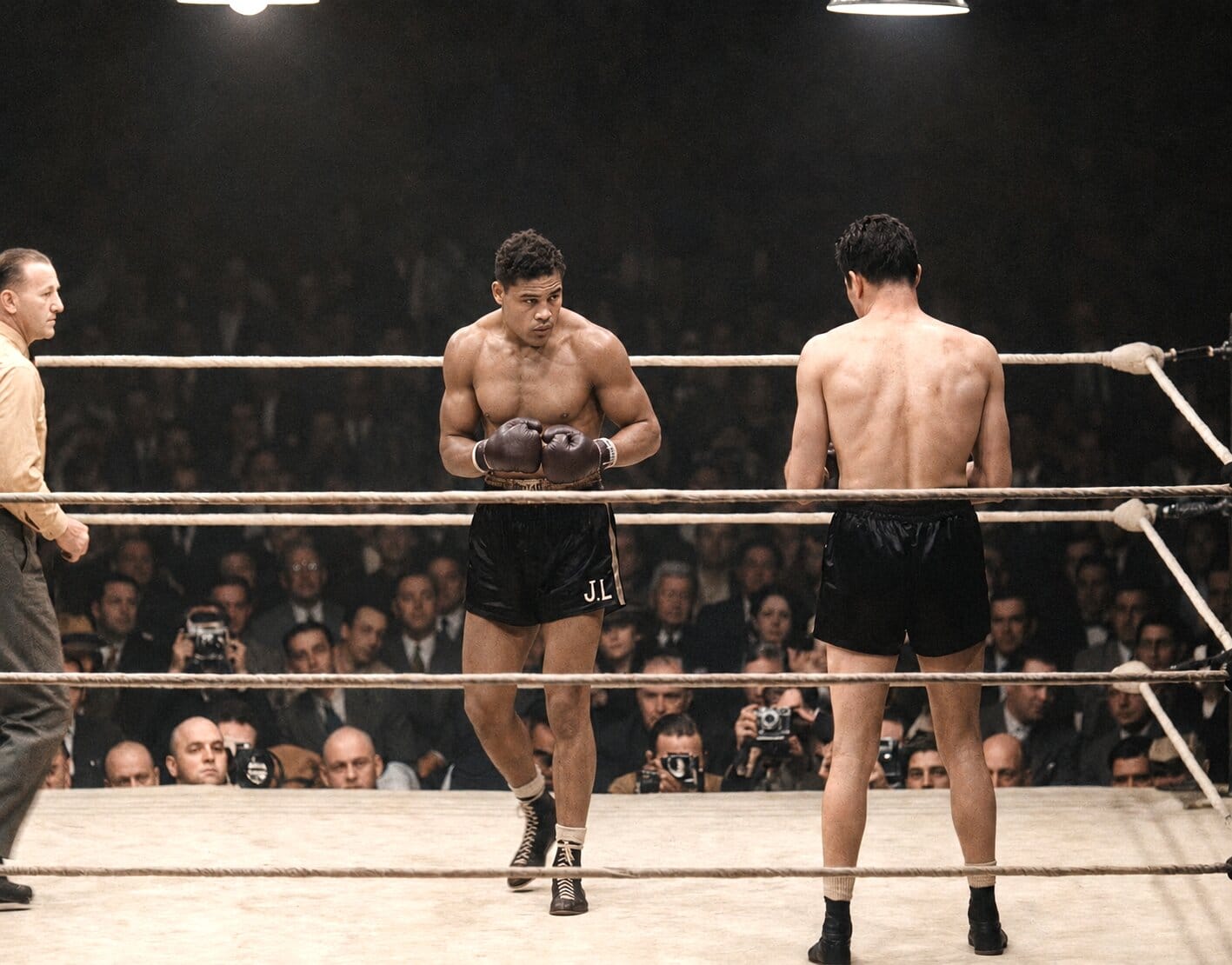
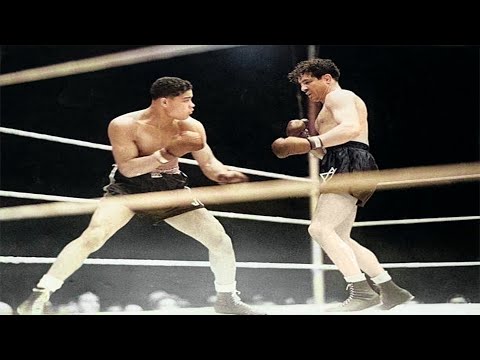
Rather than trade recklessly, Louis used short steps to move into range and beat Baer to the target with compact punches. Baer needed room to throw his wide right hand. Louis denied him that space, forced him backward and attacked the openings created by Baer’s loose defense.
The difference went beyond hand speed. Baer fought as if one powerful shot would eventually rescue him. Louis treated every movement as part of a technical process. His feet placed him in punching position, his hands delivered combinations, and his balance allowed him to attack again before Baer recovered.
Baer’s injuries complicated the test. He fought with fractured knuckles in his right hand and a bone chip in his left wrist after declining a specialist’s recommendation for surgery. Novocain injections offered temporary relief, but a rain delay reduced their effect. Jack Dempsey later recalled having to persuade a reluctant Baer to leave the dressing room.
Those injuries limited Baer’s offense. They did not account for his inability to defend himself.
Louis knocked him down twice in the third round, the first knockdowns of Baer’s professional career. The fighter portrayed as too powerful and durable for a young contender had been reduced to survival.
Another Louis combination sent Baer to one knee in the fourth. He remained there as referee Arthur Donovan completed the count at 3:09. Baer later admitted that he probably had enough strength to rise but saw little purpose in continuing an evening he jokingly compared to an execution.
The event drew 84,831 paying spectators and produced a gate of $932,944 during the Great Depression. Radio and motion-picture revenue pushed the total beyond $1 million. Louis earned $217,337, while Baer received $181,114.
The enormous audience answered another question surrounding Louis. A Black heavyweight was not merely capable of becoming champion. He was becoming the biggest attraction in American boxing.
Louis’s handlers had carefully presented him as quiet, disciplined and restrained to avoid comparisons with Jack Johnson. That strategy revealed the racial limits imposed upon a Black contender during the 1930s. Louis’s ring performances were rapidly making the campaign unnecessary. Fans did not need a manufactured explanation for his success after watching him dismantle Baer.
Braddock retained the heavyweight championship, but possession of the belt no longer established who controlled the division. Louis had demolished Carnera, Levinsky and Baer within three months. He still needed another two years to capture the title, including recovering from his 1936 loss to Schmeling.
At Yankee Stadium, Louis proved that he was no longer a promising young puncher. He was the most complete heavyweight in boxing, and Baer became the former champion forced to demonstrate it.

Read the full article here


